Compare custom mobile app development with no-code app builders to understand their costs, flexibility, scalability, security, and long-term value. Discover which approach best matches your business goals, technical requirements, budget, and growth plans.
Custom Mobile App Development vs No-Code App Builders: Which Is Better?
Mobile applications have become an important part of modern business operations. From online shopping and food delivery to healthcare, education, and financial services, businesses use mobile apps to improve customer experiences, streamline processes, and increase revenue. However, before building an application, one important decision must be made: should you invest in custom mobile app development or use a no-code app builder?
Both approaches offer advantages, but the right choice depends on your business objectives, budget, technical requirements, and future growth plans. Understanding their differences can help you make a more informed investment.
What Is Custom Mobile App Development?
Custom mobile app development involves designing and building an application specifically for a business's requirements. Developers create the app's architecture, user interface, features, integrations, and functionality according to the project's objectives.
Depending on the requirements, developers may use technologies such as Flutter, React Native, Swift, Kotlin, or native Android and iOS development frameworks.
Key benefits of custom app development include:
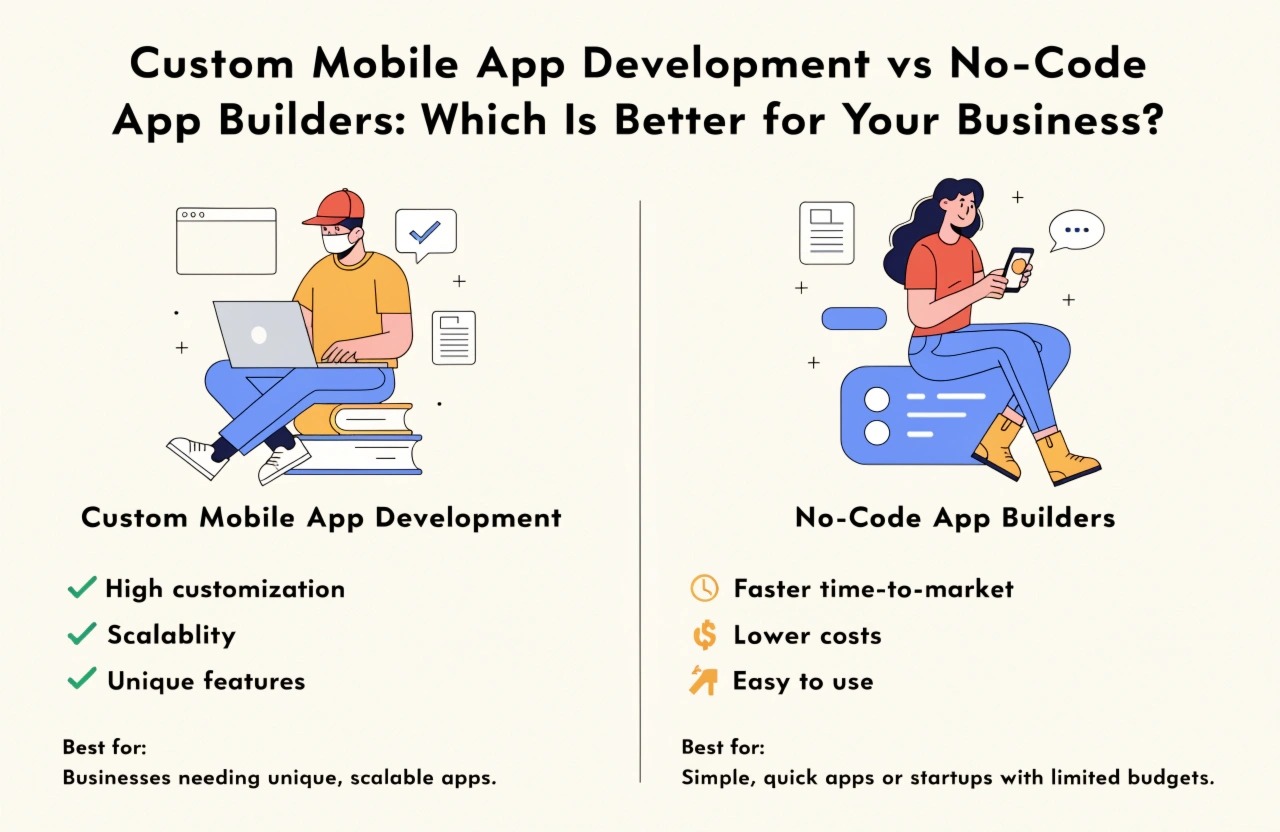
- Complete customization: Features and interfaces can be designed around specific business workflows and customer expectations.
- Scalability: The application architecture can be planned to support growing users, transactions, and functionality.
- Advanced integrations: Custom applications can connect with business software, payment gateways, APIs, and third-party services.
- Greater technical control: Businesses have more control over architecture, deployment, and development decisions.
- Enhanced optimization: Developers can optimize performance, accessibility, and security according to project requirements.
Custom development is particularly suitable for businesses building complex applications, unique digital products, or platforms intended for long-term expansion.
What Are No-Code App Builders?
No-code app builders allow users to create applications using visual interfaces, drag-and-drop components, templates, and preconfigured workflows. They reduce the need to write code manually, making application creation accessible to nontechnical users.
Popular platforms include Bubble, Glide, and Adalo, although their capabilities and supported application types differ.
Key benefits of no-code app builders include:
- Faster development: Prebuilt templates and components can accelerate the creation of prototypes and simple applications.
- Lower initial costs: Businesses may avoid some upfront programming expenses.
- Accessibility: Nontechnical teams can build and update basic applications with limited developer involvement.
- Rapid experimentation: Startups can test business ideas and collect user feedback before committing to a larger investment.
- Simplified maintenance: Platform providers often manage hosting, updates, and certain infrastructure responsibilities.
However, no-code platforms may impose limitations on customization, integrations, performance optimization, and access to underlying code. Costs can also increase as usage grows or premium features become necessary.
Custom Development vs No-Code: Key Differences
1. Development Cost
No-code platforms typically have lower initial costs because they provide ready-made components and subscription-based services. They can be ideal for small businesses validating an idea with limited resources.
Custom development generally requires a larger initial investment because it involves planning, design, programming, testing, and deployment. However, it may provide better long-term value when the application requires specialized functionality or complex integrations.
Businesses should compare the total cost of ownership, including subscriptions, maintenance, upgrades, integrations, and future migration.
2. Customization and Flexibility
Custom development offers greater flexibility. Developers can create unique features, tailor user journeys, and build functionality around specific business processes.
No-code platforms work best within their supported features and design systems. Although some provide extensions and integrations, highly specialized requirements may be difficult or impossible to implement without additional coding.
3. Scalability and Performance
Custom applications can be architected around expected traffic, data processing requirements, and future expansion. Their scalability depends on the quality of the architecture, infrastructure, and ongoing optimization.
No-code platforms can support many business applications, but scalability depends on platform limits, pricing tiers, available infrastructure, and integration capabilities. Businesses should verify these constraints before choosing a platform.
4. Security and Data Control
Custom development allows teams to implement security controls based on the application's risks, including authentication, authorization, encryption, and secure API communication. However, security still depends on implementation quality and maintenance.
No-code providers may offer built-in security features and managed infrastructure. Businesses must review data storage locations, access controls, compliance requirements, backup policies, and vendor security practices before committing.
Neither approach guarantees complete security without proper configuration and monitoring.
5. Maintenance and Ownership
With custom development, businesses can maintain the application through an internal team or a development partner. Source-code access, documentation, and contractual ownership terms should be clearly established.
No-code platforms simplify routine updates but create a dependency on the provider's pricing, features, policies, and continued availability. Moving to another platform may require rebuilding parts of the application.
Which Option Is Better for Your Business?
The best approach depends on the problem you need to solve.
Choose a no-code app builder when you want to validate an idea quickly, create a basic internal tool, develop a simple booking application, or launch a prototype with limited technical resources.
Choose custom mobile app development when you need unique functionality, complex integrations, stronger architectural control, specialized user experiences, or a scalable product designed for long-term growth.
For example, a small business creating an internal task-tracking tool may find a no-code platform sufficient. In contrast, an e-commerce business requiring customized inventory management, multiple payment integrations, personalized recommendations, and advanced analytics may benefit more from custom development.
A hybrid approach is also possible. Businesses can validate an idea using no-code tools and later invest in a custom application when user demand and business requirements become clearer. However, migration costs and technical limitations should be considered early.
Conclusion
Custom mobile app development and no-code app builders solve different business problems. No-code platforms offer speed, accessibility, and lower initial investment, while custom development provides greater flexibility, technical control, and opportunities for tailored functionality.
Before deciding, evaluate your budget, required features, security expectations, integration needs, and long-term business goals. Avoid choosing an approach based only on its initial price or development speed.
The right solution is the one that meets your current requirements while supporting your future plans. Careful evaluation and professional guidance can help you build a mobile application that delivers lasting business value.
We build scalable web, mobile, and game products for clients worldwide — combining modern frameworks, cloud infrastructure, and best engineering practices.
.jpg)