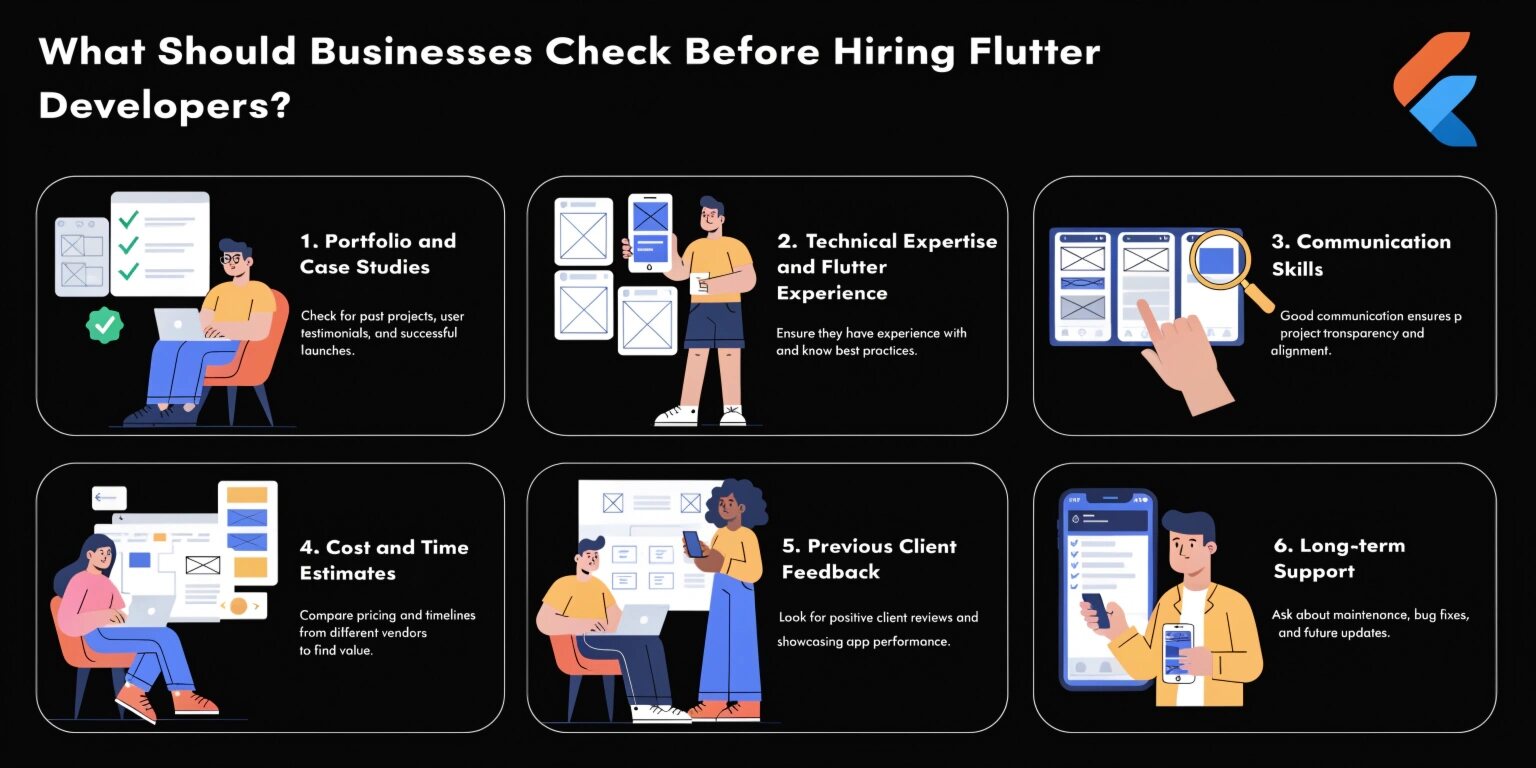
Hiring Flutter developers requires evaluating technical skills, cross-platform experience, portfolio quality, code standards, security awareness, testing practices, and communication abilities. A structured hiring process helps businesses choose developers who can build reliable, scalable, and maintainable mobile applications.
Flutter has become a popular framework for building cross-platform mobile applications using a shared codebase. Businesses can use it to develop applications for Android and iOS while reducing duplicated development effort and maintaining a consistent user experience.
However, choosing the right Flutter developer requires more than checking a résumé or reviewing a list of technical skills. Businesses must evaluate practical experience, architecture knowledge, problem-solving abilities, and the developer's capacity to deliver a reliable application.
Here are the essential factors businesses should check before hiring Flutter developers.
1. Evaluate Flutter and Dart Expertise
Flutter uses the Dart programming language, so developers should understand both the framework and its underlying language.
Look for practical knowledge of widgets, layouts, navigation, asynchronous programming, null safety, state management, and reusable components.
Developers should understand how Flutter's widget-based architecture works and how to organize application code for maintainability.
During technical interviews, ask candidates to explain how they would build a screen, manage application state, handle asynchronous operations, and troubleshoot common development issues.
2. Review Their Portfolio and Previous Projects
A developer's portfolio provides valuable insight into their practical capabilities.
Review applications they have built and assess their functionality, visual consistency, responsiveness, and overall user experience.
Where possible, request links to published applications, demonstrations, or code samples that the developer is authorized to share.
Ask about their specific contribution to each project. A developer who worked on a small feature should not be evaluated as though they independently architected the entire application.
Relevant experience in industries such as e-commerce, healthcare, education, fintech, or business applications can be an advantage when the project has similar requirements.
3. Check Cross-Platform Development Experience
One of Flutter's main advantages is its ability to support multiple platforms through a shared codebase. However, not every feature behaves identically across Android and iOS.
Check whether the developer understands platform-specific permissions, navigation patterns, notifications, camera access, file handling, and device capabilities.
They should also know when native Android or iOS code may be necessary through platform channels or plugins.
A strong Flutter developer understands how to maximize code reuse without ignoring platform-specific requirements.
4. Assess UI/UX Implementation Skills
A mobile application should be intuitive, accessible, and visually consistent.
Evaluate the developer's ability to translate design files and prototypes into functional interfaces. They should understand responsive layouts, adaptive components, screen-size variations, animations, accessibility, and loading or error states.
Ask how they would handle different device dimensions, keyboard interactions, network delays, and dynamic content.
Developers should also understand Material Design and Apple's platform conventions, applying the appropriate design approach to the intended audience.
5. Examine State Management and Application Architecture
State management becomes increasingly important as applications grow.
Flutter developers may use approaches such as Provider, Riverpod, Bloc, or other suitable patterns depending on project requirements.
Rather than selecting candidates based on a specific library alone, assess whether they understand how to separate UI components, business logic, data access, and application state.
A well-structured architecture makes the application easier to test, debug, maintain, and extend.
Ask candidates to explain how they would organize a growing application and manage shared state across multiple screens.
6. Verify API Integration and Backend Knowledge
Most business applications rely on backend services for authentication, data storage, payments, or other functionality.
Flutter developers should understand REST APIs, JSON, HTTP requests, asynchronous operations, error handling, and authentication flows. Knowledge of GraphQL, WebSockets, or Firebase may also be valuable depending on the project.
Check whether they can handle expired sessions, network interruptions, loading indicators, retries, and unexpected API responses.
For complex applications, experience collaborating with backend developers can help ensure that frontend and backend systems work together effectively.
7. Review Testing and Debugging Practices
Testing is essential for building reliable mobile applications.
Look for experience with unit tests, widget tests, integration tests, debugging tools, and automated build pipelines.
Developers should know how to reproduce defects, analyze logs, identify performance bottlenecks, and verify fixes across different devices.
Ask how they would test critical workflows such as registration, login, checkout, payments, and data synchronization.
A developer who considers testing part of everyday development is more likely to deliver maintainable software than someone who postpones quality checks until the end.
8. Check Security and Performance Knowledge
Business applications may process sensitive customer information, so security cannot be overlooked.
Flutter developers should understand secure API communication, authentication, token handling, safe local storage, input validation, and the risks of exposing secrets in client-side code.
They should also know how to profile applications, reduce unnecessary rebuilds, optimize image handling, and investigate memory or rendering problems.
Depending on the application, additional requirements may include secure payment integration, privacy controls, and compliance-related development practices.
9. Evaluate Communication and Project Management Skills
Technical ability alone does not guarantee a successful project.
Developers must communicate progress, raise concerns early, clarify requirements, and collaborate with designers, backend engineers, testers, and business stakeholders.
Check their familiarity with tools such as Jira, GitHub, GitLab, or similar project management and version-control platforms.
Discuss how they estimate tasks, manage changing requirements, document decisions, and report unexpected delays.
Clear communication is particularly important when working with remote teams or external development partners.
10. Understand Pricing, Availability, and Long-Term Support
Before hiring, clarify the engagement model, project scope, estimated timeline, payment terms, and ongoing support arrangements.
Compare candidates based on overall value rather than hourly rates alone. A lower rate may not represent a lower total cost if the project requires extensive rework or ongoing maintenance.
Confirm who owns the source code, how repositories are managed, and what documentation will be provided.
Also discuss bug-fixing commitments, maintenance availability, deployment support, and knowledge transfer after delivery.
Conclusion
Hiring Flutter developers is an important decision that can directly influence application quality, development timelines, and long-term maintenance costs.
Businesses should evaluate Dart and Flutter expertise, portfolio quality, cross-platform experience, state management, API integration, security, testing, performance optimization, and communication skills before making a decision.
A structured technical assessment and a small practical task can help verify whether a candidate's capabilities match the project's requirements.
By focusing on demonstrated skills, transparent collaboration, and long-term maintainability, businesses can select Flutter developers who are well equipped to turn their mobile application ideas into reliable digital products.
We build scalable web, mobile, and game products for clients worldwide — combining modern frameworks, cloud infrastructure, and best engineering practices.
.jpg)
.jpg)