Discover how MLflow enables version control for machine learning models through experiment tracking, model registry, deployment, and lifecycle management. Learn best practices for building reproducible and scalable MLOps workflows.
a machine learning model is only one part of developing an AI solution. As models evolve through experimentation, retraining, and deployment, managing different versions becomes increasingly challenging. Data scientists often train hundreds of models using different datasets, algorithms, hyperparameters, and feature engineering techniques. Without a structured versioning system, it becomes difficult to identify which model performed best, reproduce results, or safely deploy updates to production.
This is where MLflow plays a vital role. MLflow is an open-source platform designed to manage the complete machine learning lifecycle, including experiment tracking, model versioning, deployment, and governance. It helps organizations create reproducible, collaborative, and scalable MLOps workflows by treating machine learning models much like software artifacts in traditional version control systems.
In this article, we'll explore why machine learning model versioning matters, how MLflow works, and how it supports enterprise AI development.
Why Model Versioning Is Important
Unlike traditional software, machine learning models change as new data becomes available or algorithms are improved. Even small modifications to training data or hyperparameters can significantly affect model performance.
Without version control, teams may face issues such as:
- Difficulty reproducing experiments
- Uncertainty about deployed models
- Loss of training metadata
- Collaboration challenges
- Inconsistent production environments
- Limited auditability and governance
Versioning ensures every model can be traced back to the exact data, code, and configuration used to create it.
What Is MLflow?
MLflow is an open-source MLOps platform that helps manage the end-to-end machine learning lifecycle.
Its core capabilities include:
- Experiment tracking
- Model versioning
- Model registry
- Model packaging
- Deployment support
- Lifecycle management
MLflow is framework-agnostic, making it compatible with popular machine learning libraries such as TensorFlow, PyTorch, Scikit-learn, XGBoost, LightGBM, and many others.
Core Components of MLflow
MLflow Tracking
MLflow Tracking records every experiment, including:
- Training parameters
- Hyperparameters
- Evaluation metrics
- Training datasets
- Source code references
- Execution timestamps
- Output artifacts
This enables teams to compare experiments and reproduce results efficiently.
MLflow Projects
MLflow Projects standardize machine learning workflows by packaging code with its dependencies and execution instructions.
This ensures that experiments can be executed consistently across different environments.
MLflow Models
MLflow Models package trained models into a standardized format that supports deployment across multiple serving platforms.
This simplifies moving models from development to production without major modifications.
MLflow Model Registry
The Model Registry is one of MLflow's most valuable features.
It provides centralized management for model versions, allowing teams to:
- Register new models
- Track version history
- Assign lifecycle stages
- Approve production deployments
- Archive outdated versions
This creates a structured process for managing AI assets throughout their lifecycle.
How Model Versioning Works
Each time a model is trained, MLflow creates a unique version containing:
- Model files
- Source code references
- Parameters
- Metrics
- Environment configuration
- Dependencies
- Training metadata
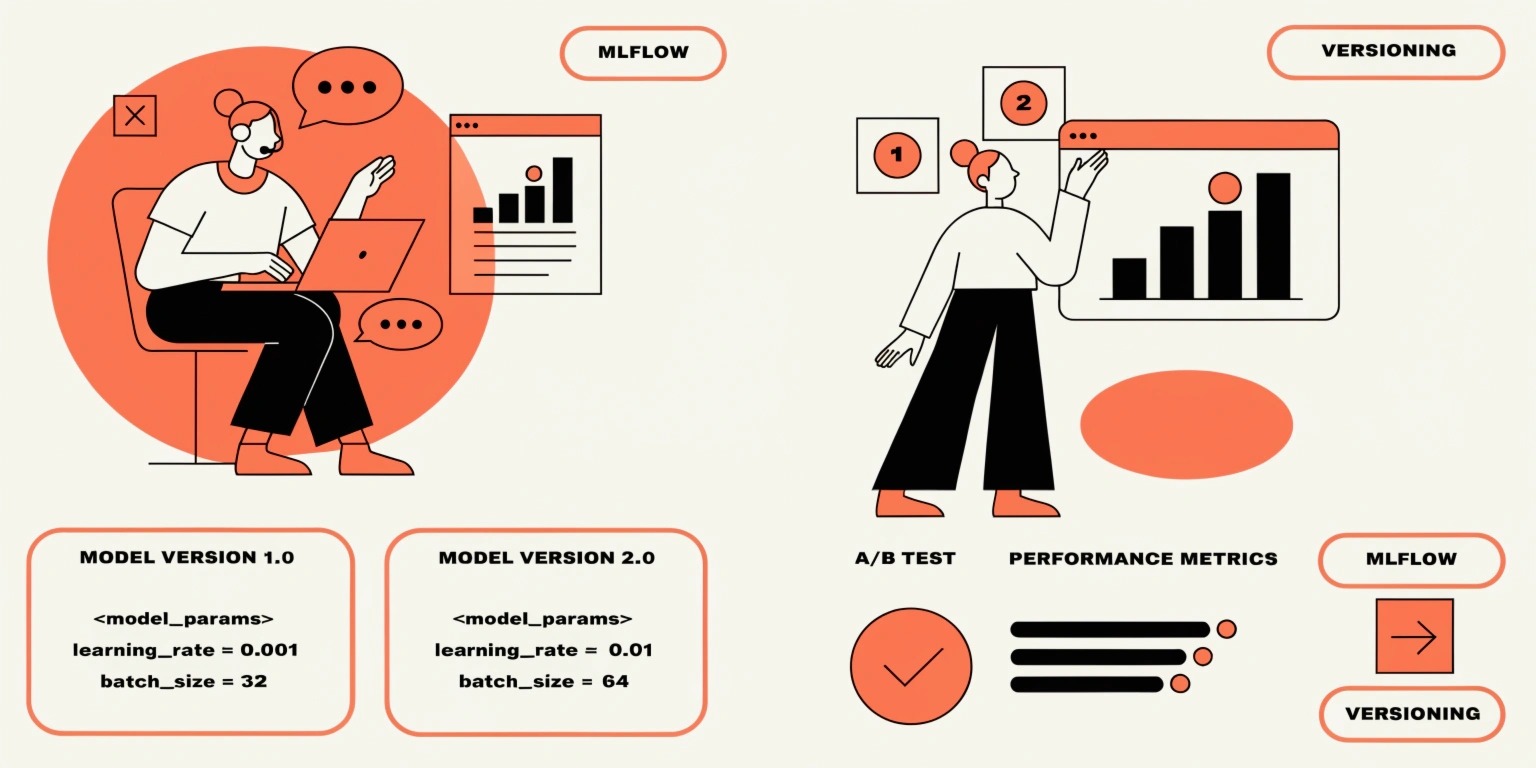
Instead of overwriting previous models, every version remains available for future comparison or rollback.
For example:
- Version 1: Initial production model
- Version 2: Improved accuracy with feature engineering
- Version 3: Retrained using recent customer data
If Version 3 performs poorly in production, teams can safely revert to Version 2.
Benefits of MLflow Versioning
Reproducibility
Every experiment stores complete metadata, making it possible to recreate results even months later.
Collaboration
Multiple data scientists can contribute to projects while maintaining a shared repository of experiments and models.
Governance
Organizations can document model approval workflows, supporting regulatory compliance and internal auditing.
Faster Deployment
Registered models move efficiently through development, staging, and production environments.
Risk Reduction
Version history enables safe rollbacks if newly deployed models introduce unexpected issues.
Integrating MLflow into an MLOps Pipeline
A typical MLOps workflow using MLflow includes:
- Data collection and preprocessing.
- Model training.
- Experiment tracking.
- Model evaluation.
- Model registration.
- Validation and approval.
- Deployment to production.
- Continuous monitoring.
- Retraining when performance declines.
This structured pipeline improves consistency and operational efficiency.
Best Practices for Model Versioning
To maximize the benefits of MLflow:
- Use meaningful experiment names.
- Track every training run.
- Store datasets and preprocessing details.
- Version feature engineering pipelines.
- Record software dependencies.
- Automate deployment workflows.
- Monitor production performance continuously.
- Archive obsolete models instead of deleting them.
Following these practices creates a reliable and maintainable machine learning ecosystem.
Common Challenges
Although MLflow simplifies model management, organizations should also address:
- Large storage requirements for artifacts
- Access control for sensitive models
- Integration with existing DevOps workflows
- Model drift monitoring
- Dependency management
- Data versioning alongside model versioning
Combining MLflow with robust data governance and CI/CD processes helps overcome these challenges.
Future Trends
Machine learning lifecycle management continues to evolve rapidly.
Emerging developments include:
- Automated model lineage tracking
- AI-powered experiment optimization
- Integrated feature stores
- Continuous model retraining
- Multi-cloud model registries
- Explainable AI integration
- Governance automation
- Federated model management
These innovations will make AI deployment more reliable, transparent, and scalable.
Conclusion
Machine learning model versioning is essential for building reliable, scalable, and enterprise-ready AI systems. As organizations deploy increasingly sophisticated models, maintaining reproducibility, collaboration, and governance becomes just as important as achieving high accuracy. MLflow addresses these challenges by providing a unified platform for experiment tracking, model registry, deployment, and lifecycle management.
By adopting MLflow and following MLOps best practices, data science teams can streamline development, reduce deployment risks, and ensure every model is traceable and reproducible. As AI continues to expand across industries, effective model versioning will remain a cornerstone of successful machine learning operations
We build scalable web, mobile, and game products for clients worldwide — combining modern frameworks, cloud infrastructure, and best engineering practices.
-1.jpg)