Learn what influences the cost of developing a custom AI solution, from data preparation and model selection to integrations, deployment, and maintenance. Discover estimated budgets, practical cost-saving strategies, and how businesses can invest in AI effectively.
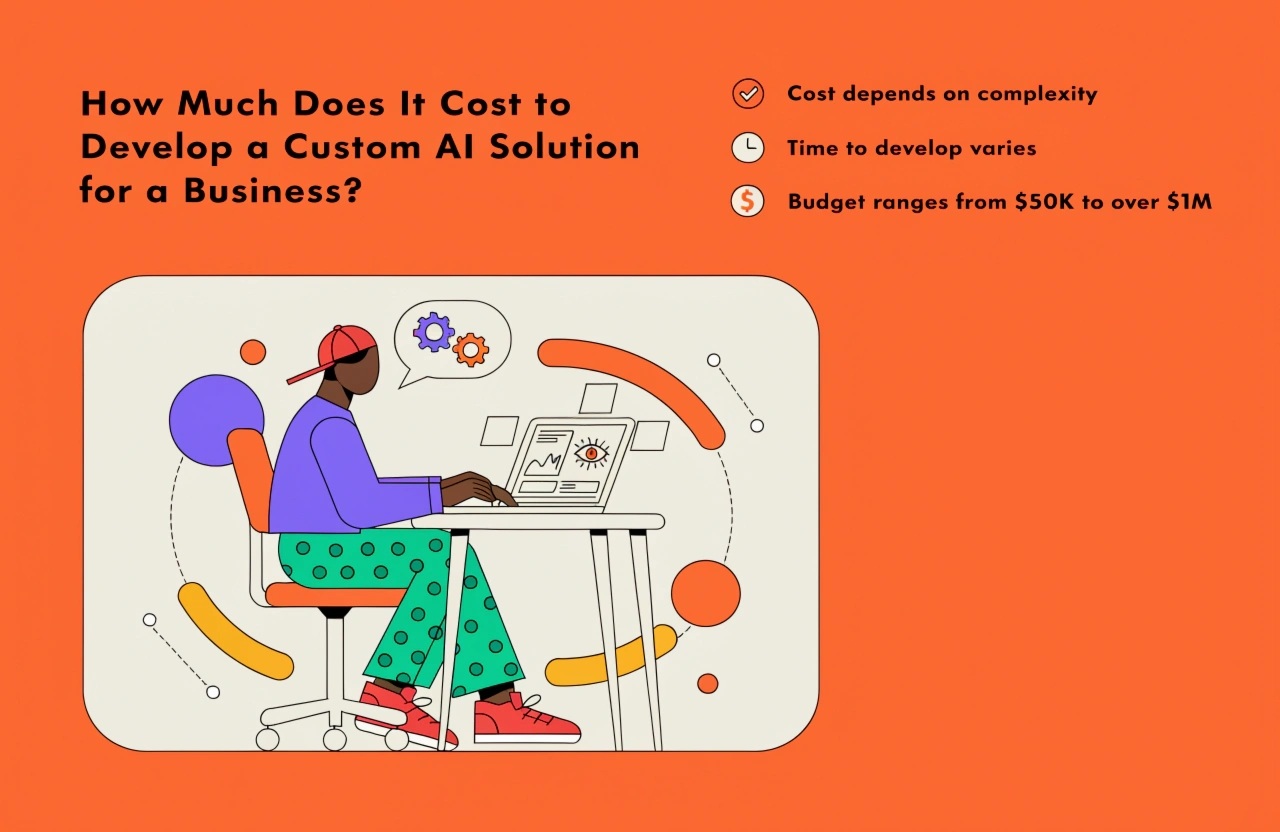
How Much Does It Cost to Develop a Custom AI Solution for a Business?
Artificial intelligence is becoming an important part of modern business operations. Companies are using AI to automate repetitive tasks, analyze customer behavior, improve decision-making, personalize services, and increase operational efficiency. However, before investing in an AI-powered product, one important question arises: how much does it cost to develop a custom AI solution for a business?
The answer depends on the project's complexity, business objectives, data availability, technology requirements, integrations, and development team. A basic AI chatbot may require a relatively small investment, while a sophisticated enterprise AI platform can demand a significantly larger budget.
Understanding these cost factors helps businesses plan their AI investments and select a solution that delivers measurable value.
1. What Is the Average Cost of Custom AI Development?
Custom AI development involves designing software that uses artificial intelligence to solve specific business problems. These solutions can include AI chatbots, recommendation engines, predictive analytics platforms, intelligent document processing systems, and automated business workflows.
The following figures are illustrative planning estimates in Indian rupees, not fixed market prices or vendor quotations.
AI solution Type Estimated development cost
Basic AI chatbot or assistant ₹50,000–₹2 lakh
AI-powered business automation ₹1–₹5 lakh
Custom AI application using existing models ₹2–₹10 lakh
Machine learning or predictive analytics system ₹3–₹15 lakh
Advanced generative AI application with integrations ₹5–₹25 lakh
Complex enterprise AI platform ₹15 lakh–₹50 lakh or more
Actual costs can fall outside these ranges depending on scope, security, data requirements, integrations, and infrastructure. Proof-of-concept projects may cost less, whereas production-ready applications require additional engineering, testing, monitoring, and support.
2. Key Factors That Influence AI Development Costs
Project Complexity and Features
Project complexity is one of the biggest cost drivers. A straightforward chatbot that answers frequently asked questions requires fewer resources than an AI assistant that accesses company databases, generates reports, and performs actions across multiple applications.
Features such as real-time predictions, voice processing, multilingual support, personalized recommendations, and advanced analytics can increase development time and cost.
Businesses should prioritize features that directly support their objectives instead of building every possible capability into the first version.
Data Collection and Preparation
AI systems depend on data to generate useful results. Businesses may need to collect, clean, label, organize, and validate information before development begins.
If relevant business data is already available in a usable format, preparation costs may be lower. However, fragmented databases, inconsistent records, missing information, and strict privacy requirements can increase expenses.
For AI solutions using confidential business information, access controls, data governance, and secure processing must also be considered.
AI Models and Technology Selection
The selected technology significantly affects the overall budget. Businesses can use existing AI APIs, open-source models, customized machine learning systems, or models trained for specialized tasks.
Using an existing model through an API is often a practical starting point because it can reduce initial development effort. Fine-tuning a model or building a specialized machine learning pipeline may require additional expertise, computing resources, and testing.
The best option depends on accuracy requirements, data sensitivity, response speed, expected usage, and long-term operating costs.
Third-Party Integrations
Many businesses want AI to work with existing CRM platforms, websites, mobile applications, ERP systems, customer support software, or internal databases.
Each integration introduces additional development and testing requirements. Older systems with limited documentation may require more effort than modern applications with reliable APIs.
3. Additional Costs Beyond Development
The initial development budget does not represent the complete cost of owning an AI solution.
Businesses should account for the following expenses:
- Cloud infrastructure: Servers, storage, databases, and computing resources.
- AI API usage: Charges based on model selection, input and output tokens, requests, or other usage metrics.
- Security and compliance: Access controls, audits, encryption, and applicable regulatory requirements.
- Testing and evaluation: Accuracy checks, performance testing, security validation, and real-world scenario testing.
- Maintenance and updates: Bug fixes, dependency updates, model changes, and performance monitoring.
- Employee training: Helping teams use the solution effectively and integrate it into daily workflows.
These expenses vary significantly with usage and architecture. Businesses should estimate both initial investment and recurring operational costs before approving a project.
4. How to Reduce Custom AI Development Costs
Developing an AI solution does not always require a large initial investment. A structured approach can help businesses manage expenses without compromising essential functionality.
Start with a clear business problem. Identify whether AI should reduce customer support workload, improve lead qualification, automate document processing, or enhance forecasting. A specific objective makes project planning more effective.
Build a minimum viable product (MVP). Begin with essential features and test them with a limited group of users. Expand the solution after validating its usefulness.
Use existing AI models where appropriate. Pretrained models and established APIs can eliminate the need to develop every capability from scratch.
Prepare your data early. Organizing business information before development can reduce rework and improve system reliability.
Choose scalable architecture. Start with infrastructure that meets current requirements while allowing the system to grow as usage increases.
Measure results regularly. Track relevant metrics such as hours saved, response time, operational expenses, conversion rates, and customer satisfaction.
5. How to Calculate the Return on Investment in AI
An AI project should be evaluated by the business value it creates, not only by its development price.
For example, suppose an AI-powered customer support system saves 100 employee hours each month. If the estimated value of each saved hour is ₹300, the monthly value of the time saved is ₹30,000.
If the solution costs ₹3,00,000 to develop and has recurring operating expenses of ₹5,000 per month, its simple payback period, assuming the savings are fully realized, would be approximately 12 months.
This calculation is illustrative. Actual results depend on adoption, implementation costs, maintenance, and whether saved time translates into measurable financial benefits.
Businesses should establish baseline performance metrics before implementation and review results after deployment.
6. How to Choose the Right AI Development Partner
Selecting an experienced development partner can help businesses avoid unnecessary expenses and technical risks.
Evaluate potential partners based on their AI project experience, software development capabilities, understanding of business requirements, data security practices, testing processes, and post-launch support.
Ask for a detailed project proposal that explains the scope, estimated timeline, technology stack, integration requirements, deliverables, payment milestones, and ongoing expenses.
A reliable partner should also explain the limitations of the proposed AI system, how its output will be evaluated, and what happens when the system produces incorrect results.
Businesses should compare proposals based on the expected outcome and total cost of ownership rather than choosing a provider solely because of the lowest quotation.
Conclusion
The cost of developing a custom AI solution for a business depends on its complexity, data requirements, model selection, integrations, security needs, and long-term maintenance. A small AI application may be achievable with a modest budget, while enterprise-grade solutions require greater investment and ongoing operational planning.
The most effective approach is to identify a clear business problem, begin with a focused MVP, select suitable technology, and measure performance against defined objectives.
With careful planning and the right development partner, businesses can adopt AI in stages, manage financial risks, and build solutions that support long-term growth.
We build scalable web, mobile, and game products for clients worldwide — combining modern frameworks, cloud infrastructure, and best engineering practices.
-1.jpg)