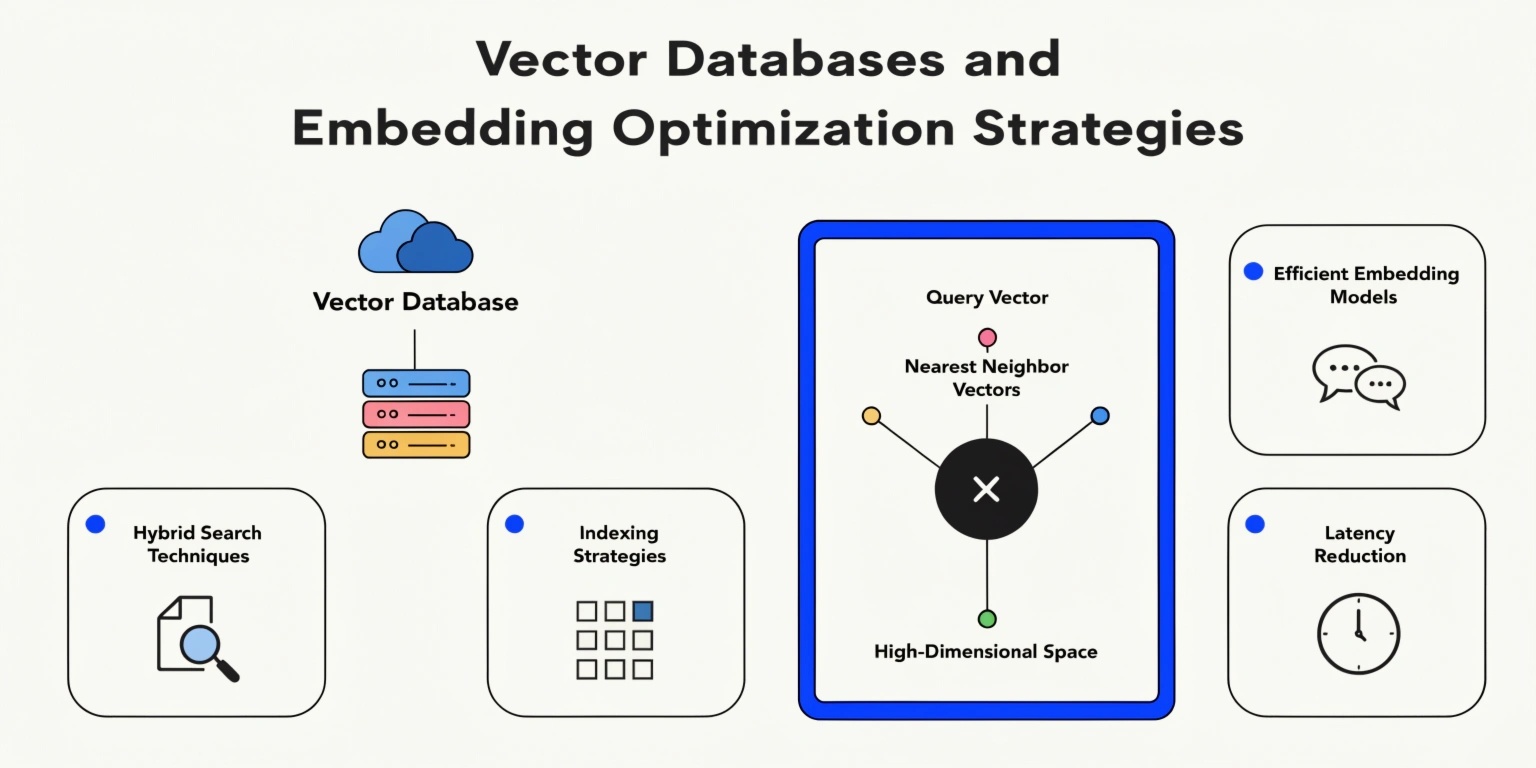
Vector databases enable AI applications to search and retrieve semantically similar information using embeddings. Optimizing embedding models, dimensions, indexes, metadata, storage, and retrieval parameters can significantly improve search relevance, latency, scalability, and cost in RAG, recommendation, and semantic-search systems.
Artificial intelligence applications increasingly need to understand relationships between pieces of information rather than simply matching exact keywords. A user searching for "ways to reduce cloud expenses" may expect results about "cloud cost optimization" even though the exact words are different.
Traditional databases are excellent at structured queries, but semantic similarity requires a different approach. This is where vector databases and embeddings become important.
Vector databases store numerical representations of information and provide efficient similarity-search capabilities. When combined with optimized embedding models, they can power applications such as Retrieval-Augmented Generation (RAG), semantic search, recommendation engines, document discovery, and AI assistants.
However, simply adding a vector database does not guarantee good performance. Embedding quality, vector dimensions, indexing methods, retrieval parameters, metadata design, and infrastructure all influence the final system.
What Are Vector Embeddings?
An embedding is a numerical representation of an object such as text, an image, an audio file, or a product.
For example, a sentence can be converted into a vector:
"Cloud computing reduces infrastructure overhead"
→ [0.021, -0.184, 0.763, 0.092, ...]
The vector contains many numerical dimensions representing learned characteristics of the original data.
Semantically related content tends to occupy nearby regions in the embedding space.
For example:
"How can I reduce cloud costs?"
may be closer to:
"Strategies for optimizing cloud infrastructure expenses"
than to an unrelated sentence.
This enables semantic retrieval.
What Is a Vector Database?
A vector database is designed to store and retrieve high-dimensional vectors efficiently.
Instead of asking:
"Find documents containing the word 'authentication'."
a vector search can ask:
"Find documents that are semantically similar to this query."
A vector database generally stores:
- Vector embeddings
- Document or object identifiers
- Metadata
- Original content or references
- Index structures
The database uses specialized indexes to efficiently identify nearby vectors.
Why Vector Databases Matter for RAG
Retrieval-Augmented Generation is one of the most important use cases for vector search.
A typical RAG pipeline looks like:
Documents → Chunking → Embedding → Vector Database → Retrieval → LLM → Response
When a user submits a question, the application converts the query into an embedding.
The vector database searches for similar document chunks.
Those chunks are then provided to the language model as context.
The quality of the final answer therefore depends heavily on retrieval quality.
Poor embeddings or inefficient retrieval can lead to irrelevant context and weaker AI responses.
Choosing the Right Embedding Model
Embedding optimization begins with model selection.
Different embedding models may be optimized for different tasks, languages, domains, and modalities.
Important factors include:
- Semantic quality
- Supported languages
- Vector dimensions
- Latency
- Cost
- Domain performance
- Maximum input length
A general-purpose embedding model may work well for common content, while specialized applications may benefit from models better suited to technical, legal, financial, medical, or multilingual data.
The best model should be selected through evaluation rather than assumptions.
Embedding Dimensions
Embedding models produce vectors with a fixed number of dimensions.
For example:
Model A → 384 dimensions
Model B → 768 dimensions
Model C → 1536 dimensions
Higher dimensionality can provide additional representational capacity, but it also increases storage requirements and computational costs.
A system containing millions of vectors can accumulate significant storage overhead.
Therefore, embedding dimension should be treated as an architectural consideration.
Dimensionality Reduction
In some applications, dimensionality reduction can decrease storage and search costs.
Techniques such as PCA or model-supported dimensionality reduction can compress vectors.
However, reducing dimensions too aggressively may remove information that contributes to semantic similarity.
The objective is to find a balance between:
Retrieval Quality ↔ Storage ↔ Latency ↔ Cost
Dimensionality reduction should therefore be evaluated using a representative benchmark dataset.
Chunking Before Embedding
For document-based AI systems, embedding optimization begins before vector generation.
Large documents are typically divided into smaller chunks.
Poor chunking can reduce retrieval quality even when the embedding model is excellent.
If chunks are too large, they may contain multiple unrelated topics.
If chunks are too small, important context may be separated.
Effective chunking considers:
- Semantic boundaries
- Paragraphs
- Sections
- Headings
- Token limits
- Document structure
Overlap between chunks can help preserve context, but excessive overlap increases storage and retrieval redundancy.
Metadata Optimization
Vectors should usually be stored alongside useful metadata.
Metadata can include:
- Document ID
- Source
- Author
- Category
- Timestamp
- Language
- Access permissions
- Product ID
- Content type
Metadata filtering can reduce the search space.
For example, an AI assistant could search only documents belonging to a specific department rather than searching the entire vector collection.
This can improve both relevance and performance.
Similarity Metrics
Vector databases use mathematical measures to determine how similar two vectors are.
Common metrics include:
Cosine Similarity
Cosine similarity measures the angle between vectors.
It is commonly used for semantic embeddings.
Euclidean Distance
Euclidean distance measures the geometric distance between points in vector space.
Dot Product
Dot-product similarity calculates the product of corresponding vector components.
The appropriate metric depends on the embedding model and how its vectors are trained or normalized.
Using an incompatible similarity metric can reduce retrieval quality.
Approximate Nearest Neighbor Search
Comparing a query vector against every vector in a database becomes increasingly expensive as the dataset grows.
Suppose a system contains 100 million vectors.
Performing an exact comparison against every vector for every query can be computationally expensive.
Approximate Nearest Neighbor (ANN) algorithms reduce search costs by efficiently navigating the vector space.
They trade a small amount of exactness for significantly improved performance.
HNSW Indexing
Hierarchical Navigable Small World, or HNSW, is a popular ANN indexing technique.
HNSW creates a graph structure that allows the search algorithm to navigate toward nearby vectors efficiently.
Important parameters can influence:
- Search accuracy
- Memory usage
- Index construction time
- Query latency
Increasing search effort can improve recall but may increase latency.
Therefore, HNSW configuration should be tuned against real application requirements.
IVF-Based Indexing
Another approach is Inverted File Indexing (IVF).
The vector space is divided into clusters.
During a search, the system examines selected clusters rather than scanning the entire dataset.
Parameters controlling the number of clusters searched can influence the balance between:
Speed and Recall
IVF-based approaches can be particularly useful when managing very large vector collections.
Quantization
Vector quantization can reduce memory and storage requirements by representing vectors with fewer bits.
For example, a high-precision vector can potentially be represented using a compressed numerical format.
Benefits can include:
- Lower storage usage
- Reduced memory requirements
- Faster data movement
- Potentially lower infrastructure costs
The trade-off is that excessive compression may reduce retrieval accuracy.
Quantization should therefore be benchmarked before being deployed broadly.
Hybrid Search
Vector search does not always need to replace traditional keyword search.
Hybrid search combines semantic similarity with lexical matching.
For example:
Keyword Search + Vector Search → Combined Ranking
This can be particularly useful when exact terms matter.
A product search system may need semantic understanding while still giving strong weight to exact product names, model numbers, or technical identifiers.
Hybrid retrieval can therefore provide stronger results than either approach alone for certain workloads.
Reranking for Better Relevance
Initial vector retrieval can produce a candidate set of documents.
A reranking model can then evaluate those candidates more deeply.
The architecture becomes:
Query → Vector Search → Top 50 Candidates → Reranker → Top 5 Results
Reranking can improve relevance because the second-stage model can perform a more detailed comparison.
The trade-off is additional computational cost and latency.
Retrieval Parameters
Vector databases often expose parameters that control search behavior.
Examples include:
- Number of candidates
- Search depth
- Probe count
- Top-K results
- Similarity threshold
Increasing the candidate pool can improve recall but may increase downstream processing.
For RAG systems, retrieving too many chunks can also overwhelm the model's context window.
Therefore, retrieval should be optimized together with context management.
Embedding Versioning
Embedding models change over time.
A company may initially use one model and later migrate to another with improved quality.
This creates a compatibility challenge.
Vectors generated by different models should generally not be treated as interchangeable.
A robust system should maintain:
- Model version
- Embedding dimensions
- Generation timestamp
- Index version
During migration, organizations may need to regenerate embeddings and rebuild indexes.
Updating Embeddings Efficiently
Large datasets can make complete re-embedding expensive.
Incremental pipelines can regenerate embeddings only when source content changes.
A useful workflow is:
Content Changed → Detect Change → Re-Chunk → Re-Embed → Update Vector
This reduces unnecessary computation.
Content hashes can help identify documents that have not changed.
Filtering and Access Control
Enterprise AI systems often require document-level permissions.
A vector search should not return information that the current user is not authorized to access.
Access-control metadata should therefore be integrated into retrieval.
For example:
User → Authentication
→ Permission Filter
→ Vector Search
→ Authorized Results
Security should be treated as part of retrieval architecture rather than added afterward.
Measuring Retrieval Quality
Vector optimization should be based on measurable results.
Useful metrics include:
- Precision
- Recall
- Recall@K
- Mean Reciprocal Rank
- Normalized Discounted Cumulative Gain
- Query latency
- Storage consumption
- Cost per query
A representative evaluation dataset should contain realistic user queries and expected relevant documents.
This allows teams to compare embedding models and index configurations objectively.
Optimizing for Cost
Large vector systems can become expensive.
Cost optimization strategies include:
- Choosing appropriate embedding dimensions
- Removing unnecessary duplicate vectors
- Compressing vectors
- Using efficient indexes
- Filtering metadata early
- Caching frequent queries
- Archiving obsolete data
- Using tiered storage
Cost should be evaluated together with retrieval quality and latency.
Scaling Vector Search
As datasets grow, vector infrastructure may need to scale horizontally.
Important considerations include:
- Sharding
- Replication
- Index distribution
- Query routing
- Load balancing
- Memory capacity
- Fault tolerance
A small prototype may run comfortably on one server, but production AI applications can require distributed vector infrastructure.
Common Optimization Mistakes
Several mistakes can reduce the effectiveness of vector systems:
- Choosing an embedding model without evaluation
- Using excessively large chunks
- Ignoring metadata
- Selecting the wrong similarity metric
- Over-compressing vectors
- Returning too many search results
- Ignoring exact keyword matching
- Failing to version embeddings
- Skipping retrieval benchmarks
- Ignoring access control
Optimization should focus on the entire retrieval pipeline rather than only the database.
A Practical Optimization Workflow
A structured process can make optimization more effective:
Step 1: Define retrieval-quality requirements.
Step 2: Create a representative evaluation dataset.
Step 3: Compare embedding models.
Step 4: Test chunking strategies.
Step 5: Select similarity metrics.
Step 6: Benchmark ANN indexes.
Step 7: Tune retrieval parameters.
Step 8: Add metadata filtering and hybrid search where appropriate.
Step 9: Measure latency and infrastructure cost.
Step 10: Continuously monitor production retrieval quality.
This approach helps teams optimize based on measurable outcomes instead of assumptions.
Conclusion
Vector databases have become an important part of modern AI infrastructure because they enable applications to retrieve information based on semantic similarity rather than exact keyword matches.
However, the vector database itself is only one component of a successful retrieval system. Embedding model selection, chunking, vector dimensions, similarity metrics, ANN indexing, metadata filtering, hybrid search, reranking, security, and evaluation all influence performance.
For RAG applications, recommendation engines, semantic search, and AI assistants, optimization should be treated as an end-to-end process.
The strongest systems continuously measure retrieval quality alongside latency, storage, and cost. By combining high-quality embeddings with efficient indexing and carefully designed retrieval strategies, development teams can build AI applications that are faster, more relevant, scalable, and cost-effective.
We build scalable web, mobile, and game products for clients worldwide — combining modern frameworks, cloud infrastructure, and best engineering practices.
-1.jpg)