Introduction
Data science has become one of the most important technological fields in 2027. Organizations across healthcare, finance, gaming, e-commerce, education, and manufacturing rely heavily on data-driven insights to improve decision-making and automate processes. Python remains the preferred programming language for data scientists because of its simplicity, flexibility, and vast ecosystem of libraries.
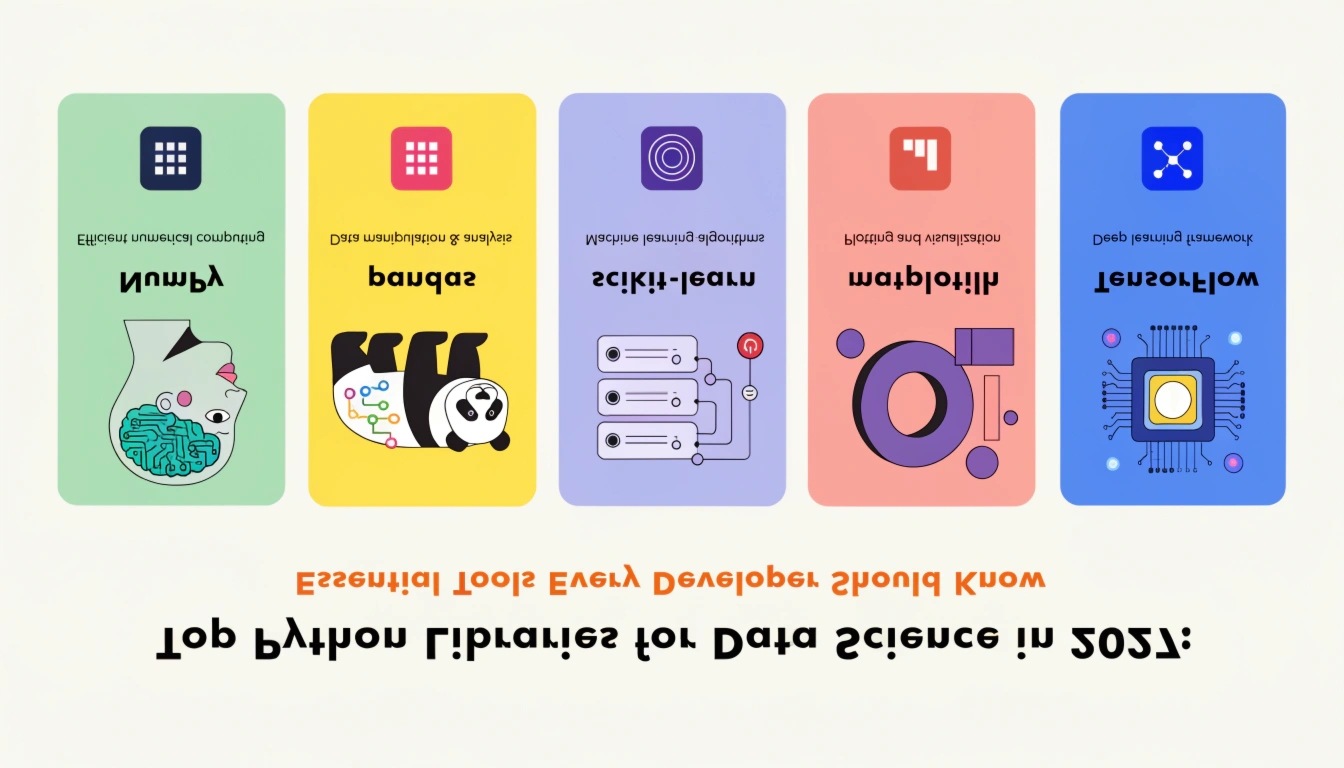
Modern Python libraries are faster, more scalable, and better integrated with artificial intelligence frameworks than ever before. Here are the top Python libraries shaping the future of data science in 2027.
1. NumPy
NumPy remains the foundation of scientific computing in Python. It provides powerful multidimensional arrays and mathematical functions that support complex numerical operations.
Key Features:
- High-performance array processing
- Mathematical and statistical functions
- Linear algebra capabilities
- Efficient memory usage
NumPy serves as the backbone for many other machine learning and data science libraries.
2. Pandas
Pandas continues to be one of the most widely used libraries for data manipulation and analysis. It allows users to work with structured datasets using DataFrames and Series objects.
Key Features:
- Data cleaning and preprocessing
- CSV, Excel, SQL, and JSON support
- Grouping and aggregation functions
- Time-series analysis
Pandas simplifies handling large datasets and remains essential for exploratory data analysis.
3. Polars
Polars has emerged as a strong alternative to Pandas in 2027 due to its speed and efficiency. Built with Rust, it provides significantly faster performance for large-scale data processing.
Key Features:
- Parallel execution
- Low memory consumption
- Lightning-fast DataFrames
- Lazy evaluation support
Many enterprises are adopting Polars for big data analytics and high-performance workflows.
4. Scikit-learn
Scikit-learn is still one of the most trusted machine learning libraries available. It offers simple yet powerful tools for predictive modeling.
Key Features:
- Classification algorithms
- Regression techniques
- Clustering methods
- Model evaluation tools
Its user-friendly design makes it ideal for beginners and professionals alike.
5. TensorFlow
TensorFlow remains a leading framework for deep learning and artificial intelligence applications.
Key Features:
- Neural network development
- Large-scale model deployment
- GPU acceleration
- TensorFlow Lite for edge devices
It is widely used in computer vision, natural language processing, and recommendation systems.
6. PyTorch
PyTorch has become increasingly popular among researchers and enterprises because of its flexibility and dynamic computation graph.
Key Features:
- Easy model experimentation
- GPU support
- Deep learning capabilities
- Extensive AI ecosystem
Many modern generative AI applications are powered by PyTorch.
7. XGBoost
XGBoost continues to dominate structured data machine learning problems.
Key Features:
- Gradient boosting algorithms
- High prediction accuracy
- Parallel processing
- Missing value handling
It is frequently used in fraud detection, customer analytics, and forecasting applications.
8. LightGBM
LightGBM offers exceptional speed and efficiency for large datasets.
Key Features:
- Faster training times
- Low memory requirements
- High accuracy
- Scalable architecture
It is commonly used in business intelligence and financial analytics.
9. Matplotlib and Seaborn
Visualization remains critical in data science. Matplotlib and Seaborn help professionals create informative charts and graphs.
Key Features:
- Line charts
- Histograms
- Heatmaps
- Statistical plots
These libraries help transform raw data into meaningful insights.
10. Plotly
Plotly enables interactive and web-based visualizations.
Key Features:
- Interactive dashboards
- 3D visualizations
- Real-time analytics
- Integration with web applications
Plotly is becoming increasingly popular for business reporting and analytics platforms.
11. Dask
As datasets continue to grow, Dask provides distributed computing capabilities for handling massive amounts of information.
Key Features:
- Parallel processing
- Big data analytics
- Scalable architecture
- Integration with Pandas and NumPy
Organizations processing terabytes of data rely on Dask to maintain performance.
12. SciPy
SciPy remains indispensable for scientific and technical computing.
Key Features:
- Optimization algorithms
- Signal processing
- Statistics and probability
- Numerical integration
Researchers and engineers frequently use SciPy for advanced mathematical analysis.
Future Trends in Data Science Libraries
In 2027, several trends are influencing the evolution of Python libraries:
- AI-assisted coding integration.
- GPU-accelerated data processing.
- Faster DataFrame libraries such as Polars.
- Distributed computing for large-scale analytics.
- Integration with generative AI systems.
- Edge AI and lightweight machine learning frameworks.
- Real-time analytics and streaming capabilities.
Conclusion
Python continues to dominate the data science landscape in 2027 due to its mature ecosystem and continuously evolving libraries. Tools like NumPy, Pandas, Polars, Scikit-learn, TensorFlow, PyTorch, XGBoost, and Plotly empower developers to solve complex analytical challenges efficiently. As AI and big data continue to grow, mastering these libraries will be essential for data scientists and machine learning engineers aiming to stay ahead in the industry.