Discover how AI is reshaping software engineering by working alongside developers. Learn how human expertise and AI-powered tools combine to improve coding, testing, deployment, and software innovation while creating new opportunities for developers.
Artificial Intelligence has become one of the most influential technologies in modern software engineering. What began as simple code completion tools has evolved into intelligent assistants capable of generating code, explaining complex logic, detecting bugs, writing documentation, and even suggesting software architectures. Rather than replacing software engineers, AI is increasingly serving as a collaborative partner that enhances productivity and enables developers to focus on higher-value work.
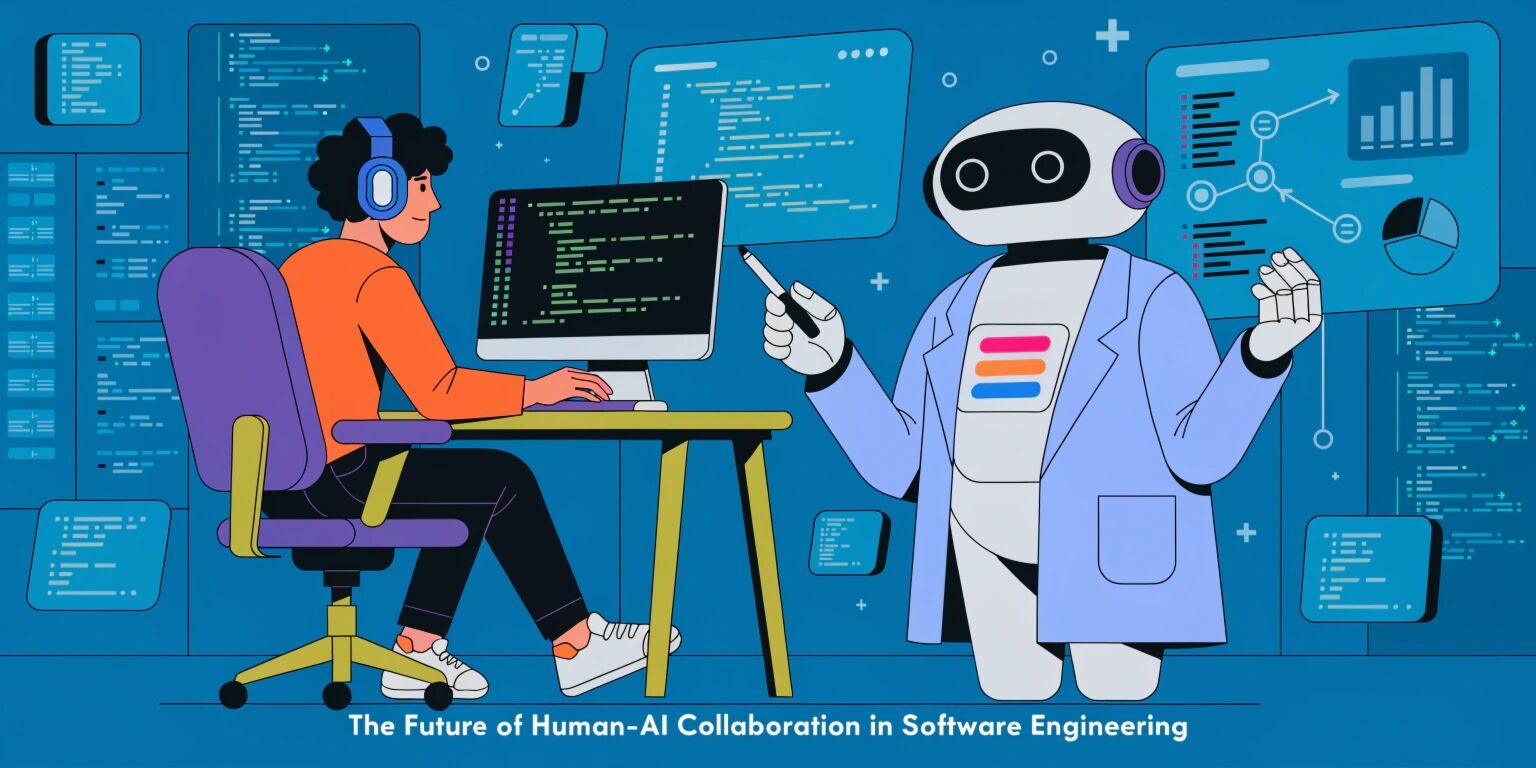
As organizations adopt AI-powered development workflows, the future of software engineering will depend on effective collaboration between human expertise and machine intelligence. Developers bring creativity, critical thinking, domain knowledge, and ethical judgment, while AI contributes speed, automation, and data-driven insights. Together, they are transforming how software is designed, built, tested, and maintained.
This article explores the future of Human-AI collaboration in software engineering, its benefits, challenges, emerging trends, and the skills developers need to succeed.
The Evolution of AI in Software Development
AI has progressed rapidly from basic automation tools to advanced development assistants.
Early tools focused on:
- Syntax highlighting
- Code completion
- Static code analysis
- Automated testing
Today, generative AI can:
- Generate functions and classes
- Explain unfamiliar codebases
- Refactor existing code
- Create unit tests
- Write technical documentation
- Assist with debugging
- Translate code between programming languages
This evolution has significantly changed the developer experience.
Where AI Adds Value
AI is becoming an integral part of nearly every phase of the software development lifecycle.
Code Generation
Developers can describe a feature in natural language, and AI can generate an initial implementation. This accelerates development by reducing repetitive coding tasks while allowing engineers to refine and validate the generated code.
Debugging and Error Detection
AI-powered tools analyze stack traces, identify potential causes of errors, and recommend fixes. This shortens troubleshooting time and helps developers resolve issues more efficiently.
Automated Testing
Creating comprehensive test cases can be time-consuming. AI assists by generating unit tests, integration tests, and edge-case scenarios, improving software quality and test coverage.
Documentation
Maintaining accurate documentation is often overlooked during development. AI can automatically produce API references, code comments, release notes, and onboarding guides, ensuring documentation remains synchronized with the codebase.
DevOps and Deployment
AI supports DevOps by analyzing deployment pipelines, detecting configuration issues, optimizing infrastructure usage, and predicting potential failures before they affect production systems.
The Continuing Importance of Human Developers
Despite AI's growing capabilities, software engineering requires skills that extend beyond code generation.
Developers remain essential for:
- Designing scalable system architectures
- Understanding business requirements
- Making ethical decisions
- Solving novel problems
- Prioritizing security and compliance
- Collaborating with stakeholders
- Balancing technical and organizational trade-offs
AI can recommend solutions, but humans determine whether those solutions align with business objectives and long-term strategies.
Collaboration Rather Than Replacement
The most effective development teams view AI as a collaborative assistant rather than a substitute for human expertise.
A typical workflow may involve:
- Defining project requirements.
- Using AI to generate an initial code structure.
- Reviewing and refining the generated code.
- Writing additional business logic.
- Using AI to create automated tests.
- Performing code reviews and security validation.
- Deploying through AI-assisted DevOps pipelines.
- Monitoring performance with AI-driven observability tools.
In this model, AI accelerates routine tasks while developers maintain oversight and accountability.
Benefits of Human-AI Collaboration
Organizations adopting AI-assisted software engineering can experience several advantages:
- Faster development cycles
- Increased developer productivity
- Improved code consistency
- Enhanced software quality
- Reduced repetitive work
- Better documentation
- Accelerated onboarding for new developers
- More time for innovation and strategic planning
These benefits enable teams to deliver software more efficiently without compromising quality.
Challenges and Considerations
While AI offers significant advantages, it also introduces challenges.
Code Accuracy
AI-generated code may contain logical errors, outdated patterns, or inefficient implementations. Human review remains essential.
Security Risks
Automatically generated code can introduce vulnerabilities if it is accepted without proper validation. Secure coding practices and security testing must remain part of the development process.
Intellectual Property
Organizations should establish policies regarding the use of AI-generated code, licensing considerations, and proprietary information shared with AI tools.
Skill Development
Developers must avoid becoming overly dependent on AI. A strong understanding of programming fundamentals, algorithms, and system design remains critical for long-term success.
Emerging Trends
The future of Human-AI collaboration is expected to include:
- Autonomous software agents that assist with project planning and maintenance
- AI-powered code review and architectural analysis
- Natural language software development interfaces
- Predictive bug detection before deployment
- Intelligent project management assistants
- AI-driven performance optimization
- Automated infrastructure provisioning
- Context-aware development environments
These innovations will further integrate AI into daily engineering workflows while expanding the role of developers as architects, reviewers, and decision-makers.
Skills Developers Should Build
To thrive in an AI-assisted future, software engineers should strengthen skills in:
- System architecture and design
- Cloud computing
- Cybersecurity
- Artificial intelligence fundamentals
- Prompt engineering
- Code review and quality assurance
- DevOps and CI/CD practices
- Communication and collaboration
- Critical thinking and problem-solving
These capabilities complement AI rather than compete with it.
Best Practices for Effective Collaboration
Organizations can maximize the value of Human-AI collaboration by:
- Treating AI-generated code as a first draft, not a final product.
- Establishing mandatory code reviews.
- Validating AI outputs with automated testing.
- Protecting sensitive data when using AI tools.
- Continuously training teams on AI capabilities and limitations.
- Monitoring productivity and quality metrics.
- Encouraging developers to focus on high-impact engineering tasks.
A balanced approach ensures AI enhances, rather than replaces, engineering excellence.
Conclusion
The future of software engineering is not a competition between humans and artificial intelligence—it is a partnership that combines the strengths of both. AI excels at automating repetitive tasks, accelerating development, and providing intelligent recommendations, while human developers contribute creativity, strategic thinking, ethical judgment, and deep technical expertise. Together, they enable faster delivery of high-quality software and more innovative solutions.
As AI technologies continue to evolve, successful software engineering teams will embrace collaboration, invest in continuous learning, and adapt their workflows to leverage intelligent tools responsibly. By combining human insight with AI-powered automation, organizations can build resilient, scalable, and future-ready software that meets the demands of an increasingly digital world.
We build scalable web, mobile, and game products for clients worldwide — combining modern frameworks, cloud infrastructure, and best engineering practices.
-1.jpg)