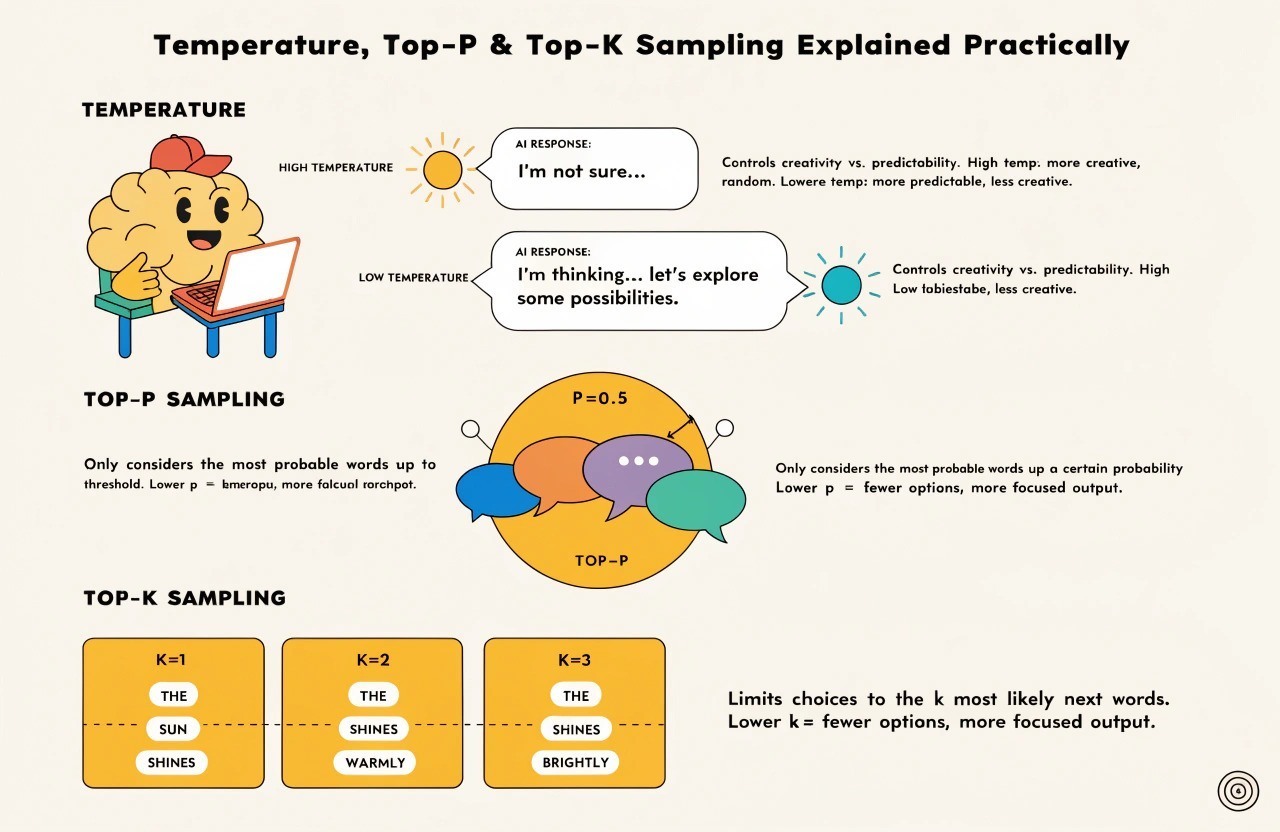
Temperature, Top-P, and Top-K are sampling parameters that influence how language models select tokens. Understanding their behavior helps developers control creativity, consistency, randomness, and predictability when building chatbots, AI agents, content generators, and production LLM applications.
Large language models can produce different outputs from similar prompts. Sometimes developers want highly predictable responses, while other applications benefit from creativity and variation.
Three important parameters commonly associated with text generation are Temperature, Top-P, and Top-K.
These parameters influence how an AI model selects the next token during generation. Understanding them is essential for developers building production-grade Generative AI applications.
How LLMs Generate Text
Before understanding sampling parameters, it is useful to understand how language models generate responses.
When an LLM processes a prompt, it calculates probabilities for possible next tokens.
For example, given:
"The sky is..."
the model might assign probabilities such as:
- Blue — 70%
- Cloudy — 15%
- Clear — 8%
- Dark — 4%
- Other tokens — 3%
The model then selects a token based on these probabilities.
Sampling parameters influence how that selection happens.
What Is Temperature?
Temperature controls the randomness of token selection.
A lower temperature makes the model more deterministic and likely to select high-probability tokens.
A higher temperature increases randomness and allows lower-probability tokens to become more likely.
Conceptually:
Low Temperature → More Predictable
High Temperature → More Diverse
For example, consider the prompt:
"Write a slogan for a coffee shop."
With a low temperature, the output might be:
"Fresh Coffee, Every Day."
With a higher temperature, the model may generate something more unusual:
"Where Every Morning Finds Its Flavor."
The exact behavior depends on the model and sampling implementation.
When Should You Use Low Temperature?
Lower temperatures are useful when consistency and reliability matter.
Typical applications include:
- Code generation
- Data extraction
- Classification
- Technical documentation
- Structured responses
- Customer support
- Question answering
- JSON generation
For example, if an application needs to extract a customer's name, email, and phone number into a structured format, unnecessary randomness provides little value.
A lower temperature can help make outputs more consistent.
When Should You Use High Temperature?
Higher temperatures can be useful when creativity is important.
Common examples include:
- Story generation
- Brainstorming
- Marketing ideas
- Creative writing
- Game dialogue
- Naming products
- Creative advertising concepts
However, higher temperature does not automatically mean better output.
Too much randomness can result in irrelevant, inconsistent, or factually unreliable responses.
What Is Top-K Sampling?
Top-K sampling limits the model's choices to the K most probable tokens.
Suppose the model predicts 1,000 possible tokens.
If:
Top-K = 10
the sampling process considers only the ten highest-probability tokens.
The remaining tokens are excluded from that sampling step.
A smaller K creates a narrower selection space, while a larger K allows more possible tokens.
Practical Top-K Example
Imagine the model predicts:
TokenProbabilityblue45%clear20%cloudy15%bright8%dark5%golden3%other4%
If Top-K = 3, only:
blue, clear, cloudy
would remain candidates for sampling.
This reduces the possibility of selecting less likely tokens.
What Is Top-P Sampling?
Top-P is also called nucleus sampling.
Instead of selecting a fixed number of tokens, Top-P selects the smallest group of tokens whose combined probability reaches a specified threshold.
For example, suppose:
- blue = 45%
- clear = 25%
- cloudy = 15%
- bright = 10%
- dark = 5%
With Top-P = 0.80, the system might consider:
45% + 25% + 15% = 85%
Depending on the exact distribution, the smallest set reaching the probability threshold becomes the candidate pool.
Unlike Top-K, Top-P dynamically changes the number of candidate tokens based on the model's probability distribution.
Top-K vs Top-P
The key difference is simple:
Top-K = Fixed number of candidate tokens
Top-P = Dynamic probability-based candidate pool
Top-K might always consider 20 tokens.
Top-P might consider 5 tokens in one situation and 50 in another, depending on how concentrated the probability distribution is.
Temperature vs Top-P vs Top-K
These parameters influence generation differently.
Temperature controls how sharply or softly probabilities are distributed.
Top-K limits the number of candidate tokens.
Top-P limits candidates based on cumulative probability.
A useful mental model is:
Temperature → How random?
Top-K → How many candidates?
Top-P → How much probability mass?
Can You Use Them Together?
Yes, depending on the model provider and inference implementation.
A generation pipeline may apply temperature and then restrict candidate tokens using Top-K or Top-P.
However, combining many sampling controls without testing can make model behavior difficult to predict.
Developers should understand how their specific model API applies these parameters.
Practical Configuration Examples
For a customer support chatbot where consistency is important:
Temperature: Low
Top-P: Moderate
Top-K: Conservative
For creative brainstorming:
Temperature: Higher
Top-P: Higher
Top-K: Larger
For code generation:
Temperature: Low
Top-P: Moderate or conservative
The exact values should be evaluated empirically rather than copied blindly between models.
Example: AI Content Generation
Imagine an application generating blog topic ideas.
At low randomness, the model may repeatedly generate predictable topics such as:
- "Benefits of Cloud Computing"
- "Future of Artificial Intelligence"
- "Importance of Cybersecurity"
Increasing randomness can produce more unusual combinations and perspectives.
This can be useful during brainstorming.
However, the final content should still be reviewed for relevance and factual accuracy.
Example: AI Coding Assistant
Consider a developer asking:
"Write a Python function to calculate the average of a list."
A highly random response is unnecessary.
Developers typically want a correct, consistent implementation.
Therefore, a lower temperature is generally more appropriate.
For coding assistants, reliability is usually more valuable than creative variation.
Common Mistakes
One common mistake is assuming that higher temperature always produces better results.
It does not.
Another mistake is changing several sampling parameters simultaneously without understanding their interaction.
Developers should also avoid assuming that parameter values behave identically across different models.
Different LLMs may have different probability distributions, tokenizers, inference implementations, and supported parameters.
Sampling and Determinism
Even with low temperature, model output may not always be perfectly deterministic.
Other factors can influence results, including backend implementation, random seeds, model versions, parallel execution, and provider-specific behavior.
Applications that require strict reproducibility should use supported deterministic settings and carefully control their inference environment.
Best Practices for Production AI
When deploying an LLM application, developers should:
- Start with conservative settings.
- Test temperature changes independently.
- Experiment with Top-P or Top-K when supported.
- Evaluate outputs using representative prompts.
- Measure quality rather than relying on assumptions.
- Keep settings documented.
- Test across different input types.
- Monitor production output quality.
- Avoid excessive randomness for structured tasks.
- Re-evaluate settings when changing models.
Conclusion
Temperature, Top-P, and Top-K are important tools for controlling LLM generation behavior.
Temperature primarily affects randomness, Top-K limits the number of candidate tokens, and Top-P dynamically limits candidates based on cumulative probability.
For production applications, the right configuration depends on the use case.
Creative applications may benefit from greater variation, while coding, extraction, classification, and structured business workflows generally require more predictable outputs.
The best approach is not to search for one universal setting. Instead, developers should experiment systematically, evaluate output quality, and select parameters based on the specific behavior required by their AI application.
We build scalable web, mobile, and game products for clients worldwide — combining modern frameworks, cloud infrastructure, and best engineering practices.
-1.jpg)