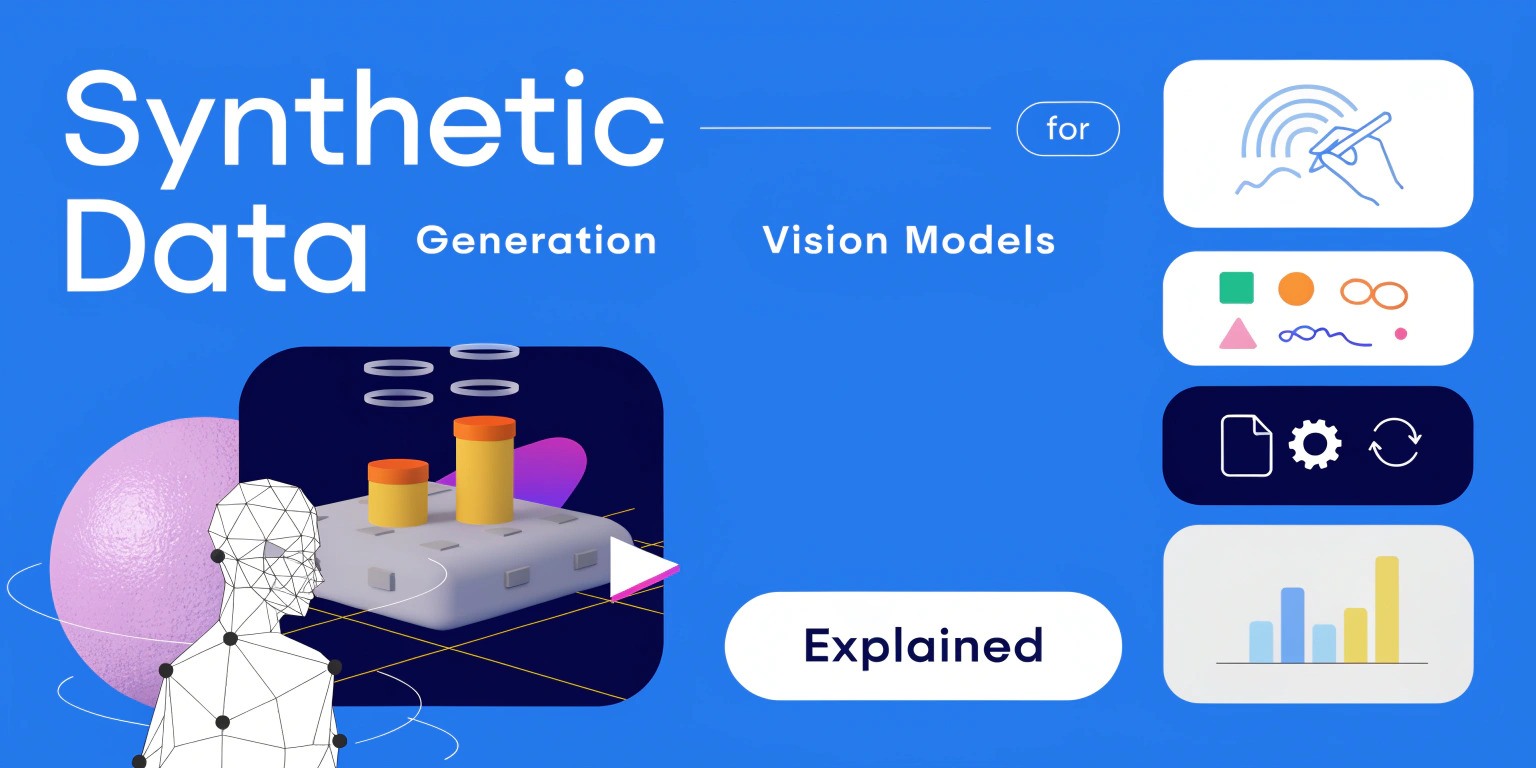
Discover how synthetic data generation is transforming computer vision by creating realistic training datasets. Learn the techniques, benefits, applications, tools, and best practices for building accurate, scalable, and privacy-friendly AI vision models.
Computer vision has become one of the most impactful branches of artificial intelligence, powering applications such as facial recognition, autonomous vehicles, medical imaging, industrial automation, retail analytics, and smart surveillance. However, the success of any vision model depends heavily on the quality and quantity of its training data.
Collecting and labeling millions of real-world images is often expensive, time-consuming, and subject to privacy restrictions. This challenge has led to the rapid adoption of synthetic data generation, where AI-generated or computer-rendered images are used to train computer vision models.
Synthetic data enables organizations to create virtually unlimited, accurately labeled datasets while reducing costs and improving model performance. As AI adoption accelerates, synthetic datasets are becoming an essential part of modern computer vision development.
What Is Synthetic Data?
Synthetic data is artificially generated data that mimics the characteristics of real-world data without directly copying actual observations.
For computer vision, synthetic data may include:
- AI-generated images
- 3D rendered scenes
- Simulated environments
- Digitally created objects
- Virtual human models
- Artificial medical scans
- Generated traffic scenarios
Each generated image comes with perfectly accurate annotations, significantly reducing manual labeling efforts.
Why Vision Models Need Synthetic Data
Traditional data collection presents several limitations:
- Limited availability of rare events
- High annotation costs
- Privacy regulations
- Class imbalance
- Environmental variability
- Safety concerns
- Difficulty capturing edge cases
Synthetic data addresses these challenges by enabling developers to generate precisely the scenarios required for training.
For example, an autonomous vehicle can be trained using thousands of simulated nighttime, rainy, snowy, or foggy driving scenes without waiting for those real-world conditions to occur.
Techniques for Synthetic Data Generation
Several technologies are used to create synthetic datasets.
1. 3D Rendering
Game engines and rendering software create highly realistic virtual environments.
Objects, lighting, shadows, and camera positions can be adjusted automatically to generate millions of labeled images.
Popular rendering platforms include Unreal Engine, Unity, and Blender.
2. Generative Adversarial Networks (GANs)
GANs generate realistic images by training two neural networks simultaneously:
- Generator
- Discriminator
The generator continuously improves until the produced images closely resemble real-world photographs.
GANs are widely used for:
- Face generation
- Medical images
- Product images
- Fashion datasets
3. Diffusion Models
Diffusion models have become one of the most advanced image generation techniques.
These models gradually remove noise to create highly realistic images from text prompts or reference images.
Applications include:
- Product visualization
- Scene generation
- Industrial inspection
- Medical imaging
4. Simulation Environments
Simulation software generates realistic environments for AI systems.
Examples include:
- Self-driving cars
- Warehouse robots
- Agricultural drones
- Smart factories
These environments safely reproduce dangerous or rare situations that are difficult to capture in real life.
Benefits of Synthetic Data
Unlimited Dataset Creation
Organizations can generate millions of images without physical data collection.
This accelerates AI development significantly.
Perfect Annotations
Bounding boxes, segmentation masks, depth maps, and object labels are automatically generated with complete accuracy.
This eliminates costly manual annotation.
Improved Privacy
Synthetic datasets contain no personally identifiable information.
This helps organizations comply with regulations while training AI models.
Better Edge Case Coverage
Rare events can be created intentionally.
Examples include:
- Heavy snowfall
- Traffic accidents
- Equipment failures
- Medical abnormalities
Training on these scenarios improves model robustness.
Lower Development Costs
Instead of organizing expensive photo shoots or annotation projects, developers can generate training data programmatically.
Real-World Applications
Autonomous Vehicles
Self-driving systems use synthetic road scenes to train:
- Object detection
- Lane recognition
- Pedestrian detection
- Traffic sign classification
Millions of driving situations can be simulated before deployment.
Healthcare
Medical imaging datasets are often limited.
Synthetic MRI, CT, and X-ray images help train diagnostic AI while protecting patient privacy.
Manufacturing
Factories use synthetic images to detect:
- Product defects
- Assembly errors
- Surface scratches
- Packaging issues
AI systems become more accurate with diverse synthetic samples.
Retail
Retail companies generate synthetic shelf images for:
- Inventory management
- Product recognition
- Checkout automation
- Store analytics
Agriculture
Synthetic aerial images help train AI for:
- Crop monitoring
- Disease detection
- Weed identification
- Yield prediction
Popular Tools for Synthetic Data Generation
Several platforms simplify synthetic dataset creation.
Common tools include:
- NVIDIA Omniverse Replicator
- Unity Perception
- Unreal Engine
- Blender
- CARLA Simulator
- AirSim
- Isaac Sim
- OpenCV (for augmentation workflows)
These tools integrate well with modern machine learning pipelines.
Challenges of Synthetic Data
Despite its advantages, synthetic data is not perfect.
Common challenges include:
Domain Gap
Artificial images may differ slightly from real-world images.
This difference can reduce model accuracy.
Techniques like domain adaptation help bridge this gap.
Realism
Poor-quality synthetic images can introduce bias.
High-quality rendering is essential.
Computational Requirements
Generating photorealistic datasets often requires powerful GPUs and substantial storage resources.
Validation
Synthetic datasets should always be tested against real-world data to ensure model reliability.
Best Practices
To maximize effectiveness:
- Combine synthetic and real datasets.
- Generate diverse environments.
- Include difficult edge cases.
- Validate model performance regularly.
- Maintain balanced class distributions.
- Simulate realistic lighting and weather.
- Continuously update datasets as requirements evolve.
Following these practices leads to more robust vision models.
Future of Synthetic Data
Synthetic data is evolving rapidly with advances in generative AI.
Future innovations include:
- AI-generated digital twins
- Real-time synthetic environments
- Automated scene generation
- Physics-aware simulations
- Foundation models for image synthesis
- Self-improving synthetic datasets
- Multi-modal synthetic training data combining images, text, and sensor information
As rendering technologies and generative models continue to improve, the gap between synthetic and real-world data will become increasingly smaller, making synthetic datasets a standard component of AI development.
Conclusion
Synthetic data generation is revolutionizing the way computer vision models are trained. By enabling the creation of scalable, accurately labeled, and privacy-preserving datasets, it addresses many of the limitations associated with collecting real-world images. From autonomous vehicles and healthcare to manufacturing and agriculture, organizations are using synthetic data to improve model accuracy, reduce costs, and accelerate AI deployment.
While challenges such as domain gaps and realism remain, combining synthetic data with real-world datasets and following best practices can produce highly reliable vision systems. As generative AI, simulation platforms, and rendering technologies continue to advance, synthetic data will play an even more significant role in shaping the future of computer vision and artificial intelligence.
We build scalable web, mobile, and game products for clients worldwide — combining modern frameworks, cloud infrastructure, and best engineering practices.
-1.jpg)