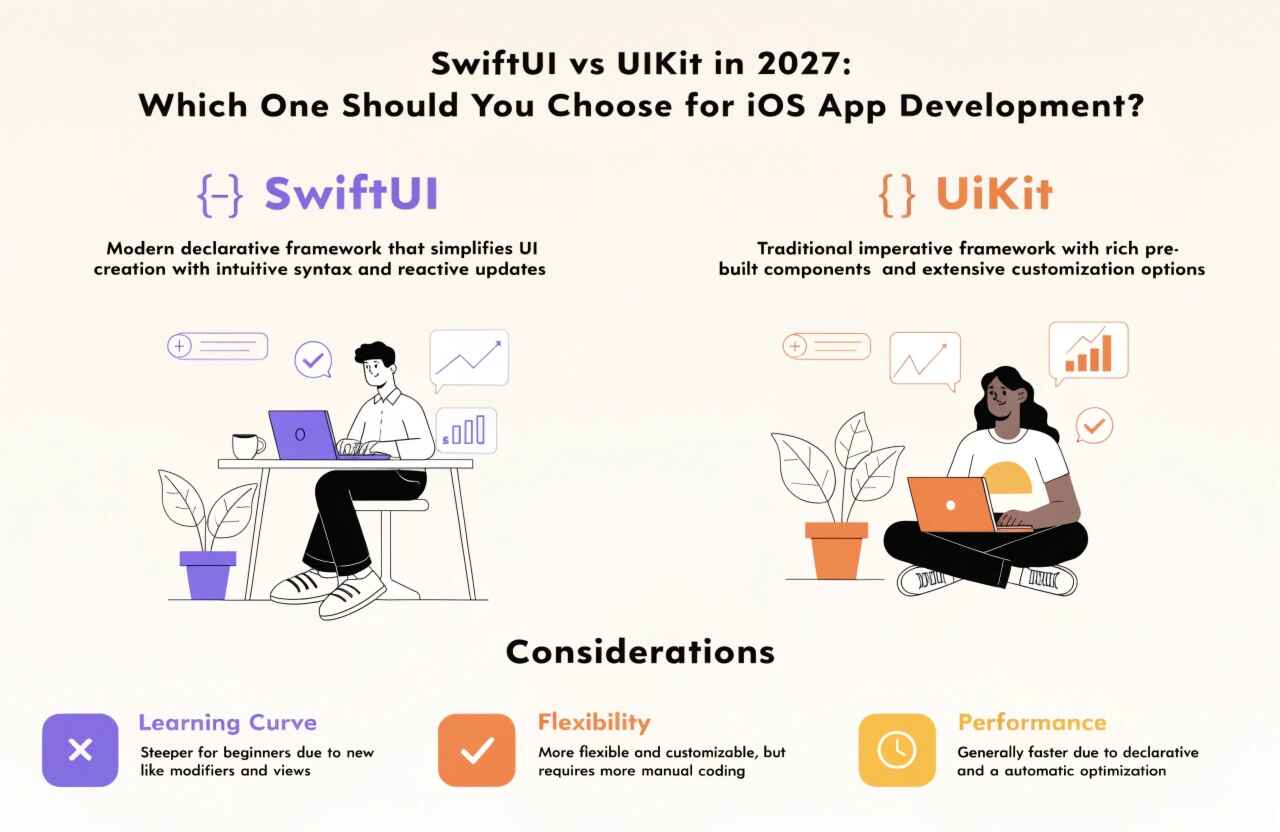
SwiftUI and UIKit continue to play significant roles in iOS development in 2027. While SwiftUI offers faster development, modern UI design, and seamless integration with Apple's latest technologies, UIKit remains valuable for legacy applications and highly customized interfaces. This guide compares both frameworks to help developers and businesses choose the right solution for their projects.
SwiftUI vs UIKit in 2027: Which One Should You Choose?
Apple's iOS development ecosystem has evolved rapidly over the past few years. Since its introduction in 2019, SwiftUI has transformed the way developers build applications, while UIKit has remained the foundation of countless successful apps.
In 2027, many developers and businesses still ask one important question:
Should you build your next iOS app using SwiftUI or UIKit?
The answer depends on your project requirements, development timeline, team expertise, and long-term maintenance goals.
Let's compare both frameworks across the factors that matter most.
What is SwiftUI?
SwiftUI is Apple's declarative UI framework that allows developers to build interfaces using concise and readable Swift code.
Instead of manually managing every UI element, developers simply describe what the interface should look like, and SwiftUI automatically updates the screen whenever data changes.
Advantages of SwiftUI
- Faster development
- Less boilerplate code
- Live Preview in Xcode
- Better support for Dark Mode
- Accessibility built-in
- Excellent animation capabilities
- Seamless integration with Swift Concurrency
- Cross-platform compatibility (iOS, macOS, watchOS, visionOS)
Apple continues investing heavily in SwiftUI, making it the preferred framework for modern applications.
What is UIKit?
UIKit is Apple's traditional UI framework introduced with the very first iPhone SDK.
It follows an imperative programming approach where developers manually create, update, and manage user interface components.
Although older, UIKit remains extremely powerful and is still widely used by enterprise applications and large-scale products.
Advantages of UIKit
- Mature and stable
- Highly customizable
- Extensive third-party library support
- Excellent backward compatibility
- Proven architecture
- Ideal for maintaining legacy applications
Many popular applications today continue to rely on UIKit because of years of optimization and production-tested reliability.
SwiftUI vs UIKit Comparison
1. Learning Curve
SwiftUI
SwiftUI is easier for beginners.
Its clean syntax makes UI development significantly more intuitive compared to UIKit.
Developers familiar with React or Flutter often adapt quickly to SwiftUI's declarative approach.
UIKit
UIKit requires understanding View Controllers, Delegates, Auto Layout, Storyboards, and lifecycle management.
Although more complex initially, it provides deeper control over application behavior.
Winner: SwiftUI
2. Development Speed
SwiftUI dramatically reduces development time.
Features like Live Preview, reusable components, and automatic state updates allow developers to build interfaces much faster.
UIKit often requires significantly more code to accomplish the same tasks.
Winner: SwiftUI
3. Performance
Performance differences have narrowed considerably by 2027.
SwiftUI now performs exceptionally well for most applications.
UIKit still offers advantages when creating extremely complex animations, highly customized layouts, or graphics-intensive interfaces.
Winner: Tie (Depends on project complexity)
4. Code Maintenance
SwiftUI encourages reusable components and modern architecture patterns such as MVVM.
Its smaller codebase makes debugging and future updates easier.
UIKit projects generally contain more files and greater complexity, increasing maintenance costs over time.
Winner: SwiftUI
5. Customization
UIKit still provides unmatched control over every UI element.
If your application demands pixel-perfect interfaces or highly specialized interactions, UIKit remains an excellent choice.
SwiftUI has improved tremendously but still abstracts certain low-level UI behaviors.
Winner: UIKit
6. Compatibility
SwiftUI works best with newer Apple operating systems.
If your business must support older iOS versions, UIKit remains the safer option.
Many organizations continue using UIKit because their customer base includes older devices.
Winner: UIKit
7. Future Growth
Apple introduces most new interface features in SwiftUI first.
New APIs, widgets, Vision Pro experiences, and platform innovations are increasingly optimized for SwiftUI.
This indicates Apple's long-term direction.
Winner: SwiftUI
When Should You Choose SwiftUI?
SwiftUI is ideal when:
- Building a brand-new application
- Developing MVPs quickly
- Creating apps for the latest Apple devices
- Building cross-platform Apple applications
- Working with small development teams
- Reducing maintenance costs
- Leveraging modern Apple frameworks
Most startups launching new iOS products in 2027 choose SwiftUI because it accelerates development while maintaining excellent performance.
When Should You Choose UIKit?
UIKit remains the better option when:
- Maintaining existing enterprise applications
- Supporting older iOS versions
- Building highly customized interfaces
- Integrating with older third-party libraries
- Working within large legacy codebases
Many Fortune 500 companies continue investing in UIKit because rewriting mature applications would require significant time and resources.
Can You Use Both Together?
Absolutely.
One of Apple's biggest strengths is interoperability.
Developers can embed SwiftUI views inside UIKit applications using UIHostingController, while UIKit components can also be integrated into SwiftUI projects through UIViewRepresentable.
This hybrid approach allows teams to modernize applications gradually instead of rebuilding everything from scratch.
Which Framework is Better for Businesses?
From a business perspective, SwiftUI often provides:
- Faster project delivery
- Lower development costs
- Easier maintenance
- Better scalability
- Future-ready architecture
However, businesses with existing UIKit applications may achieve better ROI by gradually introducing SwiftUI into their current projects rather than performing a complete migration.
Choosing the right framework should always align with your product roadmap, target audience, and technical requirements.
Final Verdict
In 2027, SwiftUI is the preferred choice for most new iOS application development projects. Its modern architecture, rapid development capabilities, seamless integration with Apple's latest technologies, and lower maintenance requirements make it the future of iOS development.
Nevertheless, UIKit remains highly relevant, particularly for enterprise applications, legacy systems, and projects requiring deep UI customization or broader compatibility.
Rather than viewing SwiftUI and UIKit as competitors, developers should see them as complementary technologies. Understanding both frameworks enables teams to build high-quality,
scalable, and future-ready iOS applications while preserving the flexibility to meet diverse business needs.
We build scalable web, mobile, and game products for clients worldwide — combining modern frameworks, cloud infrastructure, and best engineering practices.
.jpg)
.jpg)