Introduction
Developers entering the Apple ecosystem often encounter two important technologies: Swift and SwiftUI. Because both are widely used in modern iOS development, beginners sometimes assume that Swift and SwiftUI are competing technologies. In reality, they serve different purposes and are frequently used together.
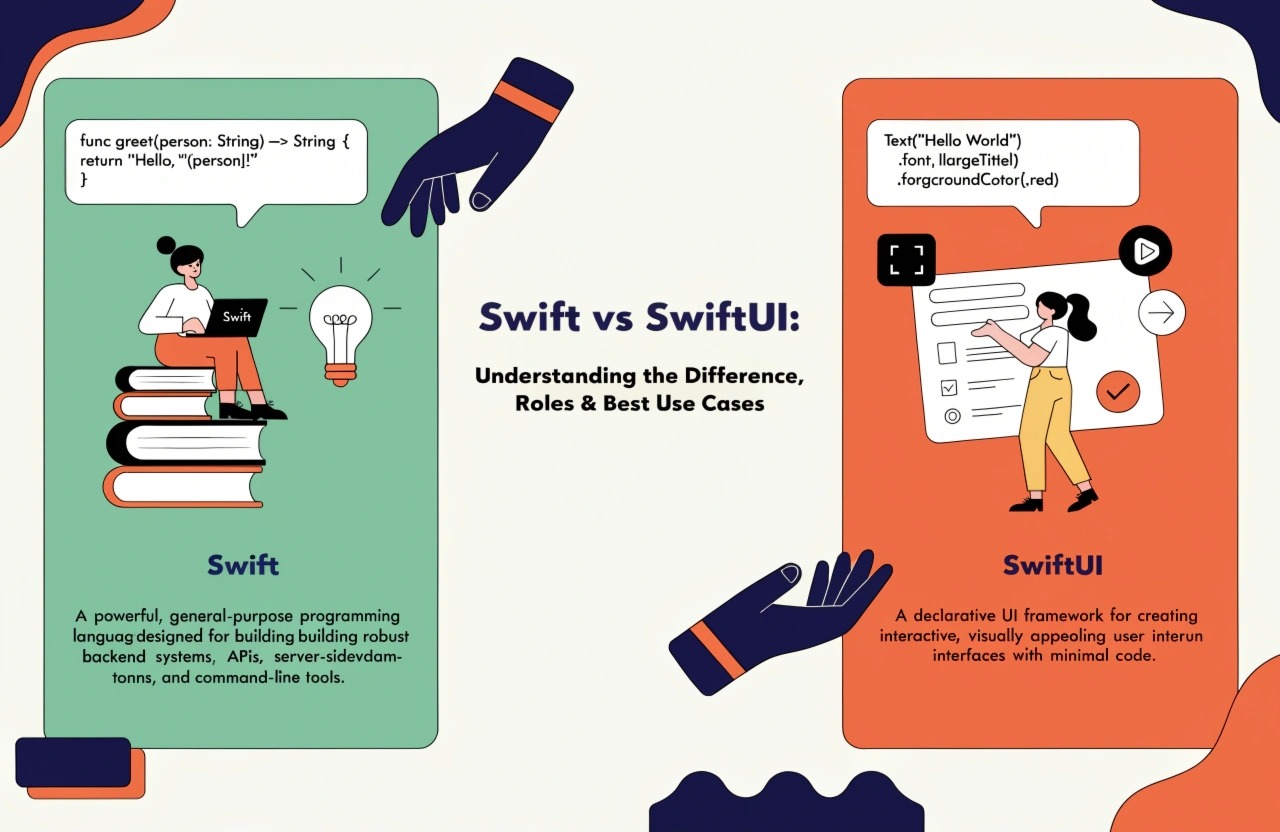
Swift is a powerful, modern programming language created by Apple for building applications across its ecosystem. SwiftUI, on the other hand, is a user-interface framework that allows developers to create application interfaces using Swift and a declarative development approach.
Understanding the difference between these technologies is important when planning an iOS application, selecting a development architecture, or building a career in Apple-platform development.
What Is Swift?
Swift is Apple’s general-purpose programming language designed for performance, safety, and developer productivity. It can be used to implement an application's business logic, data processing, networking, algorithms, application state, APIs, and other core functionality.
Swift is not limited to designing screens. Developers can use it for almost every programming layer of an Apple application.
For example, Swift can handle:
- Business and application logic
- Data structures and algorithms
- Networking and API integration
- JSON processing
- Database operations
- Authentication
- Concurrency and asynchronous tasks
- Error handling
- Application architecture
- System-level functionality
Swift supports modern programming concepts such as optionals, protocols, generics, closures, structured concurrency, and strong type safety.
What Is SwiftUI?
SwiftUI is Apple's declarative framework for building user interfaces across Apple platforms. Instead of describing every individual UI operation imperatively, developers describe what the interface should look like based on the application's current state.
SwiftUI can be used to build interfaces for:
- iOS
- iPadOS
- macOS
- watchOS
- tvOS
- visionOS
A major advantage of SwiftUI is its declarative approach. Developers can define views using Swift syntax and connect those views to application state.
For example, instead of manually updating several UI components whenever data changes, a SwiftUI view can automatically respond when its underlying state changes.
Swift vs SwiftUI: The Core Difference
The simplest way to understand the difference is:
Swift = Programming Language
SwiftUI = User Interface Framework
Swift provides the programming foundation, while SwiftUI provides tools for constructing the visual interface.
They are therefore not alternatives like two competing programming languages. SwiftUI itself uses Swift, meaning developers generally write Swift code when developing SwiftUI applications.
Swift and SwiftUI Working Together
Modern iOS applications commonly use Swift and SwiftUI together.
Consider an e-commerce application. Swift can be responsible for API communication, product models, authentication, business rules, and data processing. SwiftUI can then display products, shopping carts, checkout screens, buttons, lists, and other interface elements.
A simplified architecture might look like:
Swift → Logic, Data, Networking, Models
SwiftUI → Views, Layouts, UI State and User Interaction
This combination can produce applications that are easier to maintain and adapt as requirements evolve.
Key Differences
Feature Swift SwiftUI
Type Programming language UI framework
Primary purpose Application logic User interface development
Created by Apple Apple
Syntax Swift Swift-based declarative syntax
Business logic Yes Not its primary purpose
UI development Can support UI through frameworks Core purpose
Networking Yes Usually works with Swift networking code
Data processing Yes Uses Swift underneath
Platform support Broad Apple ecosystem and beyond Apple platforms
Can be used together? Yes Yes
When Should Developers Use Swift?
Swift is essential when an application requires custom functionality beyond its visual interface.
Developers should use Swift for tasks such as API integration, authentication systems, data management, algorithms, business logic, local storage, background processing, and application architecture.
Even developers who primarily work with SwiftUI need a strong understanding of Swift because SwiftUI applications are written using Swift.
When Should Developers Use SwiftUI?
SwiftUI is particularly useful when building modern Apple-platform interfaces.
It is a strong choice for applications that require:
- Modern responsive interfaces
- Reusable UI components
- State-driven interfaces
- Cross-platform Apple UI
- Faster UI development
- Consistent design systems
- Maintainable view structures
SwiftUI can also simplify many common interface-development tasks compared with traditional imperative UI approaches.
SwiftUI vs UIKit
SwiftUI is not the same as UIKit. UIKit is Apple's long-established framework for building interfaces on Apple platforms, while SwiftUI provides a newer declarative approach.
For new applications, SwiftUI can be an excellent option, particularly when the target platform and deployment requirements support the required SwiftUI capabilities.
However, UIKit remains important because many existing enterprise applications use it, and developers may need to maintain or extend legacy codebases.
Can Swift and SwiftUI Be Used Together?
Yes. In fact, using them together is one of the most common approaches to modern Apple application development.
A project may use Swift for its models, services, business logic, networking, and application architecture while using SwiftUI for its presentation layer.
Developers can also integrate SwiftUI with existing technologies when migrating older applications gradually rather than rewriting an entire application from scratch.
Best Use Cases
Swift is ideal for:
- Application logic
- Backend/API communication
- Data processing
- Algorithms
- Authentication
- Networking
- Concurrency
- Application architecture
SwiftUI is ideal for:
- iOS interfaces
- iPad applications
- macOS interfaces
- watchOS applications
- visionOS experiences
- Reusable UI components
- State-driven interfaces
- Modern responsive layouts
Conclusion
Swift and SwiftUI should not be viewed as competing technologies. Swift is the programming language, while SwiftUI is a framework built around Swift for creating modern user interfaces.
For developers building contemporary Apple-platform applications, understanding both technologies is highly valuable. Swift provides the foundation for application logic and functionality, while SwiftUI makes it possible to create modern, declarative, and responsive interfaces.
The most effective approach is often not choosing between Swift and SwiftUI, but learning how to use them together. With strong Swift fundamentals and practical SwiftUI knowledge, developers can create scalable, maintainable, and modern applications across Apple's growing ecosystem.