Sparse and dense transformers differ in efficiency, scalability, and performance. This blog explains their trade-offs, helping you choose the right model architecture for building cost-effective and high-performing AI systems.
Transformer models have revolutionized the field of natural language processing (NLP) and beyond, powering modern applications like chatbots, search engines, and recommendation systems. However, as these models grow larger and more complex, efficiency and scalability become critical concerns. This has led to the emergence of two key architectures: sparse transformers and dense transformers.
Understanding the trade-offs between these two approaches is essential for building efficient and scalable AI systems.
What Are Dense Transformer Models?
Dense transformer models are the traditional form of transformers where every token attends to every other token in a sequence. This is known as full self-attention.
In a dense model:
- All parameters are active for every input
- Every token interacts with every other token
- Computation grows quadratically with sequence length
Popular models like GPT, BERT, and many large language models follow this dense architecture.
Advantages of Dense Models:
- High accuracy and strong performance
- Simpler architecture and easier to implement
- Better generalization across tasks
Disadvantages:
- High computational cost
- Memory-intensive
- Poor scalability for very long sequences
As the sequence length increases, the cost of computing attention becomes a bottleneck.
What Are Sparse Transformer Models?
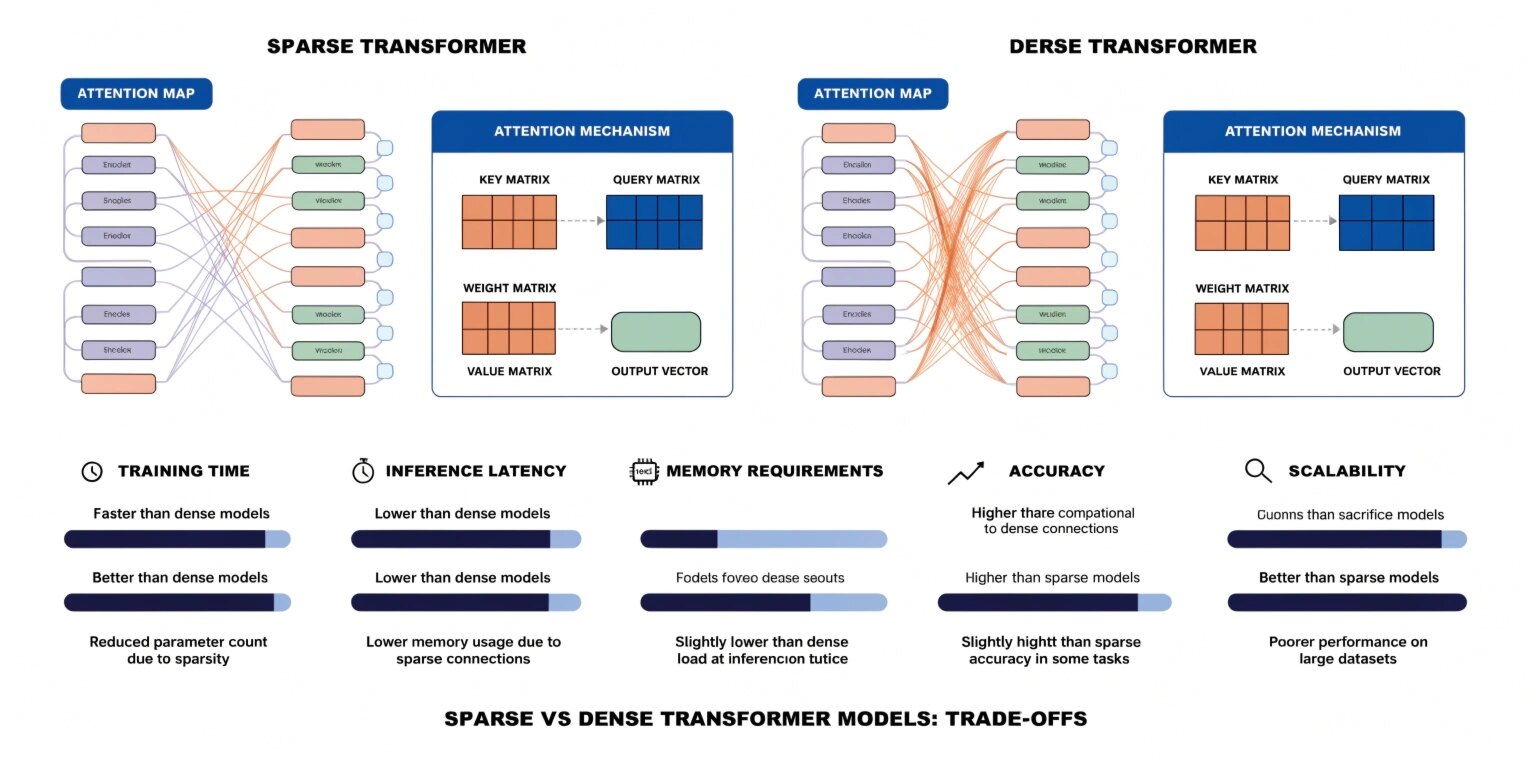
Sparse transformer models aim to reduce computational complexity by limiting the number of attention connections. Instead of every token attending to all others, tokens attend only to a subset.
This sparsity can be designed in different ways:
- Fixed patterns (local attention, sliding windows)
- Learned patterns (adaptive attention)
- Random or block-based attention
Models like Sparse Transformer, Longformer, and BigBird use sparse attention mechanisms.
Advantages of Sparse Models:
- Reduced computational cost
- Lower memory usage
- Ability to handle longer sequences efficiently
Disadvantages:
- More complex architecture
- Potential loss of global context
- Harder to optimize and tune
Key Trade-offs Between Sparse and Dense Models
Let’s break down the core differences:
1. Performance vs Efficiency
Dense models generally achieve higher accuracy because they capture full relationships between tokens. Sparse models trade some of this performance for efficiency.
If your application requires maximum precision (e.g., critical NLP tasks), dense models may be preferable. For large-scale systems where cost matters, sparse models offer a better balance.
2. Computational Complexity
Dense transformers have O(n²) complexity due to full attention, while sparse transformers reduce this to near O(n log n) or even O(n) depending on the pattern.
This makes sparse models significantly faster and more scalable for long inputs.
3. Scalability
Sparse transformers are designed for scalability. They can process longer documents, making them ideal for:
- Document summarization
- Long-form content analysis
- Genomics and scientific data
Dense models struggle with such tasks due to memory constraints.
4. Hardware Utilization
Dense models are easier to optimize on GPUs and TPUs because of their regular structure. Sparse models, on the other hand, may face inefficiencies due to irregular computation patterns.
This can sometimes reduce the theoretical performance gains of sparsity in real-world systems.
5. Implementation Complexity
Dense transformers are straightforward and widely supported in frameworks like TensorFlow and PyTorch.
Sparse transformers require:
- Custom attention mechanisms
- Specialized kernels
- Careful tuning
This increases development time and complexity.
When to Choose Dense Transformers
Dense models are a better choice when:
- You need state-of-the-art accuracy
- The input sequence length is moderate
- Computational resources are not a major constraint
- You want faster development and deployment
They are ideal for applications like chatbots, sentiment analysis, and classification tasks.
When to Choose Sparse Transformers
Sparse models are more suitable when:
- You are dealing with very long sequences
- You need to optimize cost and memory usage
- Scalability is a priority
- You are building large-scale AI systems
Use cases include document processing, legal text analysis, and long-context language modeling.
The Future: Hybrid Approaches
The future of transformer models lies in hybrid architectures that combine the strengths of both sparse and dense approaches. Researchers are exploring models that:
- Use dense attention for important tokens
- Apply sparse attention for less critical parts
- Dynamically adjust attention patterns
These innovations aim to achieve high performance while maintaining efficiency.
Conclusion
Sparse and dense transformer models each have their strengths and trade-offs. Dense models offer superior accuracy and simplicity, while sparse models provide scalability and efficiency.
Choosing the right approach depends on your specific use case, resource constraints, and performance requirements. As AI continues to evolve, understanding these trade-offs will help you design smarter and more efficient systems.
We build scalable web, mobile, and game products for clients worldwide — combining modern frameworks, cloud infrastructure, and best engineering practices.
-1.jpg)