Main Content
Modern applications often process large amounts of data, from network packets and JSON documents to images, files, game assets, and database results. Traditional programming approaches can create unnecessary temporary objects and memory allocations, increasing garbage collection activity and reducing performance. C# provides powerful tools such as Span<T> and Memory<T> to address these challenges.
What Is Span<T>?
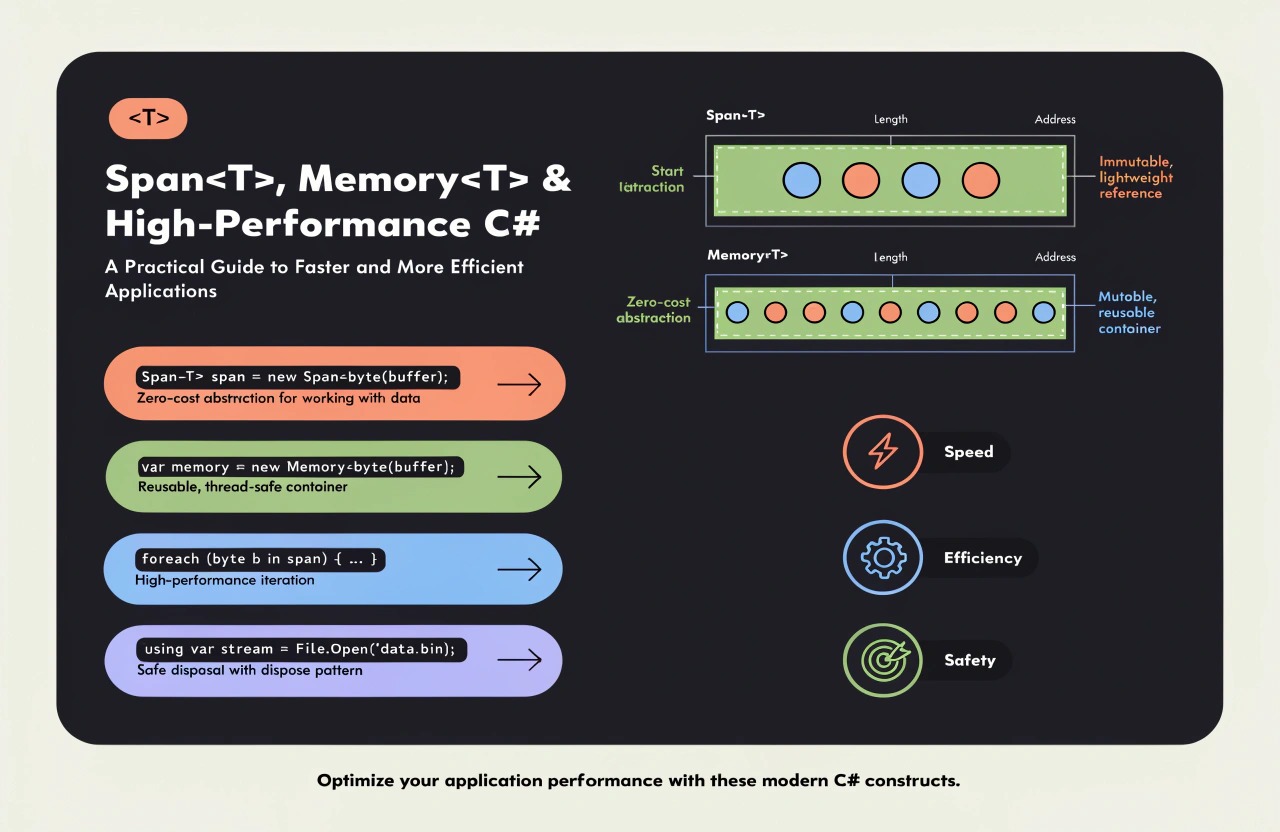
Span<T> is a stack-only type that represents a contiguous region of memory. Instead of creating a new array when developers need a portion of existing data, a span can provide a view over that data.
For example, suppose an application has an array containing thousands of values but only needs to process a specific section. Creating a new array would require copying those values. With Span<T>, developers can create a slice that refers to the original memory.
This approach can significantly reduce unnecessary allocations and improve performance in data-intensive applications.
Span<T> can work with arrays, stack-allocated memory, and other compatible memory sources. It is particularly useful for parsing, serialization, data processing, and performance-critical code.
Understanding Memory<T>
Memory<T> provides similar functionality but is designed for scenarios where the memory reference needs to live beyond the current synchronous method call.
The key difference is that Span<T> is a ref struct, meaning it has restrictions around where it can be stored and used. For example, a Span<T> cannot normally be stored in a class field or used across an await boundary.
Memory<T> does not have these same restrictions. This makes it useful for asynchronous programming, long-lived buffers, and APIs where memory needs to be passed between different components.
For example, an asynchronous file or network operation can receive a Memory<byte> buffer, process it, and continue working with it after asynchronous operations.
Span<T> vs. Memory<T>
Although both types provide access to contiguous memory, they serve different purposes.
Span<T> is generally ideal for short-lived, synchronous operations where maximum performance and simple memory access are required. Memory<T> is better when memory must survive across method boundaries, asynchronous operations, or object lifetimes.
Developers should not automatically replace every array with Span<T> or Memory<T>. Instead, the appropriate type should be selected based on how the data is accessed and how long the memory reference needs to remain valid.
Reducing Allocations with Slicing
One of the biggest advantages of these APIs is slicing.
Suppose a string contains a large amount of text and an application needs to inspect only a small portion. Traditional approaches may create additional strings through methods such as Substring(). Modern APIs using ReadOnlySpan<char> can inspect portions of the original string without creating another string object.
This is especially valuable when processing large volumes of data repeatedly. Fewer temporary objects mean less pressure on the garbage collector and potentially better application responsiveness.
ReadOnlySpan<T>
When data should only be read, ReadOnlySpan<T> is often a better choice than Span<T>. It provides access to a memory region without allowing the referenced elements to be modified through that span.
It is commonly used for parsing text, processing binary data, and creating APIs that should not modify their input.
High-Performance C# Programming
High-performance C# is not simply about using advanced language features. Developers should first identify actual performance bottlenecks using profiling and benchmarking tools.
Important optimization areas include:
- Reducing unnecessary allocations
- Reusing buffers
- Avoiding unnecessary data copying
- Choosing appropriate collection types
- Minimizing excessive string operations
- Optimizing I/O operations
- Reducing unnecessary garbage collection
- Using asynchronous APIs appropriately
- Benchmarking critical code paths
Span<T> and Memory<T> are especially useful when memory copying and allocation are measurable performance problems.
Common Use Cases
These technologies are useful in several areas of software development. Web applications can use them when processing request data, serialization, and networking workloads. Game developers can benefit when processing large asset buffers, binary data, and performance-sensitive game systems.
They are also valuable in file processing, image manipulation, protocol parsing, database-related operations, compression, cryptography, and high-throughput services.
Best Practices
Developers should keep several principles in mind. First, measure performance before optimizing. Second, use Span<T> for short-lived synchronous memory operations and Memory<T> when memory needs to cross asynchronous boundaries.
Third, avoid unnecessary conversions between arrays, strings, spans, and other representations. Finally, make APIs clear and safe rather than optimizing code prematurely.
Conclusion
Span<T> and Memory<T> have become important tools for modern high-performance C# development. They allow developers to work efficiently with contiguous memory while reducing unnecessary copying and allocations.
Understanding when to use Span<T>, ReadOnlySpan<T>, and Memory<T> can help developers build applications that are faster, more scalable, and more memory-efficient. Combined with profiling, benchmarking, thoughtful architecture, and efficient algorithms, these features provide a strong foundation for performance-focused .NET development.