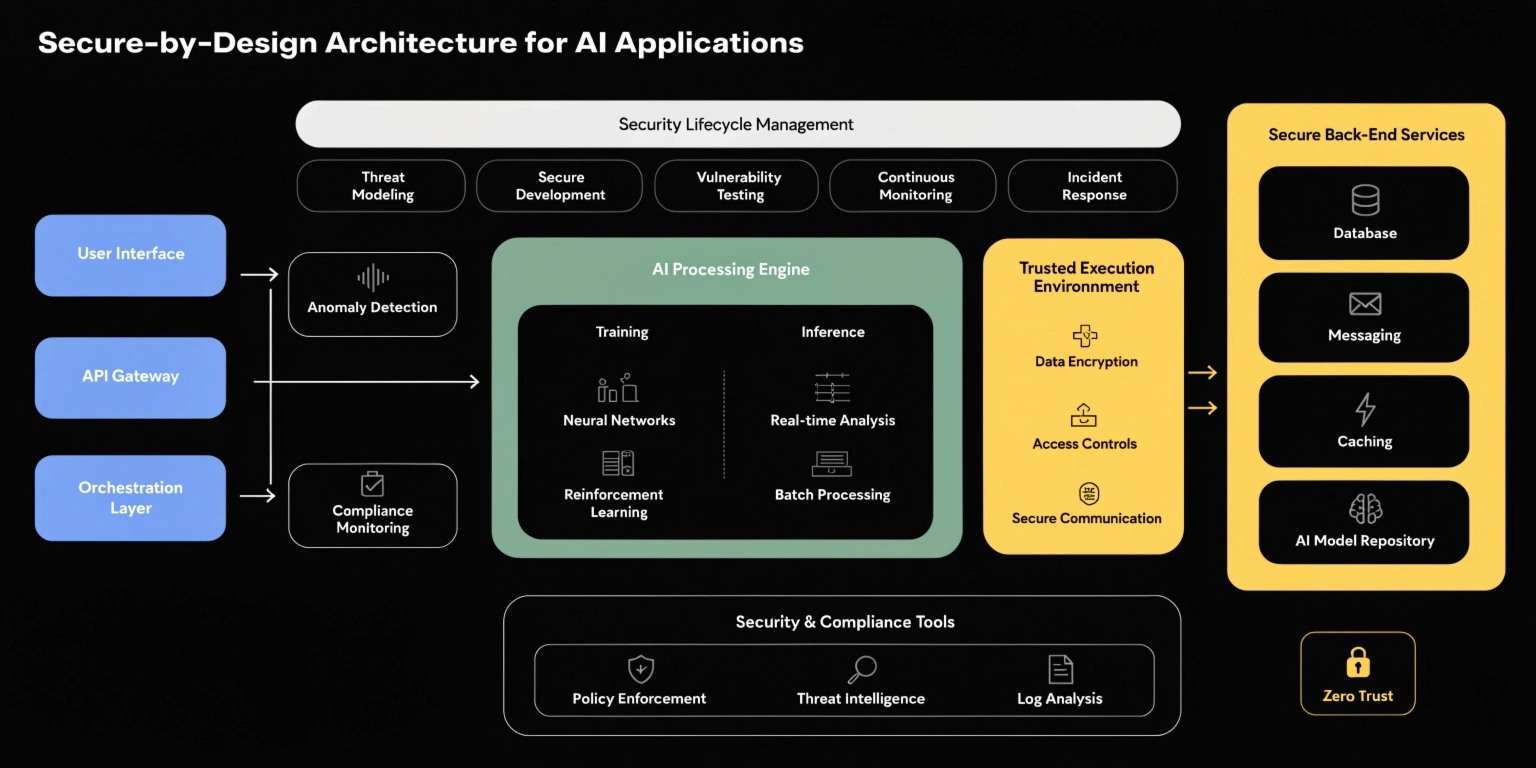
Secure-by-design architecture integrates security, privacy, and governance into every stage of AI application development. By combining zero-trust access, data protection, model security, threat modeling, and continuous monitoring, organizations can build resilient and trustworthy AI systems.
Artificial intelligence is becoming an essential part of modern business applications, powering intelligent assistants, recommendation engines, document analysis, predictive analytics, and automated workflows. However, integrating AI also introduces security challenges involving sensitive data, external models, untrusted prompts, connected tools, and unpredictable outputs.
Traditional application security remains important, but AI systems require additional safeguards because their behavior depends on models, training data, retrieved information, and user inputs.
A secure-by-design architecture addresses these risks from the beginning rather than treating security as a final testing stage. It integrates security controls into architecture decisions, development workflows, deployment processes, and ongoing operations.
1. Start with AI-Specific Threat Modeling
Before developing an AI application, identify its assets, trust boundaries, entry points, and potential attackers.
An AI-powered customer support assistant, for example, may process customer records, retrieve internal documents, call business APIs, and generate responses. Each capability creates potential security risks.
Threat modeling should consider:
- Unauthorized access to sensitive information
- Prompt injection and instruction manipulation
- Data leakage through model outputs
- Compromised third-party models or dependencies
- Abuse of connected tools and APIs
- Model theft, tampering, or service disruption
Map how information flows between users, application services, AI models, databases, retrieval systems, and external providers. Assess the impact and likelihood of each threat, then prioritize controls based on risk.
Repeat this assessment when introducing new models, tools, data sources, or business capabilities.
2. Build a Zero-Trust Security Foundation
Zero-trust architecture assumes that no user, service, or device should receive automatic trust simply because it operates inside a company network.
Every request should be authenticated, authorized, and evaluated according to applicable security policies.
For AI applications, enforce role-based or attribute-based access controls across application interfaces, model gateways, vector databases, and connected enterprise systems.
Use short-lived credentials where practical, multifactor authentication for privileged access, and narrowly scoped service identities.
For example, an AI assistant answering employee questions should retrieve only documents the requesting employee is authorized to view. The model itself should not become a shortcut around existing permission systems.
Apply network segmentation and restrict communication between components to reduce the potential impact of compromised services.
3. Protect Data Throughout Its Lifecycle
AI applications may process personal information, confidential documents, source code, financial records, and proprietary business data. Security controls must cover collection, transmission, processing, storage, and deletion.
Begin with data minimization: collect and send only the information required for a specific task. Mask or redact sensitive values before forwarding prompts to external services whenever appropriate.
Use strong encryption for data in transit and at rest, and manage encryption keys separately with restricted permissions and rotation procedures.
Establish retention policies for prompts, generated responses, embeddings, logs, and backups. Embeddings and vector databases can still expose sensitive information, so they should not automatically be treated as anonymous.
When using external AI providers, verify data retention practices, model-training policies, processing locations, contractual protections, and deletion capabilities.
4. Secure LLMs Against Prompt Injection and Unsafe Outputs
Large language models introduce risks that cannot be eliminated through ordinary input validation alone.
Prompt injection occurs when malicious or misleading instructions in user inputs or retrieved content attempt to influence model behavior. An attacker might try to make an assistant disclose confidential information or misuse a connected tool.
Treat user prompts, uploaded files, retrieved documents, and external content as untrusted data. Separate trusted application instructions from user-controlled content where supported, but do not rely on prompt wording as a security boundary.
Enforce permissions outside the model, validate tool arguments, constrain available actions, and check generated outputs before using them in sensitive workflows.
For high-impact operations, such as transferring funds or modifying important records, require explicit authorization and appropriate human approval.
5. Isolate Models, Tools, and Application Services
AI models should not have unrestricted access to databases, internal networks, or operating-system resources.
Introduce a controlled model gateway or service layer to manage requests, apply security policies, enforce quotas, and record relevant audit events.
For AI agents, provide only the tools necessary for their assigned tasks. Execute code in isolated environments with restricted filesystem, network, and resource permissions.
Use secure API gateways, request validation, rate limiting, and secrets management to protect integrations. Never embed long-lived credentials directly in prompts, source code, or model configuration files.
This layered architecture reduces the chance that a compromised prompt, vulnerable component, or unsafe model response can directly affect critical business systems.
6. Secure the AI Supply Chain and Model Artifacts
AI applications frequently depend on external models, open-source libraries, datasets, plugins, and cloud services. Each dependency can introduce vulnerabilities or unexpected behavior.
Use trusted sources for model artifacts and packages, verify integrity where supported, and maintain an inventory of dependencies and model versions.
Review licenses, security advisories, permissions, and provenance before adopting external components. Scan dependencies regularly and establish a process for updating vulnerable packages.
Protect model files, training datasets, and configuration artifacts against unauthorized modification. Restrict access to model registries and production deployment pipelines.
For fine-tuned models, evaluate whether sensitive training information could be memorized or exposed through model outputs.
7. Apply Continuous Testing and Security Monitoring
Secure-by-design development requires ongoing validation because models, prompts, dependencies, and attacker techniques can change over time.
Include conventional security testing, dependency scanning, API testing, and access-control verification in the development pipeline. Add AI-specific evaluations for prompt injection, sensitive-data disclosure, unsafe tool execution, and unintended behavior.
Monitor unusual request volumes, repeated attempts to access restricted information, suspicious tool calls, and abnormal usage patterns.
Protect audit logs and avoid unnecessarily storing complete prompts containing sensitive data. Establish incident response procedures covering investigation, containment, credential rotation, model rollback, and required notifications.
Security metrics should help teams detect weaknesses and verify that corrective actions are effective.
8. Establish AI Governance and Accountability
Technical controls are most effective when supported by clear ownership and policies.
Assign responsibility for AI security, privacy, model approval, incident management, and risk acceptance. Document system limitations, permitted use cases, data-handling requirements, and escalation procedures.
Assess applicable legal and regulatory requirements before deployment. Requirements vary depending on the jurisdiction, industry, type of data, and intended use of the AI application.
Review the system whenever significant architectural or operational changes occur. Governance should support accountability without preventing teams from developing and improving AI solutions.
Conclusion
Secure-by-design architecture is essential for building AI applications that can be trusted with sensitive information and important business operations. It combines threat modeling, zero-trust access, data protection, controlled model integration, supply-chain security, and continuous testing.
Organizations should enforce security boundaries in application code and infrastructure rather than relying solely on model behavior or prompt instructions.
By embedding these practices throughout the AI lifecycle, businesses can reduce vulnerabilities, strengthen privacy, and build resilient AI applications that scale responsibly as technologies and threats evolve.
We build scalable web, mobile, and game products for clients worldwide — combining modern frameworks, cloud infrastructure, and best engineering practices.
-1.jpg)