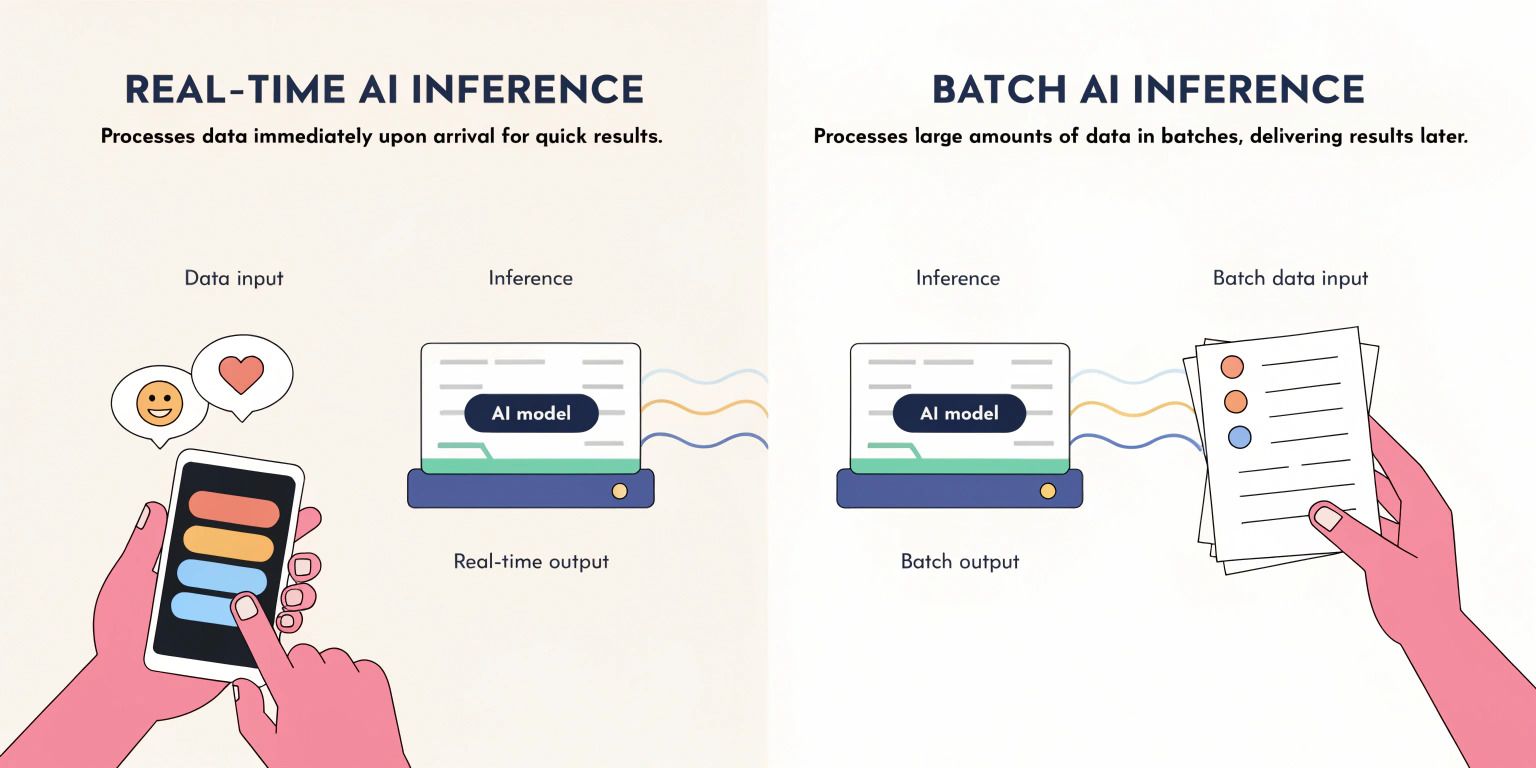
Real-time inference delivers AI predictions within milliseconds or seconds, while batch inference processes large volumes of data at scheduled intervals. Choosing between them depends on latency, throughput, cost, infrastructure, and business requirements.
Artificial intelligence systems do not all need to generate predictions at the same speed. A fraud detection platform may need an answer within milliseconds, while a retailer analyzing millions of customer records may only need predictions once every night.
This difference creates two major approaches to machine learning inference: real-time inference and batch inference.
Choosing the right architecture can have a major impact on application performance, infrastructure costs, scalability, and user experience.
What Is AI Inference?
AI inference is the process of using a trained machine learning model to generate predictions or outputs from new data.
Training typically happens offline using historical datasets. Once a model is trained, inference systems use that model to process new inputs.
For example, a recommendation model may receive information about a customer and predict which products they are most likely to purchase.
The way these predictions are generated depends on whether the application requires immediate results or can process data later.
What Is Real-Time AI Inference?
Real-time inference, also called online inference, processes requests as they arrive and returns predictions immediately or within a defined latency target.
A typical architecture might look like:
User Request → API → Model Server → AI Model → Prediction → Application
For example, when a customer makes an online payment, a fraud detection model can analyze the transaction and return a risk score before the transaction is completed.
Real-time inference is particularly useful when the prediction directly affects an active user interaction or business decision.
Real-Time Inference Use Cases
Common applications include:
- Fraud detection
- Recommendation systems
- Voice assistants
- Chatbots
- Real-time personalization
- Autonomous systems
- Computer vision
- Spam detection
- Dynamic pricing
- Credit risk assessment
- Content moderation
These applications benefit from fast predictions because delays can negatively affect user experience or business operations.
What Is Batch Inference?
Batch inference processes a large collection of records together instead of responding to individual requests immediately.
For example, an e-commerce company might generate product recommendations for millions of customers every night.
The process could look like:
Data Warehouse → Batch Processing → Model Inference → Predictions Database
When customers visit the application the next day, precomputed predictions can be retrieved without running the model again.
Batch inference is particularly useful when predictions do not need to be generated immediately.
Batch Inference Use Cases
Common examples include:
- Customer churn prediction
- Sales forecasting
- Demand forecasting
- Customer segmentation
- Large-scale recommendation generation
- Document classification
- Marketing analytics
- Risk analysis
- Inventory forecasting
- Periodic business reporting
Batch processing can efficiently handle very large datasets and is often more cost-effective when immediate predictions are unnecessary.
Real-Time vs Batch: Latency
The most obvious difference is latency.
Real-time systems prioritize fast responses. Depending on the application, latency targets may range from milliseconds to several seconds.
Batch systems prioritize efficient processing of large amounts of data rather than immediate responses.
If a prediction must influence an action happening right now, real-time inference is usually more appropriate.
If predictions can be generated hourly, daily, or weekly, batch inference may provide a better architecture.
Throughput and Resource Utilization
Batch inference can often achieve high throughput because multiple records can be processed together.
Batching allows hardware resources such as GPUs to process many inputs efficiently.
Real-time inference, however, must handle unpredictable request patterns. Traffic may suddenly increase, requiring additional model-serving instances.
This makes autoscaling, load balancing, caching, and capacity planning important components of real-time AI infrastructure.
Cost Considerations
Real-time inference can be more expensive because infrastructure may need to remain available continuously.
A production model-serving system may require multiple instances for availability, autoscaling, monitoring, and low-latency response.
Batch inference can often use compute resources only during scheduled processing windows.
For organizations processing millions or billions of records, batch inference can significantly reduce infrastructure costs when immediate predictions are not necessary.
Model Serving Architecture
Real-time systems generally require an API or inference service capable of receiving requests and returning predictions.
Common components can include:
API Gateway → Load Balancer → Model Server → GPU/CPU → Prediction
Batch systems generally integrate more closely with data pipelines and storage systems.
A typical batch workflow might include:
Data Lake/Warehouse → Feature Processing → Batch Inference → Prediction Store
The architecture should be designed around the application's business requirements rather than simply choosing the newest infrastructure technology.
Hybrid Inference Systems
Many modern AI applications use both approaches.
For example, an e-commerce platform could use batch inference to generate general product recommendations for millions of customers every morning.
When a customer visits the website, real-time inference can then adjust those recommendations based on the customer's current session.
This creates a hybrid architecture:
Batch Predictions + Real-Time Signals → Final Recommendation
Hybrid systems can provide both scalability and personalization.
How to Choose the Right Approach
Organizations should evaluate several factors before selecting an inference architecture.
Ask:
- How quickly must the prediction be available?
- How many predictions are required?
- How frequently does the underlying data change?
- Can predictions be precomputed?
- What is the infrastructure budget?
- Does the model need GPU acceleration?
- What happens if the inference service becomes unavailable?
- How important is real-time personalization?
- Can predictions tolerate stale data?
- What are the application's scalability requirements?
If the answer requires immediate predictions, real-time inference is generally the better choice.
If the workload involves large datasets and predictions can be delayed, batch inference is often more efficient.
Optimizing AI Inference
Regardless of architecture, inference performance should be measured and optimized.
Developers can consider techniques such as model quantization, batching, caching, optimized runtimes, GPU acceleration, model compression, and efficient feature pipelines.
For real-time systems, latency and availability are especially important.
For batch systems, throughput, compute efficiency, and processing time are usually the primary concerns.
Monitoring Inference Systems
Production inference systems need continuous monitoring.
Important metrics include:
- Inference latency
- Throughput
- Error rate
- GPU utilization
- CPU utilization
- Memory consumption
- Queue length
- Model accuracy
- Prediction distribution
- Data drift
- Infrastructure cost
Monitoring helps teams identify both technical problems and model-quality degradation.
Conclusion
Real-time AI inference and batch inference solve different machine learning deployment problems.
Real-time inference is ideal when applications need immediate predictions, such as fraud detection, personalization, recommendation systems, and interactive AI.
Batch inference is better suited for large-scale workloads where predictions can be generated periodically, such as customer segmentation, forecasting, analytics, and churn prediction.
The best architecture is not always one or the other. Many production AI systems combine batch and real-time inference to achieve a balance between latency, scalability, accuracy, cost, and user experience.
By understanding the workload and business requirements before designing the infrastructure, organizations can build AI inference systems that are both technically efficient and commercially sustainable.
We build scalable web, mobile, and game products for clients worldwide — combining modern frameworks, cloud infrastructure, and best engineering practices.
-1.jpg)