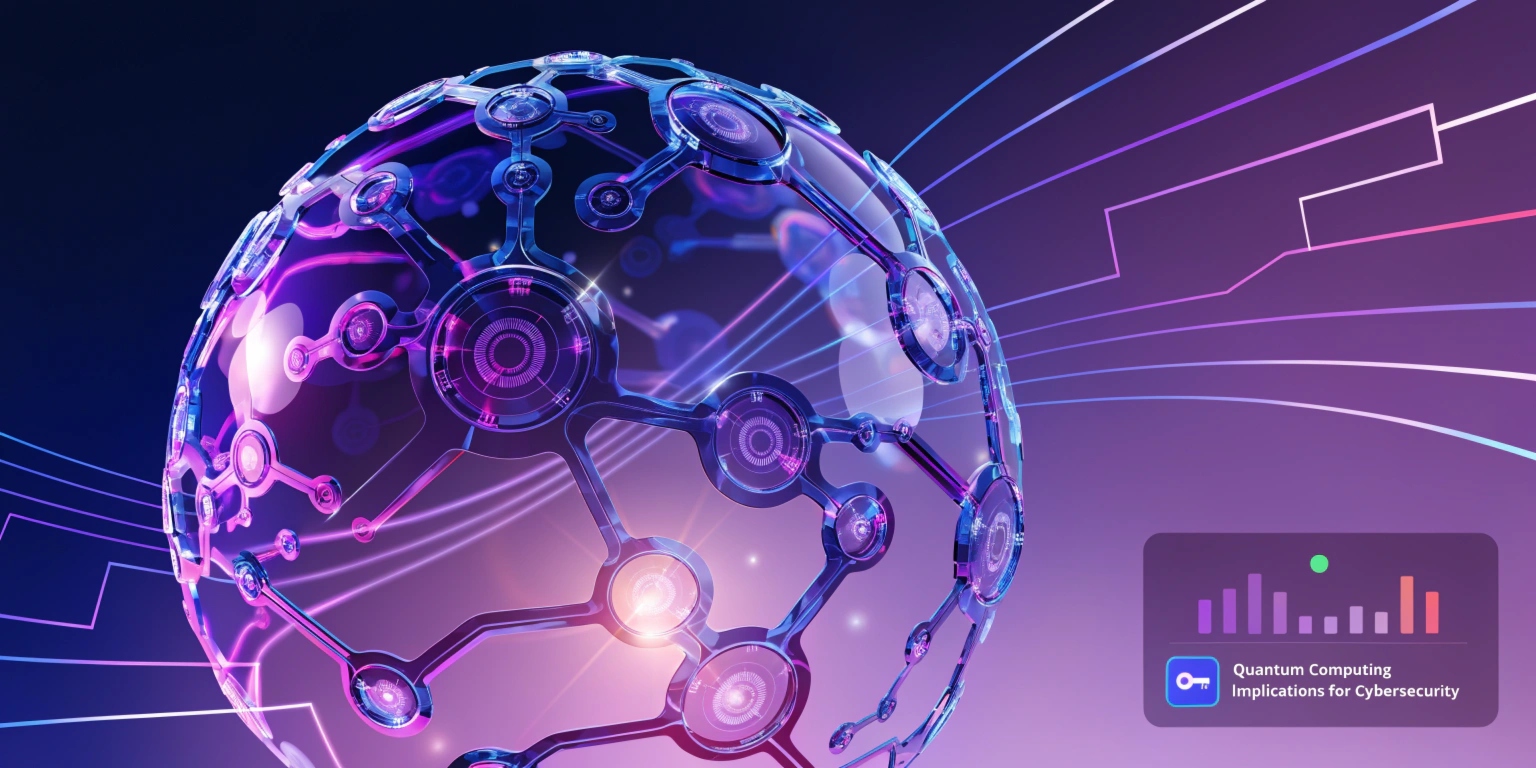
Quantum computing promises revolutionary computational power but also poses challenges for today's encryption methods. Discover its impact on cybersecurity, post-quantum cryptography, and how organizations can prepare for a quantum-secure future.
Cybersecurity has always evolved alongside advances in computing technology. As computers became faster and more powerful, encryption methods also improved to protect sensitive information from unauthorized access. Today, widely used encryption standards secure online banking, e-commerce transactions, government communications, healthcare systems, and cloud services.
However, quantum computing represents a technological leap that could fundamentally change this landscape. Unlike classical computers that process information using bits (0s and 1s), quantum computers use quantum bits, or qubits, enabling them to perform certain calculations exponentially faster. This breakthrough creates exciting opportunities in scientific research and optimization, but it also raises serious concerns about the future of digital security.
Understanding the relationship between quantum computing and cybersecurity is essential for organizations preparing for the next generation of computing.
What Is Quantum Computing?
Quantum computing is a computing paradigm based on the principles of quantum mechanics.
Unlike classical computers, which process information sequentially using binary bits, quantum computers leverage:
- Superposition
- Entanglement
- Quantum interference
These properties allow quantum systems to evaluate many possible solutions simultaneously, making them highly effective for solving specific computational problems that are impractical for classical computers.
Although large-scale fault-tolerant quantum computers are still under development, rapid progress suggests they may eventually become powerful enough to influence many industries, including cybersecurity.
Why Quantum Computing Matters for Cybersecurity
Modern cybersecurity relies heavily on cryptographic algorithms that are considered computationally infeasible for classical computers to break within a practical timeframe.
Common public-key cryptographic systems include:
- RSA
- Elliptic Curve Cryptography (ECC)
- Diffie-Hellman Key Exchange
Their security depends on mathematical problems such as integer factorization and discrete logarithms, which are extremely difficult for traditional computers.
A sufficiently powerful quantum computer, however, could solve these problems much more efficiently using specialized quantum algorithms.
This potential shift makes quantum computing both a challenge and an opportunity for cybersecurity.
Quantum Algorithms That Affect Security
Shor's Algorithm
One of the most significant developments in quantum computing is Shor's algorithm.
It can efficiently solve:
- Integer factorization
- Discrete logarithm problems
Since RSA and ECC rely on these mathematical foundations, a large-scale quantum computer running Shor's algorithm could compromise many existing public-key encryption systems.
Grover's Algorithm
Grover's algorithm speeds up brute-force searches.
Although it does not completely break symmetric encryption, it reduces the effective security level.
For example:
- AES-128 would offer security roughly comparable to 64-bit protection against a quantum attacker.
- AES-256 remains considerably more resistant because of its larger key size.
These algorithms highlight why organizations are evaluating quantum-resistant security strategies.
Risks of the Quantum Era
Breaking Current Encryption
If quantum computers mature sufficiently, encrypted communications protected by RSA or ECC could become vulnerable.
Harvest Now, Decrypt Later
One emerging concern is that attackers may collect encrypted information today and store it until quantum computers become capable of decrypting it in the future.
This poses risks for sensitive data with long confidentiality requirements, including:
- Government records
- Healthcare information
- Financial transactions
- Intellectual property
- Legal documents
Digital Identity Challenges
Digital certificates, authentication systems, and secure communication protocols also depend on public-key cryptography, making them potential targets in a post-quantum world.
Post-Quantum Cryptography
To address future quantum threats, researchers are developing Post-Quantum Cryptography (PQC).
PQC refers to cryptographic algorithms designed to remain secure against both classical and quantum computers.
Unlike quantum-based security systems, PQC can often be implemented using existing hardware and software infrastructure.
Promising approaches include:
- Lattice-based cryptography
- Hash-based signatures
- Code-based cryptography
- Multivariate cryptography
Governments, standards organizations, and technology companies are actively working toward adopting these algorithms.
Quantum Key Distribution (QKD)
Another promising technology is Quantum Key Distribution.
QKD uses quantum mechanics to exchange encryption keys securely.
One unique advantage is that any attempt to intercept or measure the quantum transmission alters its state, allowing communicating parties to detect eavesdropping.
Potential applications include:
- Government communications
- Military networks
- Financial institutions
- Critical infrastructure
Although QKD offers exceptional theoretical security, deployment remains expensive and technically challenging.
Industries Most Affected
Quantum computing will influence many sectors that depend on strong cybersecurity.
Financial Services
Banks and payment providers must protect transactions, customer identities, and confidential financial data.
Healthcare
Medical organizations store highly sensitive patient records requiring long-term confidentiality.
Government
National security agencies depend on secure communications and classified information.
Cloud Computing
Cloud providers will need to update infrastructure to support quantum-resistant encryption.
E-commerce
Online businesses must safeguard payment systems and customer information against evolving threats.
Preparing for a Quantum-Secure Future
Organizations can begin preparing today by:
- Identifying cryptographic assets across their systems
- Evaluating dependencies on RSA and ECC
- Monitoring post-quantum cryptography standards
- Planning phased migration strategies
- Implementing cryptographic agility so algorithms can be updated more easily
- Training security teams on quantum-related developments
Early preparation reduces future migration complexity.
Challenges of Transitioning
Migrating to quantum-resistant security involves several challenges:
- Updating legacy systems
- Ensuring compatibility across platforms
- Performance considerations
- Regulatory compliance
- Large-scale deployment costs
Organizations will need careful planning to maintain both security and operational continuity during the transition.
Future Trends
The coming years are expected to bring significant advances in quantum security, including:
- Wider adoption of post-quantum cryptography
- Hybrid encryption combining classical and quantum-resistant methods
- Improved quantum hardware
- Quantum-secure communication networks
- AI-assisted cryptographic analysis
- Increased regulatory guidance for quantum readiness
Businesses that begin adapting early will be better positioned as quantum technologies mature.
Conclusion
Quantum computing has the potential to redefine cybersecurity. While it promises breakthroughs in science, optimization, and computing, it also challenges many of the cryptographic systems that protect today's digital world. Public-key algorithms such as RSA and ECC may eventually become vulnerable to sufficiently advanced quantum computers, making preparation essential.
The emergence of post-quantum cryptography, quantum key distribution, and quantum-safe security strategies demonstrates that the cybersecurity industry is already adapting. Organizations that assess their current cryptographic infrastructure, embrace cryptographic agility, and monitor evolving standards will be better equipped to safeguard sensitive data in the quantum era. Preparing today is the best way to ensure resilience against tomorrow's technological advancements.
We build scalable web, mobile, and game products for clients worldwide — combining modern frameworks, cloud infrastructure, and best engineering practices.
-1.jpg)