Main Content
Software development is becoming faster, more complex, and increasingly dependent on continuous delivery. Modern applications involve cloud infrastructure, APIs, mobile platforms, microservices, AI features, third-party integrations, and rapidly changing user interfaces. Traditional manual testing and rule-based automation alone can struggle to keep pace with this complexity.
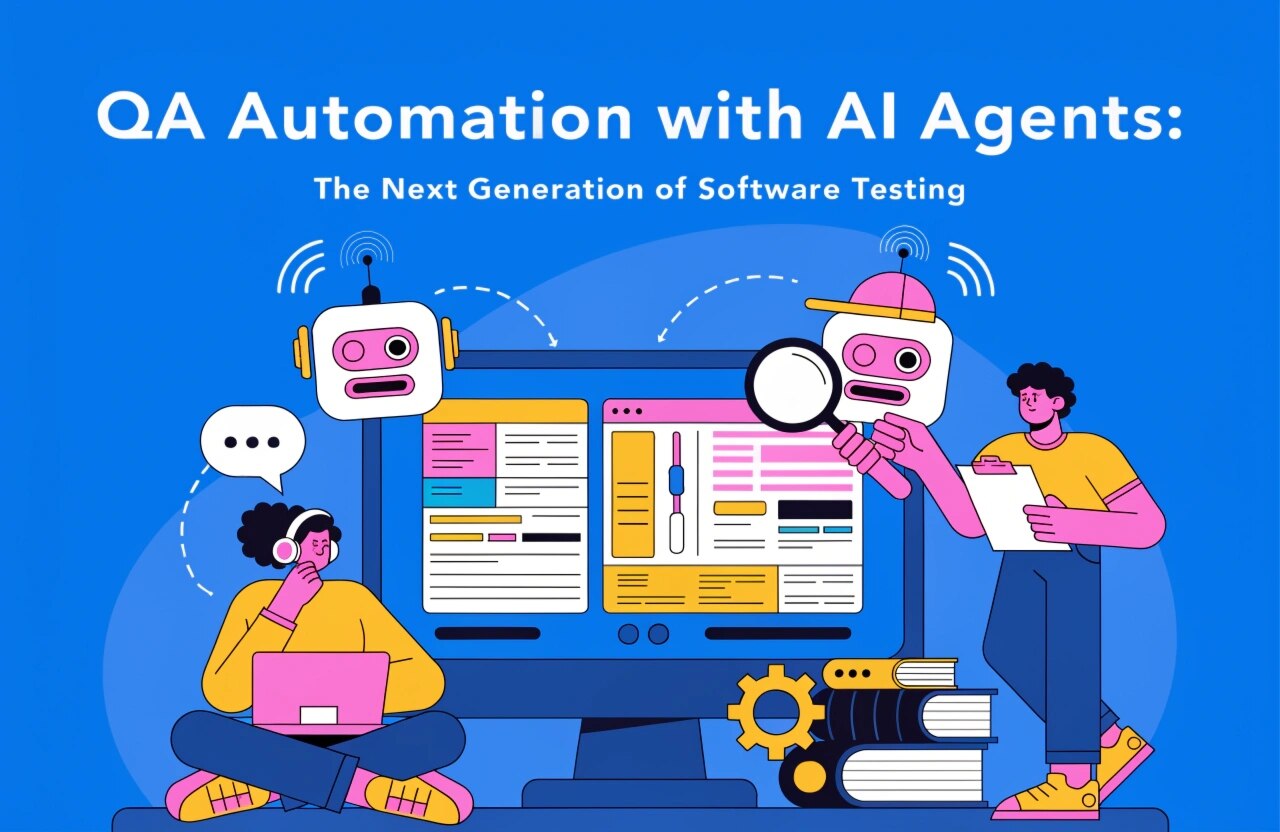
This is where AI agents are emerging as the next generation of QA automation.
AI-powered QA agents can analyze application behavior, understand requirements, generate test cases, execute tests, identify anomalies, and learn from previous testing results. Instead of simply following predefined scripts, intelligent testing agents can make decisions based on application context and test outcomes.
What Are AI Agents in QA Automation?
An AI agent is a software system capable of observing an environment, reasoning about a task, taking actions, and responding to results. In software testing, an AI agent can be designed to perform multiple stages of the QA lifecycle.
For example, an AI testing agent may receive a requirement such as:
“Users should be able to register using their email address and verify their account.”
The agent can analyze the requirement and generate scenarios covering successful registration, invalid email formats, duplicate accounts, missing fields, incorrect verification codes, expired links, and security-related conditions.
It can then execute those scenarios, analyze the results, and report potential defects.
Intelligent Test Case Generation
One of the most valuable applications of AI in QA automation is automated test generation.
Traditional automation requires QA engineers to manually identify scenarios and create test scripts. AI can analyze requirements, user stories, application workflows, API documentation, and previous defects to suggest relevant test cases.
AI-generated testing can cover:
- Functional test scenarios
- Negative test cases
- Regression scenarios
- API testing
- UI workflows
- Boundary conditions
- Data validation
- Cross-browser scenarios
- Mobile application flows
This allows QA professionals to spend less time creating repetitive test cases and more time focusing on complex quality problems.
Self-Healing Test Automation
Automated tests frequently fail because an application's UI or technical structure changes. A button ID, CSS selector, API response, or page structure may change even though the application's functionality remains correct.
Traditional automation scripts may fail immediately.
AI-powered automation introduces the concept of self-healing tests. AI can analyze the changed application structure and identify alternative elements or workflows that correspond to the original test objective.
For example, if a login button changes from one identifier to another, an AI agent can recognize that the button still represents the login action and adjust the automation accordingly.
This can significantly reduce test maintenance and unnecessary automation failures.
Autonomous Test Execution
AI agents can also move beyond test generation and participate in autonomous test execution.
An intelligent QA agent can:
- Understand the testing objective.
- Select relevant test scenarios.
- Execute automated tests.
- Monitor application behavior.
- Analyze failures.
- Gather logs and evidence.
- Identify potential root causes.
- Generate a testing report.
This creates a more dynamic QA workflow where testing becomes an intelligent process rather than a collection of fixed scripts.
AI-Powered Defect Detection
Finding defects is another important area where AI can support QA teams.
AI systems can analyze large volumes of test results, application logs, performance metrics, screenshots, and error messages. By recognizing patterns, AI can identify unusual behavior that may not be immediately obvious to human testers.
For example, an AI system might identify that a particular API fails intermittently after a specific sequence of operations. Instead of simply reporting a failed test, the system could correlate the failure with logs and previous incidents to help developers investigate the underlying problem.
Predictive Quality Assurance
AI can also make QA more proactive through predictive analysis.
By analyzing historical defects, code changes, test results, deployment information, and application behavior, AI models can identify areas that may have a higher probability of failure.
Development teams can then prioritize testing around high-risk components.
This approach supports a shift from:
“Test everything after development.”
to:
“Predict risk and test intelligently throughout development.”
AI Agents and Continuous Testing
Modern DevOps and CI/CD environments require testing to happen continuously.
AI agents can integrate with automated development pipelines to monitor builds, execute appropriate test suites, analyze failures, and provide quality insights.
For example, when a developer submits a code change, an AI-powered QA system could determine which regression tests are most relevant instead of executing every test unnecessarily.
This can help reduce testing time while maintaining meaningful coverage.
Human QA Engineers Still Matter
AI agents do not eliminate the need for QA professionals. Instead, they can change the role of QA engineers.
Human testers remain essential for exploratory testing, usability evaluation, business validation, security thinking, ethical considerations, and understanding real-world user behavior.
The future of QA is therefore more likely to be human + AI collaboration rather than AI replacing QA teams.
QA engineers can focus on strategy and complex quality challenges while AI handles repetitive testing activities and large-scale analysis.
Challenges of AI-Powered QA
Despite its potential, AI-based QA automation also introduces challenges.
AI-generated tests may contain incorrect assumptions. AI systems can produce false positives or miss important business-specific scenarios. Organizations must also consider data privacy, security, explainability, model reliability, and integration with existing automation frameworks.
Strong governance and human validation are therefore important when introducing AI into QA processes.
The Future of QA Automation
AI agents are moving software testing toward a more autonomous and intelligent model. Future QA platforms are likely to combine test generation, execution, defect analysis, predictive quality, self-healing automation, and continuous monitoring within unified workflows.
For organizations developing complex web, mobile, cloud, and enterprise applications, AI-powered QA can become an important competitive advantage.
The goal is not simply to automate more tests. The real objective is to create smarter testing systems that understand application behavior, adapt to change, identify risks, and help teams deliver higher-quality software faster.
As AI agents continue to evolve, QA automation will increasingly become an intelligent engineering discipline where automation handles repetitive execution while human experts focus on strategy, creativity, and overall product quality.