Main Content
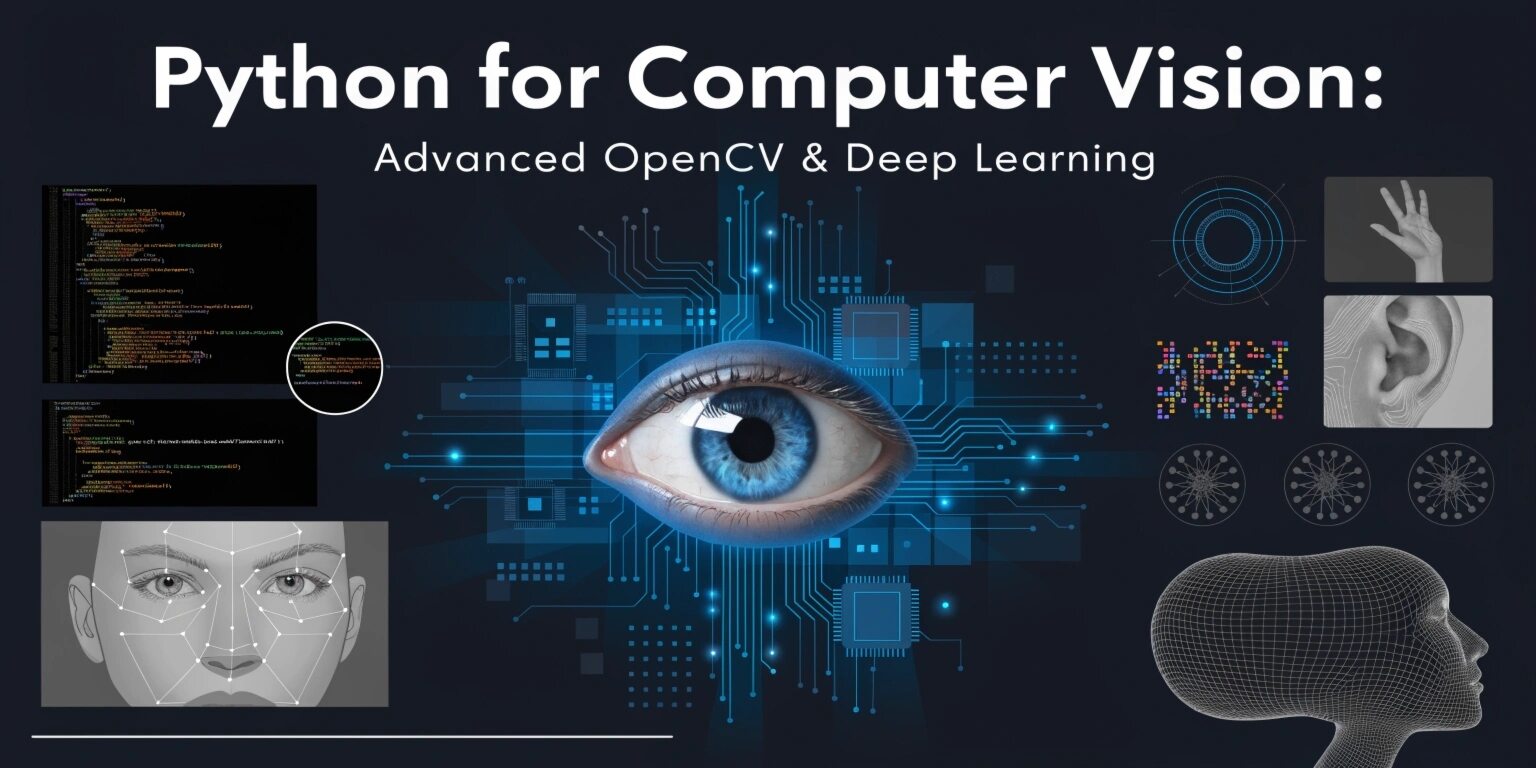
Computer vision has become one of the most important applications of artificial intelligence, enabling machines to understand and analyze images and videos. From autonomous systems and security cameras to healthcare, manufacturing, retail, and augmented reality, computer vision is transforming how organizations use visual data. Python has emerged as a leading programming language for computer vision because of its simple syntax, extensive libraries, and powerful AI ecosystem.
Among the most widely used technologies in this field are OpenCV and deep learning frameworks such as TensorFlow and PyTorch. Combining these technologies allows developers to create sophisticated vision systems capable of detecting objects, recognizing faces, classifying images, analyzing video streams, and automating visual inspection.
Understanding OpenCV in Computer Vision
OpenCV, or Open Source Computer Vision Library, is a powerful library designed for image and video processing. With Python bindings, developers can perform complex computer vision operations with relatively little code.
Basic OpenCV capabilities include image loading, resizing, cropping, color conversion, filtering, edge detection, contour detection, and image transformation. Advanced applications can use these capabilities as preprocessing steps before passing visual data to machine learning or deep learning models.
For example, an image can be converted from RGB to grayscale, noise can be reduced using filters, and edges can be detected before extracting important visual information. These preprocessing techniques can significantly improve the quality of downstream computer vision tasks.
Advanced Image Processing
Advanced computer vision applications often require more than basic image manipulation. Developers may use morphological operations, histogram processing, perspective transformations, thresholding, feature extraction, and background subtraction.
Image segmentation is another important technique. It divides an image into meaningful regions, helping systems distinguish objects or areas from their surroundings. This is particularly useful in medical imaging, industrial inspection, agriculture, and autonomous systems.
OpenCV can also process video frames in real time. Developers can capture frames from webcams, cameras, or video files and apply computer vision algorithms continuously.
Deep Learning for Computer Vision
Traditional computer vision techniques depend heavily on manually designed features. Deep learning has changed this approach by allowing neural networks to automatically learn useful representations from visual data.
Convolutional Neural Networks, commonly known as CNNs, are especially effective for image-related tasks. CNNs learn patterns such as edges, textures, shapes, and increasingly complex visual structures as information moves through multiple network layers.
Modern deep learning models can perform image classification, object detection, image segmentation, pose estimation, and facial recognition.
Frameworks such as TensorFlow and PyTorch make it easier for Python developers to train, evaluate, and deploy these models.
Object Detection and Recognition
Object detection goes beyond determining what is present in an image. It also identifies where objects are located.
Modern object detection architectures can identify multiple objects in a single image and return bounding boxes with confidence scores. This makes them useful for applications such as traffic monitoring, security systems, inventory management, manufacturing, and smart surveillance.
A Python-based system can combine OpenCV for camera input and image preprocessing with a deep learning model for object detection. The detected results can then be displayed, stored, analyzed, or used to trigger automated actions.
Transfer Learning
Training a deep learning model from scratch can require significant amounts of data, computing power, and development time. Transfer learning provides a more efficient alternative.
With transfer learning, developers start with a model that has already learned useful visual features from a large dataset. The model can then be fine-tuned using a smaller dataset for a specific business problem.
This approach can be highly valuable when developing specialized computer vision applications where collecting thousands or millions of labeled images is difficult.
Real-Time Computer Vision
Real-time processing is an important requirement for many modern vision applications. Python and OpenCV can capture frames continuously from cameras while deep learning models analyze those frames.
Performance optimization becomes important as model complexity increases. Developers may use techniques such as image resizing, batch processing, hardware acceleration, optimized inference engines, and efficient model architectures.
Applications include real-time facial detection, vehicle tracking, workplace monitoring, retail analytics, and interactive AI systems.
Building Production-Ready Vision Applications
Moving a computer vision project from a prototype to production requires more than selecting an accurate model. Developers must consider scalability, latency, security, monitoring, data management, and deployment infrastructure.
Computer vision systems may be deployed on cloud servers, edge devices, mobile platforms, or dedicated GPU environments. Edge processing can reduce latency and minimize the amount of sensitive visual information transmitted to remote servers.
Developers should also monitor model performance over time because real-world data can change. Lighting conditions, camera angles, environments, and user behavior may affect prediction accuracy.
Future of Python-Based Computer Vision
The combination of Python, OpenCV, and deep learning continues to create new opportunities for intelligent automation. Advances in vision transformers, multimodal AI, generative AI, edge computing, and efficient neural networks are expanding what computer vision systems can accomplish.
Businesses can use these technologies to automate repetitive visual tasks, improve quality control, enhance security, understand customer behavior, and build smarter digital products.
Python remains an excellent choice because it provides access to a broad ecosystem of computer vision, machine learning, and deep learning libraries. By combining OpenCV's powerful image-processing capabilities with modern deep learning models, developers can build computer vision solutions that are accurate, scalable, and capable of solving complex real-world problems.
For organizations exploring AI-powered applications, mastering Python computer vision is therefore an important step toward developing the next generation of intelligent software systems.