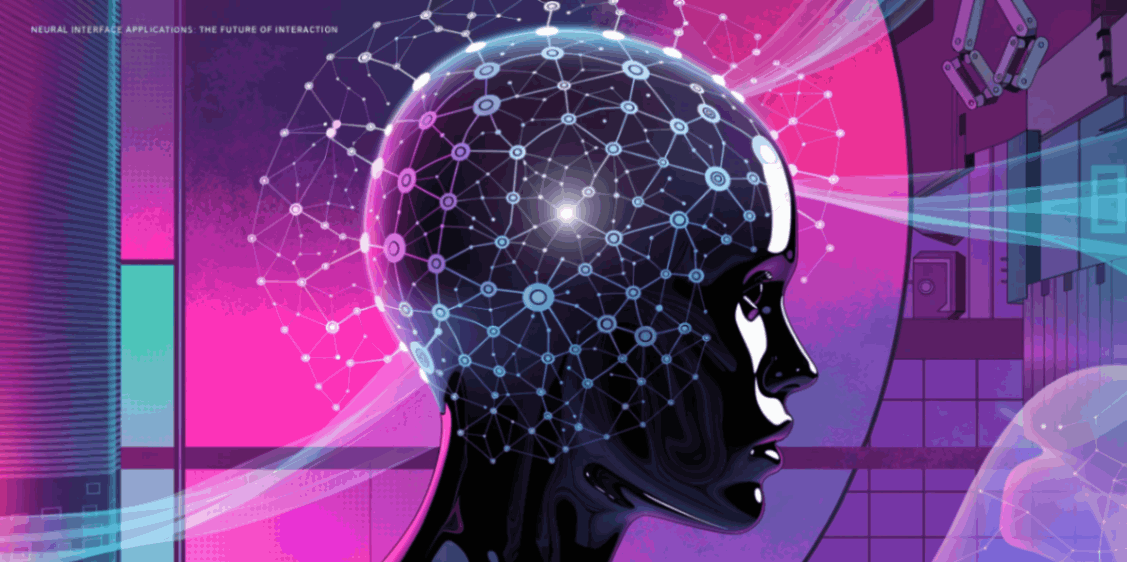
Neural interface applications connect human neural activity with digital systems, creating new possibilities for hands-free computing, accessibility, healthcare, gaming, robotics, and immersive experiences. AI-powered signal processing could make future interfaces more adaptive, natural, and personalized.
Human-computer interaction has evolved from keyboards and command-line interfaces to graphical interfaces, touchscreens, voice assistants, gestures, and immersive technologies. The next major transformation could involve interacting with computers through signals generated by the human nervous system.
Neural interface applications are designed to interpret neural activity and translate it into commands that software and digital devices can understand. When combined with artificial intelligence, machine learning, signal processing, and wearable or implanted sensors, these technologies could create new forms of communication between humans and machines.
Although neural interfaces are still developing, their potential applications extend across healthcare, accessibility, gaming, robotics, education, communication, and consumer technology.
What Are Neural Interface Applications?
A neural interface establishes a communication pathway between biological neural activity and an external system.
A Brain-Computer Interface (BCI) is one example. It attempts to interpret brain activity and convert specific patterns into digital commands.
A simplified workflow looks like:
Neural Activity → Signal Acquisition → Signal Processing → AI Interpretation → Digital Action
Sensors collect signals, algorithms remove noise and identify meaningful patterns, and software translates those patterns into an intended action.
The resulting action could involve controlling a cursor, selecting an option, moving a robotic device, generating text, or interacting with a virtual environment.
How Neural Interfaces Work
Developing a neural interface requires several technological layers.
Signal Acquisition
The first stage involves capturing biological signals.
Depending on the application, systems may use different sensing technologies, ranging from external sensors to more specialized systems.
The quality of the captured signal has a major influence on application accuracy.
Signal Processing
Raw neural signals can contain noise and interference.
Signal-processing algorithms can filter unwanted information and identify useful characteristics within the data.
This stage is essential because the application needs reliable signals before machine-learning models can interpret them.
Machine Learning
Machine learning can identify relationships between neural patterns and intended actions.
A model may be trained to distinguish patterns associated with different commands.
For example, a system could learn patterns associated with intended left or right cursor movement.
Application Layer
Once a neural signal has been interpreted, software converts the result into an action.
Applications may control:
- Computers
- Mobile devices
- Robotic systems
- Prosthetics
- Wheelchairs
- Virtual environments
- Communication tools
Accessibility and Assistive Technology
Accessibility is one of the most promising areas for neural interfaces.
People with severe motor impairments may have difficulty operating traditional input devices.
Neural interfaces could provide alternative interaction mechanisms for:
- Communication
- Cursor control
- Text entry
- Environmental control
- Assistive robotics
- Digital navigation
Instead of relying entirely on physical movement, users could potentially control certain systems through interpreted neural activity.
This could create new opportunities for people who cannot easily use keyboards, mice, touchscreens, or conventional controllers.
Healthcare Applications
Neural interface technology also has significant potential in healthcare and rehabilitation.
Possible applications include:
- Neuroprosthetics
- Rehabilitation systems
- Assistive communication
- Motor recovery research
- Neural monitoring
- Brain-controlled devices
For healthcare applications, development requirements are substantially higher than for ordinary consumer applications.
Safety, accuracy, reliability, clinical validation, and regulatory compliance must be considered throughout the development lifecycle.
Neural Interfaces in Gaming
Gaming is another area where neural interaction could create new experiences.
Traditional games depend on controllers, keyboards, touchscreens, motion tracking, and other input systems.
Neural interfaces could introduce additional interaction mechanisms.
Potential applications include:
- Hands-free controls
- Accessibility-focused gaming
- Adaptive gameplay
- Immersive environments
- Brain-controlled game mechanics
- Personalized experiences
For example, a game could potentially adapt certain elements based on detected patterns associated with player attention or engagement.
However, developers would need to ensure that such systems remain reliable and comfortable for players.
Virtual and Augmented Reality
Virtual Reality and Augmented Reality could also benefit from neural interfaces.
Modern immersive systems already use technologies such as:
- Eye tracking
- Hand tracking
- Motion tracking
- Voice commands
- Controllers
Neural interaction could become an additional input layer.
A future immersive system might combine gaze, gestures, voice, movement, and neural signals to create a multimodal interface.
This could reduce the need for physical controllers in certain experiences.
Artificial Intelligence and Neural Interfaces
AI is likely to play a central role in making neural interfaces practical.
Neural signals are complex and can vary between individuals. Machine-learning models can analyze these patterns and adapt to individual users.
AI can potentially improve:
- Signal classification
- Noise reduction
- Intent prediction
- Personalization
- Adaptive interfaces
- Real-time interpretation
Over time, systems may learn an individual's patterns and improve their accuracy through continued interaction.
This could make neural interfaces more personalized than traditional input systems.
Challenges in Neural Interface Development
Despite their potential, neural interfaces face considerable technical challenges.
Signal Quality
Neural signals can be weak and susceptible to noise.
Poor signal quality can reduce system accuracy.
Calibration
Different users can produce different signal patterns. Systems may therefore require individual calibration and training.
Latency
Interactive applications require fast responses. Delays between user intention and system response can negatively affect usability.
Reliability
The system must operate consistently despite changes in signal quality and user behavior.
Hardware
Sensors must balance accuracy, comfort, portability, durability, and usability.
These challenges make neural-interface development a multidisciplinary field.
Privacy and Data Security
Neural interfaces create unique privacy considerations.
Traditional applications may collect information such as browsing behavior, location, and purchasing activity. Neural systems can potentially process biological signals that users may consider significantly more sensitive.
Developers should carefully consider:
- Data ownership
- Data storage
- Data processing
- Consent
- Access control
- Data sharing
- Retention policies
Strong encryption and authentication should be incorporated into the architecture.
Organizations must also clearly communicate how neural data is collected and used.
Ethical Considerations
Neural technology raises important ethical questions.
Developers and organizations need to consider:
- User autonomy
- Informed consent
- Accessibility
- Data ownership
- Potential discrimination
- Psychological effects
- Responsible commercialization
As neural interfaces become more capable, maintaining user control over the technology will become increasingly important.
Designing Neural Interface Applications
Successful neural applications require collaboration between multiple disciplines.
Development teams may need expertise in:
- Neuroscience
- Signal processing
- Machine learning
- Software engineering
- Human-computer interaction
- Embedded systems
- Cybersecurity
- Data privacy
User experience should also remain a priority.
Users need clear feedback that communicates whether their intended action has been correctly recognized.
Future Possibilities
As neural sensing and AI technologies improve, neural interfaces could become more capable and accessible.
Potential future applications include:
- Advanced assistive communication
- Brain-controlled robotics
- Personalized computing
- Adaptive educational systems
- Immersive entertainment
- Smart-device control
- Advanced prosthetics
- Multimodal interfaces
Rather than replacing traditional interfaces immediately, neural systems will likely complement keyboards, touch, voice, eye tracking, and gesture-based interaction.
Conclusion
Neural interface applications represent an emerging frontier in human-computer interaction. By combining neural sensing, signal processing, artificial intelligence, and software development, these systems can potentially enable new ways for people to communicate with and control digital technologies.
Healthcare and accessibility may remain important areas of development, while gaming, robotics, VR, AR, and consumer technology could introduce neural interaction to broader audiences.
However, technical reliability, privacy, cybersecurity, ethics, and user control must remain central to development.
The future of interaction may not involve one technology replacing another. Instead, humans may interact with digital systems through multiple complementary channels—including voice, vision, movement, touch, and eventually neural signals. As the technology matures, neural interfaces could become an important part of increasingly natural and adaptive computing experiences.
We build scalable web, mobile, and game products for clients worldwide — combining modern frameworks, cloud infrastructure, and best engineering practices.
-1.jpg)