actors manipulate neural-interface systems?
Developers must consider privacy and security from the beginning.
Ethical Considerations
Neural technology also introduces broader ethical questions.
Developers and organizations must consider:
- Informed consent
- Data ownership
- Accessibility
- Potential discrimination
- Psychological effects
- User autonomy
- Responsible commercialization
Technology that interacts directly with human neural signals requires particularly strong ethical safeguards.
Designing Neural Interface Applications
Developers working on neural applications will need expertise across multiple disciplines.
Important areas include:
- Signal processing
- Machine learning
- Software engineering
- Human-computer interaction
- Neuroscience
- Cybersecurity
- Data privacy
- Embedded systems
Applications should also prioritize clear feedback so users understand how the system interprets their intentions.
Future Possibilities
As neural sensing and AI technologies improve, neural interfaces could become more practical and accessible.
Potential future applications include:
- Advanced assistive communication
- Brain-controlled robotics
- Personalized computing
- Adaptive learning environments
- Immersive entertainment
- Smart-device control
- Advanced prosthetics
- Multimodal human-computer interfaces
Rather than completely replacing existing interfaces, neural interaction may initially complement keyboards, touchscreens, voice, gesture, and eye tracking.
Conclusion
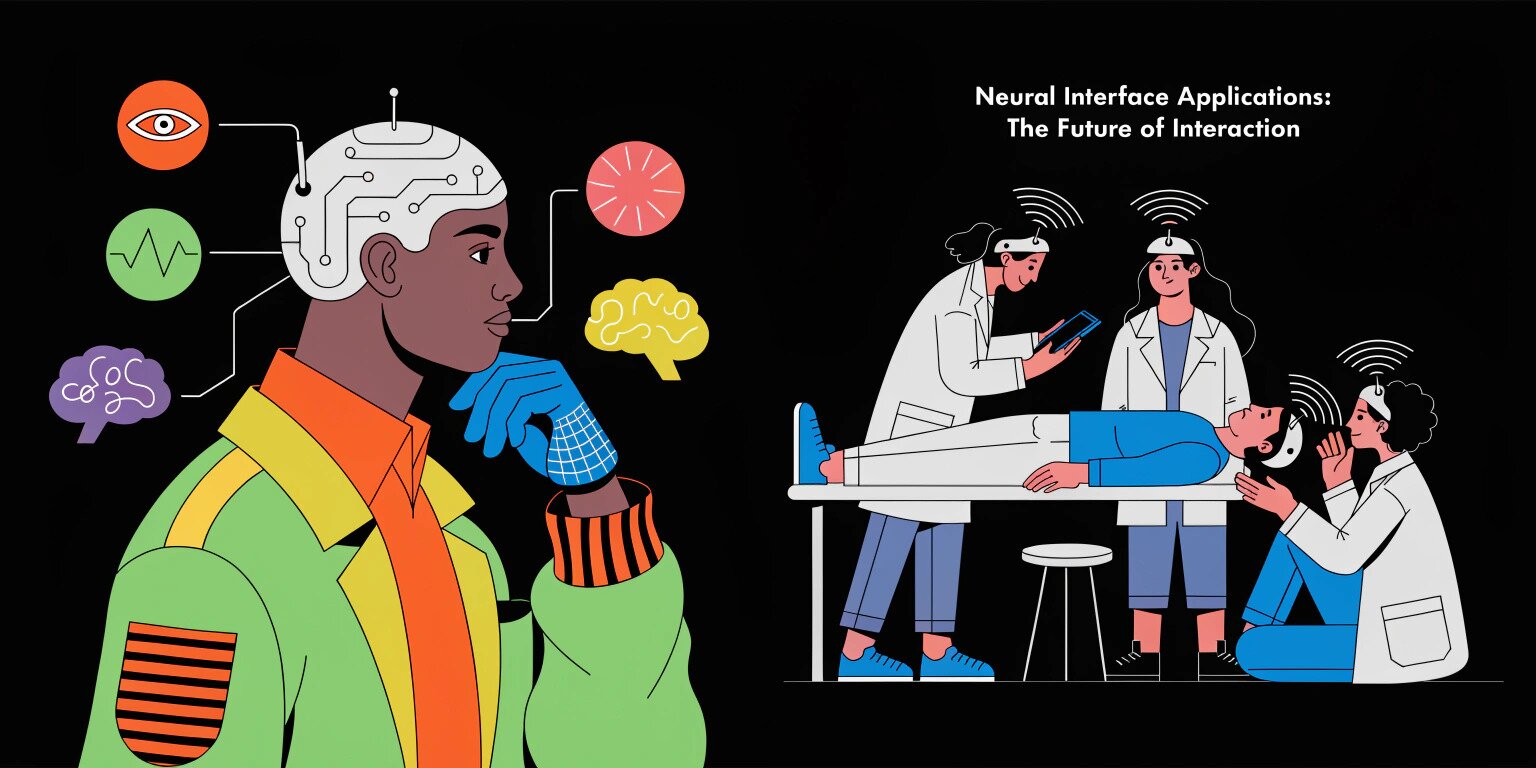
Neural interface applications represent an emerging frontier in human-computer interaction. By combining neural sensing, signal processing, artificial intelligence, and software engineering, these systems can create new ways for people to communicate with digital devices.
The technology has promising applications in accessibility, healthcare, gaming, robotics, and immersive computing. However, significant challenges remain around signal quality, reliability, latency, privacy, security, ethics, and accessibility.
The future of interaction may not depend on choosing between keyboards, touchscreens, voice, or neural signals. Instead, the most powerful systems may combine multiple input methods to understand users more naturally. As research and technology continue to advance, neural interfaces could become an important component of the next generation of human-centered computing.