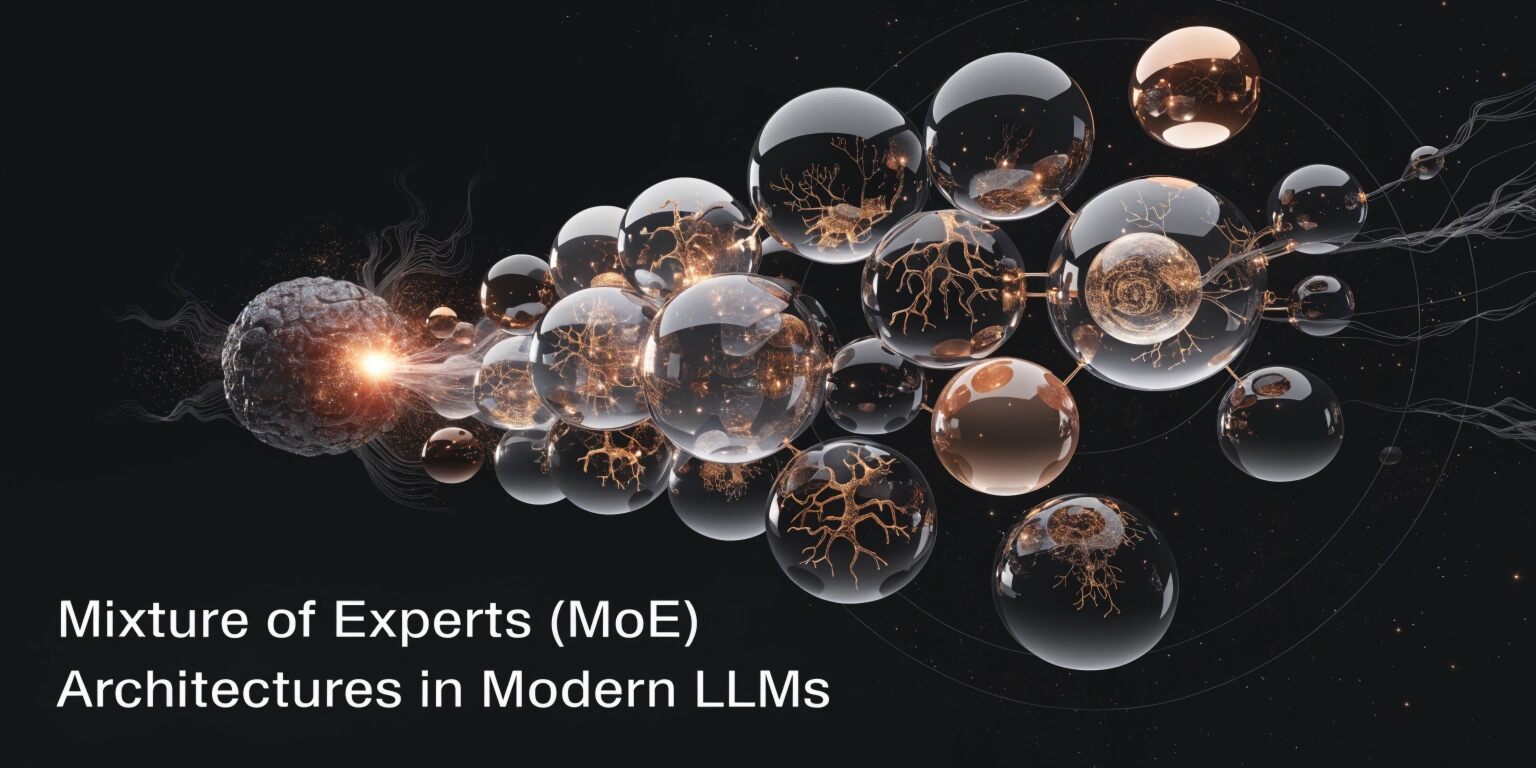
Mixture of Experts (MoE) architectures enable LLMs to scale efficiently by activating only relevant parts of the model. This reduces computational cost while improving performance, making MoE a key innovation in modern AI systems.
As large language models (LLMs) continue to grow in size and capability, one of the biggest challenges faced by researchers and engineers is scalability. Traditional dense models require all parameters to be activated during inference, leading to massive computational costs. To address this, Mixture of Experts (MoE) architectures have emerged as a powerful solution.
MoE allows models to scale to billions or even trillions of parameters while keeping computation efficient. This architecture is now a foundational component in many modern AI systems.
What is Mixture of Experts (MoE)?
Mixture of Experts is a neural network architecture where multiple sub-models, known as “experts,” are trained to specialize in different aspects of the data. Instead of using the entire model for every input, only a subset of experts is activated.
A gating mechanism determines which experts should process a given input. This selective activation is what makes MoE efficient and scalable.
How MoE Works
1. Experts
Experts are independent neural networks trained within the larger model. Each expert may specialize in specific patterns, languages, or problem types.
2. Gating Network
The gating network acts as a router. It decides which experts to activate based on the input. Typically, only the top 1 or 2 experts are selected for each token.
3. Sparse Activation
Unlike dense models, MoE activates only a small fraction of the total parameters. This drastically reduces computational requirements while maintaining performance.
4. Load Balancing
To prevent certain experts from being overused, load balancing techniques are applied. This ensures all experts contribute effectively during training.
Why MoE is Important for Modern LLMs
1. Efficient Scaling
MoE enables models to scale to massive sizes without proportional increases in computation. This makes it feasible to build trillion-parameter models.
2. Reduced Inference Cost
Since only a few experts are active at a time, inference becomes faster and more cost-effective compared to dense models.
3. Specialization
Experts can focus on specific tasks or domains, improving accuracy and contextual understanding.
4. Better Resource Utilization
MoE allows distributed systems to allocate resources dynamically, making better use of hardware.
Real-World Applications of MoE
1. Natural Language Processing
MoE enhances translation, summarization, and conversational AI by leveraging specialized experts.
2. Multilingual Models
Different experts can handle different languages, improving performance in global applications.
3. Recommendation Systems
MoE can personalize recommendations by routing inputs to relevant experts based on user behavior.
4. Code Generation
Experts trained on programming languages improve the quality of AI-generated code.
Challenges in MoE Architectures
1. Training Complexity
Training MoE models is more complex due to routing mechanisms and load balancing requirements.
2. Communication Overhead
In distributed environments, routing inputs between experts can introduce latency.
3. Expert Collapse
Some experts may dominate while others remain underutilized, reducing efficiency.
4. Debugging Difficulty
Understanding which expert contributed to an output can be challenging.
MoE vs Dense Models
FeatureDense ModelsMoE ModelsParameter UsageAll parameters usedPartial activationScalabilityLimited by computeHighly scalableEfficiencyLowerHigherSpecializationGeneralizedExpert-based
Future of MoE in AI
Mixture of Experts is expected to play a critical role in the future of AI. As models grow larger, the need for efficient architectures will become even more important.
Advancements in routing algorithms, hardware optimization, and distributed training will further enhance MoE performance. Many next-generation LLMs are already adopting this architecture to achieve better results with fewer resources.
Conclusion
Mixture of Experts (MoE) architectures represent a major breakthrough in scaling large language models efficiently. By activating only relevant experts, MoE reduces computational costs while improving performance and specialization.
As AI continues to evolve, MoE will likely become a standard approach in building powerful, scalable, and efficient models. For developers and researchers, understanding MoE is essential to staying ahead in the rapidly advancing field of artificial intelligence.
We build scalable web, mobile, and game products for clients worldwide — combining modern frameworks, cloud infrastructure, and best engineering practices.
-1.jpg)