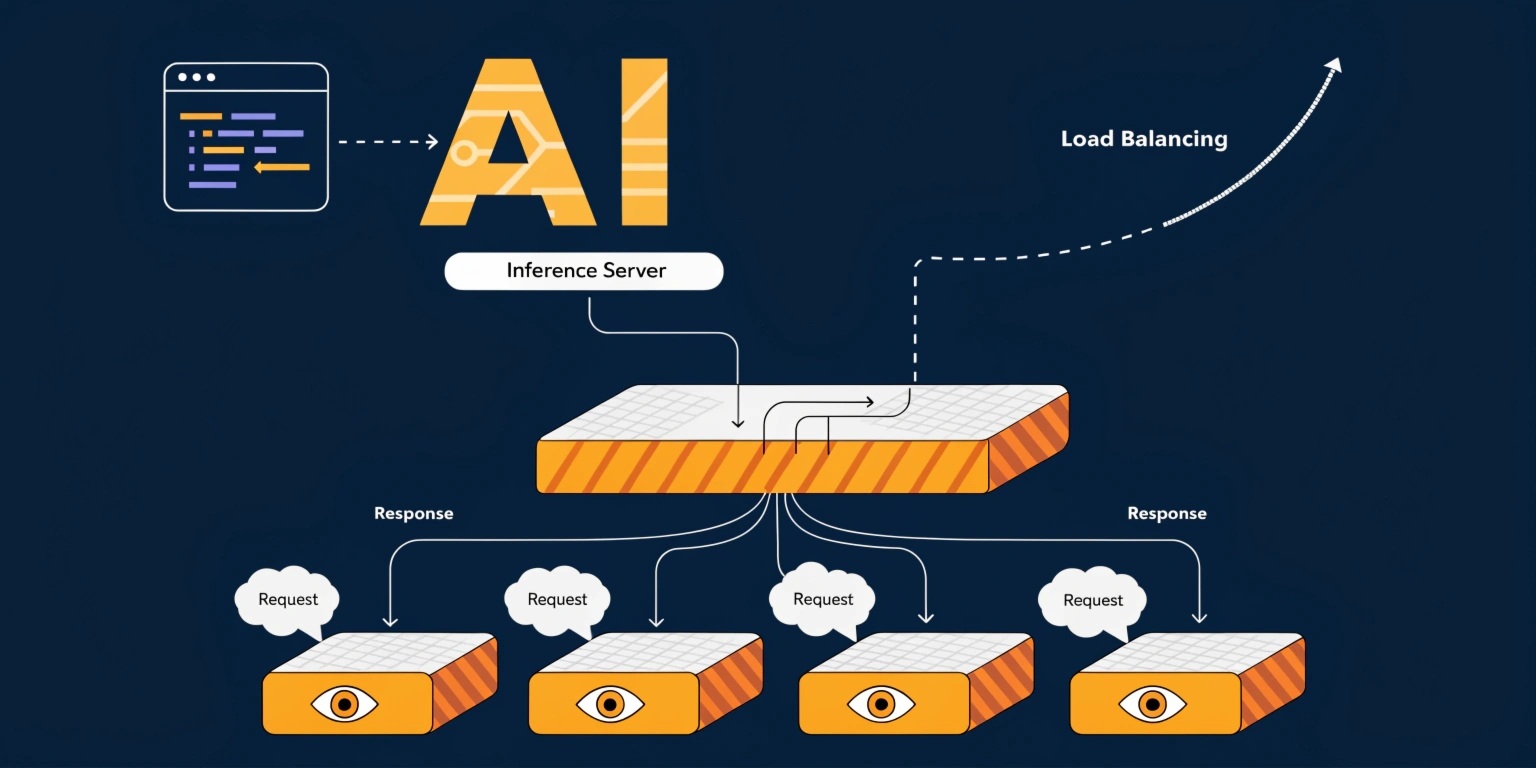
Load balancing is essential for scalable AI inference systems. Discover how modern AI platforms distribute inference requests across GPUs, optimize latency, improve throughput, and ensure high availability for machine learning applications.
Artificial Intelligence applications such as conversational assistants, recommendation engines, image recognition platforms, fraud detection systems, and predictive analytics rely on inference servers to generate responses in real time. Unlike model training, which occurs offline, inference involves processing live user requests with minimal latency. As AI adoption grows, inference servers must handle thousands or even millions of requests while maintaining speed, reliability, and cost efficiency.
A single server is rarely sufficient for production-scale AI deployments. Large Language Models (LLMs), computer vision models, and speech recognition systems require significant computational resources, often powered by GPUs or specialized AI accelerators. To distribute workloads efficiently and prevent bottlenecks, organizations implement load balancing across AI inference infrastructure.
This article explores how load balancing works in AI inference servers, the algorithms involved, implementation strategies, and best practices for building scalable AI services.
What Is an AI Inference Server?
An AI inference server hosts trained machine learning models and processes incoming requests to generate predictions or responses.
Typical responsibilities include:
- Loading trained models
- Managing inference requests
- Allocating GPU resources
- Returning predictions
- Monitoring performance
- Scaling based on demand
Popular inference platforms include NVIDIA Triton Inference Server, TensorFlow Serving, TorchServe, and custom model-serving frameworks.
Why Load Balancing Matters
AI inference workloads differ from traditional web applications.
Each request may involve:
- Large model execution
- GPU memory allocation
- Complex tensor operations
- Variable processing time
- High computational cost
Without effective load balancing, some servers may become overloaded while others remain underutilized.
Benefits of load balancing include:
- Lower latency
- Higher throughput
- Improved GPU utilization
- Better fault tolerance
- Increased scalability
- Enhanced user experience
AI Inference Architecture
A modern inference platform typically includes:
- Client applications
- API Gateway
- Load Balancer
- AI inference servers
- GPU clusters
- Model repository
- Monitoring services
- Autoscaling infrastructure
The load balancer sits between clients and inference servers, directing requests to the most appropriate resources.
Common Load Balancing Algorithms
Round Robin
Requests are distributed sequentially among available inference servers.
Best suited for:
- Identical hardware
- Uniform workloads
- Small AI deployments
Although simple, it does not account for GPU utilization or model complexity.
Least Connections
Incoming requests are routed to the server with the fewest active sessions.
This works well when inference durations vary significantly.
Weighted Load Balancing
Servers receive traffic according to their computational capacity.
For example:
- High-end GPU nodes receive more requests.
- CPU-only servers receive fewer requests.
This approach maximizes hardware utilization.
Least Response Time
Requests are sent to servers with the fastest response times and lower workloads.
Ideal for latency-sensitive AI applications such as chatbots and real-time recommendation systems.
Resource-Aware Load Balancing
Modern AI platforms monitor:
- GPU utilization
- Memory consumption
- CPU usage
- Queue length
- Network bandwidth
Traffic is directed toward the server with the most available resources.
This method is especially valuable for heterogeneous AI clusters.
Model-Aware Routing
Not all inference servers host the same models.
Some servers specialize in:
- Language models
- Image recognition
- Speech processing
- Recommendation engines
Model-aware routing ensures requests are forwarded only to servers capable of serving the required model, reducing unnecessary transfers and improving response times.
GPU Load Balancing
GPUs are the backbone of AI inference, but they have finite memory and compute capacity.
Effective GPU load balancing considers:
- Available VRAM
- Streaming multiprocessor utilization
- Batch size
- Model size
- Concurrent inference jobs
By distributing workloads intelligently, organizations can avoid GPU bottlenecks and maximize throughput.
Autoscaling AI Infrastructure
Traffic to AI services often fluctuates throughout the day.
Autoscaling enables infrastructure to:
- Add inference servers during traffic spikes
- Remove idle resources during low demand
- Reduce operational costs
- Maintain service availability
Platforms such as Kubernetes support Horizontal Pod Autoscaling (HPA) and Cluster Autoscaling to automate this process.
Request Batching
Many inference servers improve efficiency by batching multiple requests together.
Instead of processing requests individually, the server groups them into batches before executing the model.
Advantages include:
- Better GPU utilization
- Increased throughput
- Lower infrastructure costs
However, excessive batching may introduce additional latency, requiring careful tuning.
Monitoring and Observability
Continuous monitoring helps maintain optimal performance.
Key metrics include:
- Request latency
- Throughput
- GPU utilization
- Memory usage
- Error rates
- Queue length
- Model loading time
Monitoring tools provide insights that help optimize load balancing policies and identify bottlenecks.
High Availability and Fault Tolerance
AI services must remain available even when servers fail.
Load balancers improve resilience by:
- Performing health checks
- Removing unhealthy servers from rotation
- Redirecting traffic automatically
- Supporting failover mechanisms
- Distributing traffic across multiple regions
These capabilities reduce downtime and improve reliability.
Best Practices
To build efficient AI inference systems:
- Match routing strategies to workload characteristics.
- Use GPU-aware load balancing.
- Implement autoscaling for variable demand.
- Monitor latency and resource utilization continuously.
- Enable request batching where appropriate.
- Deploy health checks and automatic failover.
- Separate inference workloads from training workloads.
Following these practices improves scalability, reliability, and cost efficiency.
Future Trends
AI inference infrastructure continues to evolve rapidly.
Emerging innovations include:
- AI-driven load balancing
- Predictive autoscaling
- Serverless AI inference
- Edge AI deployment
- Multi-cloud inference routing
- Dynamic model placement
- Energy-aware scheduling
- Intelligent GPU orchestration
These technologies will further enhance performance while reducing operational complexity.
Conclusion
Load balancing is a critical component of modern AI inference systems. By intelligently distributing requests across servers, GPUs, and regions, organizations can deliver low-latency, high-throughput AI services while maximizing hardware utilization and minimizing costs. Techniques such as resource-aware routing, model-aware scheduling, request batching, and autoscaling enable AI platforms to scale efficiently under varying workloads.
As AI applications continue to grow in complexity and demand, advanced load balancing strategies will become even more important. Organizations that invest in intelligent traffic management and cloud-native infrastructure will be better equipped to build reliable, scalable, and high-performance AI services for the future.
We build scalable web, mobile, and game products for clients worldwide — combining modern frameworks, cloud infrastructure, and best engineering practices.
-1.jpg)