As Artificial Intelligence evolves from simple chatbots to autonomous agents and multi-step reasoning systems, developers face a new challenge: orchestrating complex AI workflows efficiently. Traditional workflow engines have long powered business automation and distributed systems, but the rise of Large Language Models (LLMs) has introduced new requirements that many legacy orchestration tools struggle to address.
This is where LangGraph enters the picture. Built specifically for AI-driven applications, LangGraph provides a graph-based framework for managing agent workflows, memory, state transitions, and decision-making processes.
But how does it compare with traditional workflow engines such as Apache Airflow, Temporal, Camunda, or AWS Step Functions?
Let's explore the key differences.
Understanding Traditional Workflow Engines
Traditional workflow engines were designed to automate predefined business processes.
Examples include:
- Apache Airflow
- Temporal
- Camunda
- AWS Step Functions
- Azure Logic Apps
These platforms excel at:
- Task scheduling
- Business process automation
- ETL pipelines
- Data processing
- Event-driven workflows
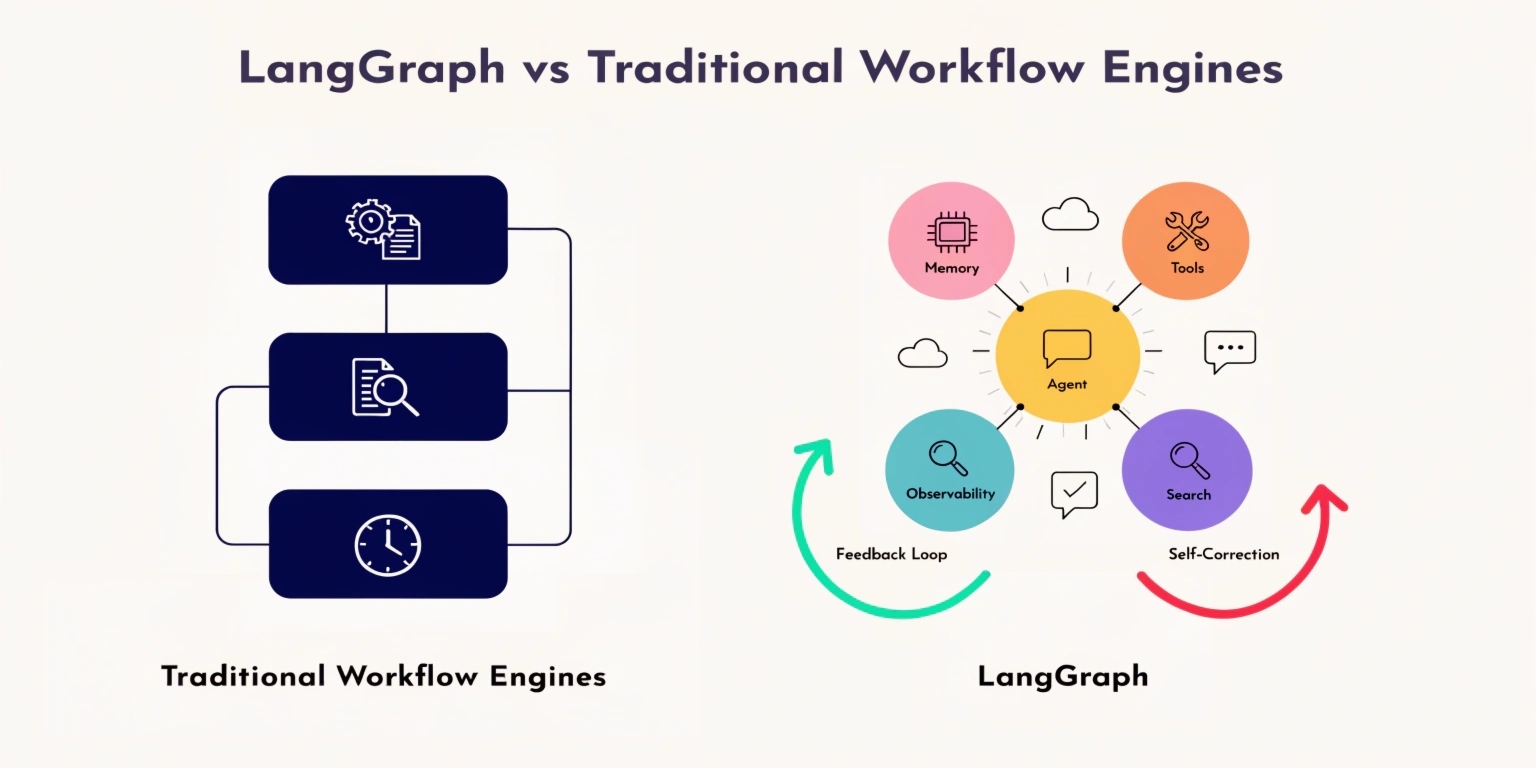
A traditional workflow typically follows a structured path:
Start → Validate Data → Process Data → Store Results → Notify User
Each step is deterministic and predictable.
Advantages include:
- Strong reliability
- High scalability
- Mature monitoring tools
- Clear audit trails
- Enterprise-grade governance
However, these systems assume that workflow paths are largely fixed and known beforehand.
What Is LangGraph?
LangGraph is an AI workflow orchestration framework developed as part of the LangChain ecosystem.
Instead of executing predefined sequences, LangGraph manages workflows as interconnected nodes within a graph structure.
A node can represent:
- LLM calls
- AI agents
- Tool executions
- Memory operations
- Human approvals
- External API requests
Unlike traditional workflows, execution paths can change dynamically based on AI-generated outputs.
Example:
User Query
↓
AI Agent
↙ ↘
Search Database
↓ ↓
Reasoning Agent
↓
Final Response
The workflow adapts according to context, reasoning, and agent decisions.
Core Architectural Differences
1. Deterministic vs Dynamic Execution
Traditional workflow engines follow predefined rules.
Example:
- Step A always leads to Step B.
- Step B always leads to Step C.
This creates predictability but limits flexibility.
LangGraph introduces dynamic routing.
Example:
- AI evaluates user intent.
- Workflow path changes accordingly.
- Different tools are selected automatically.
This makes LangGraph ideal for agentic systems.
2. State Management
Traditional engines maintain process states such as:
- Pending
- Running
- Completed
- Failed
LangGraph goes much further.
It manages:
- Conversation history
- Agent memory
- Context windows
- Intermediate reasoning steps
- Tool outputs
Persistent state management is essential for advanced AI agents.
3. Human-Like Decision Making
Traditional workflows operate using explicit conditions:
If amount > $1000
Approve manually
Else
Auto approve
LangGraph enables AI-driven decisions:
Analyze customer request
Determine urgency
Select appropriate action
This allows systems to adapt intelligently to unpredictable inputs.
4. Multi-Agent Collaboration
Traditional workflow platforms were not designed for AI agents collaborating together.
LangGraph supports:
- Planner agents
- Research agents
- Coding agents
- Validation agents
- Review agents
Multiple agents can interact and exchange context before producing outputs.
This capability is increasingly important for enterprise AI solutions.
Performance Considerations
Traditional Workflow Engines
Strengths:
- High throughput
- Predictable execution
- Excellent fault tolerance
- Mature retry mechanisms
- Strong compliance support
Weaknesses:
- Limited adaptability
- Difficult to model complex reasoning
LangGraph
Strengths:
- Dynamic workflows
- Context-aware execution
- AI-native architecture
- Supports autonomous agents
- Better handling of uncertainty
Weaknesses:
- Higher computational costs
- LLM latency
- More complex debugging
- Increased token consumption
Performance depends heavily on the underlying AI models.
Real-World Use Cases
Traditional Workflow Engines
Best suited for:
Data Pipelines
ETL processes with fixed execution paths.
Business Process Automation
Invoice processing, HR workflows, approvals.
System Integration
Connecting multiple enterprise applications.
Scheduled Operations
Reports, backups, and batch processing.
LangGraph
Best suited for:
AI Customer Support
Agents dynamically determine solutions.
Research Assistants
Systems decide which sources to consult.
Coding Agents
AI evaluates code, runs tools, and refines outputs.
Multi-Agent Applications
Teams of AI agents collaborate toward shared objectives.
Monitoring and Observability
Traditional workflow engines offer mature observability features:
- Workflow dashboards
- Execution logs
- SLA monitoring
- Failure tracking
LangGraph introduces additional requirements:
- Prompt tracking
- Agent behavior monitoring
- Memory inspection
- Tool usage analytics
- Reasoning trace visualization
AI workflows require visibility into decision-making processes, not just execution status.
When to Choose Traditional Workflow Engines
Choose traditional workflow engines if:
- Processes are predictable.
- Compliance requirements are strict.
- Auditability is critical.
- Tasks follow fixed business rules.
- High throughput is required.
Examples include banking systems, payroll automation, and data engineering pipelines.
When to Choose LangGraph
Choose LangGraph if:
- Applications rely heavily on LLMs.
- Agents need memory and reasoning capabilities.
- Workflow paths change dynamically.
- Human-like decision-making is required.
- Multi-agent collaboration is important.
Examples include AI assistants, autonomous research systems, intelligent customer support, and AI copilots.
Hybrid Architecture: The Emerging Trend
Many organizations are combining both approaches.
For example:
- Airflow manages data pipelines.
- Temporal coordinates business workflows.
- LangGraph orchestrates AI agents.
This hybrid architecture delivers:
- Enterprise reliability
- AI adaptability
- Better scalability
- Improved governance
As AI adoption grows, hybrid orchestration models are becoming increasingly common.
Conclusion
LangGraph and traditional workflow engines solve different problems. Traditional workflow platforms excel at predictable, structured, and repeatable business processes, while LangGraph is designed specifically for dynamic AI workflows involving reasoning, memory, and autonomous decision-making.
For organizations building AI-native applications powered by LLMs and agents, LangGraph offers capabilities that conventional workflow engines cannot easily provide. However, traditional engines remain indispensable for enterprise automation, compliance, and operational reliability.
The future of intelligent systems will likely combine both approaches, leveraging traditional workflow engines for operational control and LangGraph for AI-driven decision-making. Understanding the strengths of each technology allows organizations to build scalable, resilient, and intelligent applications that meet the demands of the next generation of software.