Transformers transformed artificial intelligence by overcoming the limitations of RNNs and LSTMs. Learn how self-attention, parallel processing, and scalability made Transformers the preferred architecture for modern AI applications, including large language models and generative AI.
How Transformers Replaced RNNs and LSTMs
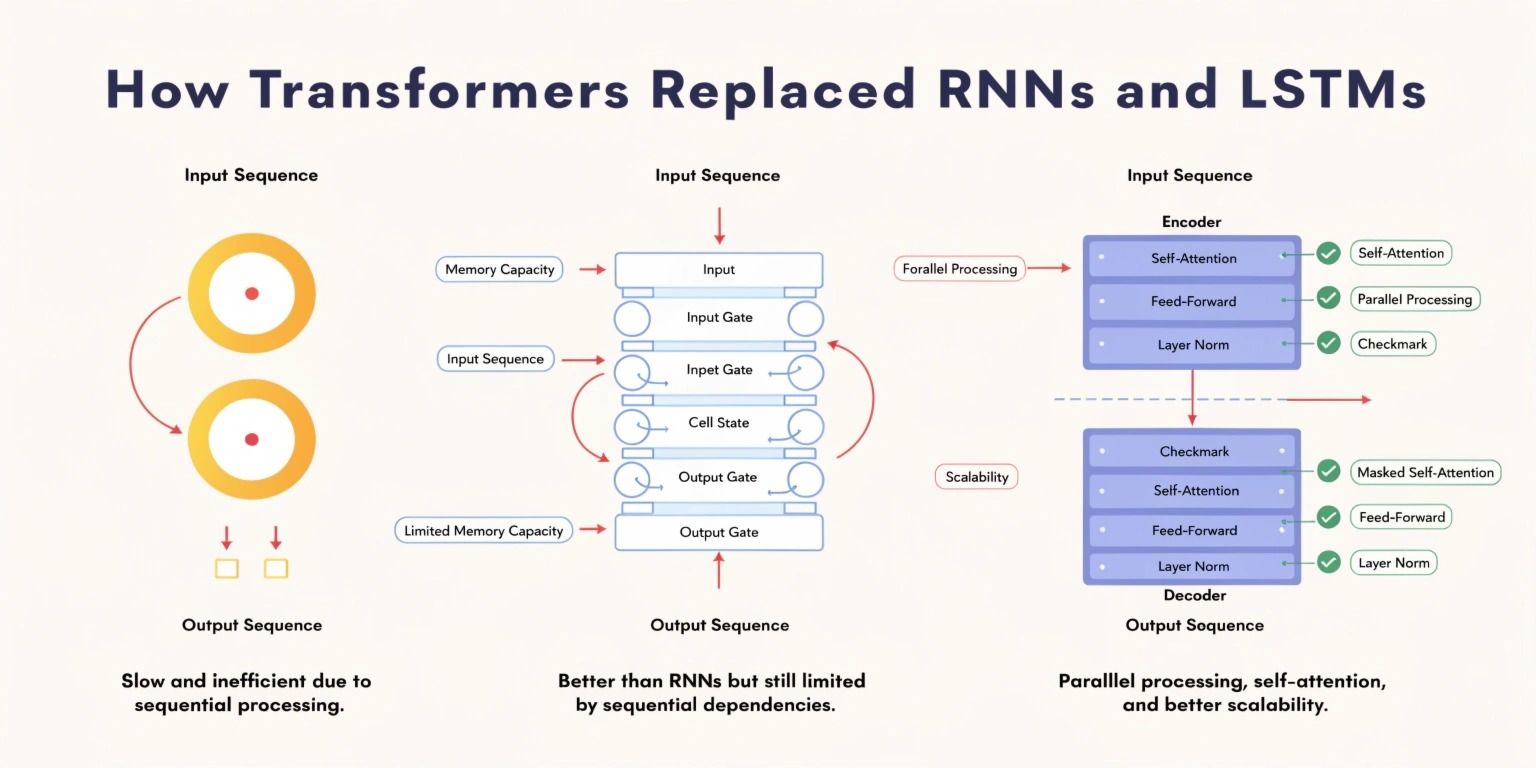
Artificial Intelligence has evolved dramatically over the past decade, with one of the most significant breakthroughs being the introduction of the Transformer architecture. Before Transformers, Recurrent Neural Networks (RNNs) and Long Short-Term Memory (LSTM) networks dominated sequence modeling tasks such as language translation, speech recognition, and text generation. While these models were revolutionary at the time, they struggled with long-range dependencies, slow training, and limited scalability.
The publication of the paper "Attention Is All You Need" in 2017 changed the trajectory of AI research. By introducing the Transformer architecture and its self-attention mechanism, researchers unlocked faster training, improved accuracy, and the ability to build models with billions of parameters. Today, Transformers power many of the world's most advanced AI systems, including GPT, BERT, T5, Claude, Llama, and numerous multimodal models.
This article explores why Transformers replaced RNNs and LSTMs, how they work, and why they remain the foundation of modern AI.
Understanding RNNs
Recurrent Neural Networks were designed to process sequential data by maintaining a hidden state that carries information from previous inputs.
For example, when reading the sentence:
"The cat sat on the mat."
An RNN processes one word at a time:
- The
- cat
- sat
- on
- the
- mat
Each word depends on the hidden state generated from the previous word.
Advantages of RNNs
- Suitable for sequence data
- Shared weights across time steps
- Effective for short text sequences
- Simpler architecture compared to later models
However, RNNs faced several practical challenges.
The Limitations of RNNs
Vanishing and Exploding Gradients
During training, gradients can become extremely small or excessively large.
This makes learning long-term relationships difficult.
For example:
"The movie that I watched three weeks ago was fantastic."
An RNN may struggle to connect "movie" with "fantastic" because many intermediate words weaken the learning signal.
Sequential Processing
RNNs process inputs one token at a time.
This prevents parallel computation and significantly increases training time.
Large datasets become computationally expensive.
Limited Context
Traditional RNNs often forget information from earlier parts of long sequences.
This limits their performance on tasks requiring broad contextual understanding.
How LSTMs Improved Sequence Learning
Long Short-Term Memory (LSTM) networks were introduced to address many shortcomings of RNNs.
LSTMs include memory cells and gating mechanisms that decide:
- What information to remember
- What information to forget
- What information to output
These mechanisms allow LSTMs to preserve useful information across longer sequences.
Advantages of LSTMs
- Better handling of long-term dependencies
- Improved translation quality
- Stronger speech recognition
- Reduced vanishing gradient issues
For years, LSTMs became the standard architecture for many Natural Language Processing (NLP) applications.
Why LSTMs Still Fell Short
Although LSTMs significantly improved sequence modeling, they still had important limitations.
Slow Training
Each word still had to be processed sequentially.
Modern GPUs thrive on parallel computation, making sequential architectures inefficient.
Difficulty Scaling
Training increasingly large LSTMs became expensive.
Adding more layers often resulted in diminishing performance improvements.
Long-Range Context Challenges
Even with memory cells, very long documents remained difficult to model accurately.
The Birth of Transformers
In 2017, researchers introduced the Transformer architecture through the landmark paper Attention Is All You Need.
Instead of processing tokens sequentially, Transformers process the entire sequence simultaneously.
This single innovation dramatically increased training efficiency.
The key innovation was the self-attention mechanism.
Understanding Self-Attention
Self-attention allows every word in a sentence to evaluate the importance of every other word.
Consider the sentence:
"The trophy didn't fit in the suitcase because it was too small."
The model must determine whether "it" refers to the trophy or the suitcase.
Using self-attention, the model learns relationships between all words simultaneously, enabling more accurate contextual understanding.
This mechanism captures both nearby and distant dependencies far more effectively than RNNs or LSTMs.
Parallel Processing
One of the biggest advantages of Transformers is parallelization.
Unlike RNNs:
RNN:
- Word 1 → Word 2 → Word 3 → Word 4
Transformer:
- Word 1
- Word 2
- Word 3
- Word 4
All processed simultaneously.
Benefits include:
- Faster training
- Better GPU utilization
- Reduced training time
- Easier scaling
Parallel processing made it practical to train models on enormous datasets.
Positional Encoding
Since Transformers process all tokens at once, they need a way to understand word order.
Positional encoding adds information about each token's position within the sequence.
This enables the model to distinguish between:
- "Dog bites man."
- "Man bites dog."
Even though both contain the same words, the meaning changes because of word order.
Scalability
Transformers scale exceptionally well.
Researchers have successfully trained models ranging from millions to trillions of parameters.
As model size increases, Transformers often demonstrate emergent capabilities, such as improved reasoning, coding assistance, multilingual understanding, and content generation.
This scalability has been a major driver behind the success of modern foundation models.
Applications of Transformers
Originally developed for language translation, Transformers now power a wide range of AI applications, including:
- Conversational AI and chatbots
- Machine translation
- Text summarization
- Search engines
- Sentiment analysis
- Code generation
- Speech recognition
- Image classification
- Video understanding
- Medical diagnostics
- Recommendation systems
Their flexibility has made them the dominant architecture across multiple domains.
Challenges of Transformers
Despite their advantages, Transformers are not without limitations.
High Computational Cost
Training large Transformer models requires significant computing resources, including powerful GPUs or specialized AI accelerators.
Memory Requirements
Self-attention has quadratic complexity with respect to sequence length, making long-context processing memory-intensive.
Researchers are actively developing more efficient attention mechanisms to address this issue.
Environmental Impact
Training very large models consumes considerable energy, prompting increased focus on model efficiency, optimization, and sustainable AI practices.
The Future Beyond Transformers
Although Transformers currently dominate AI, researchers continue to explore architectures that improve efficiency and reasoning.
Emerging directions include:
- Sparse attention mechanisms
- Linear attention models
- Mixture of Experts (MoE)
- Retrieval-Augmented Generation (RAG)
- State Space Models (SSMs)
- Hybrid neural architectures
- Multimodal foundation models
- Efficient long-context architectures
These innovations aim to reduce computational costs while maintaining or improving performance.
Conclusion
The transition from RNNs and LSTMs to Transformers marked a defining moment in the evolution of artificial intelligence. By replacing sequential computation with self-attention and parallel processing, Transformers overcame many of the limitations that constrained earlier neural networks. Their ability to capture long-range dependencies, scale to massive model sizes, and excel across diverse tasks has made them the foundation of today's AI ecosystem. As research advances, new architectures may complement or enhance Transformers, but their impact on natural language processing, computer vision, and generative AI will continue to shape the future of intelligent systems for years to come.
We build scalable web, mobile, and game products for clients worldwide — combining modern frameworks, cloud infrastructure, and best engineering practices.
-1.jpg)