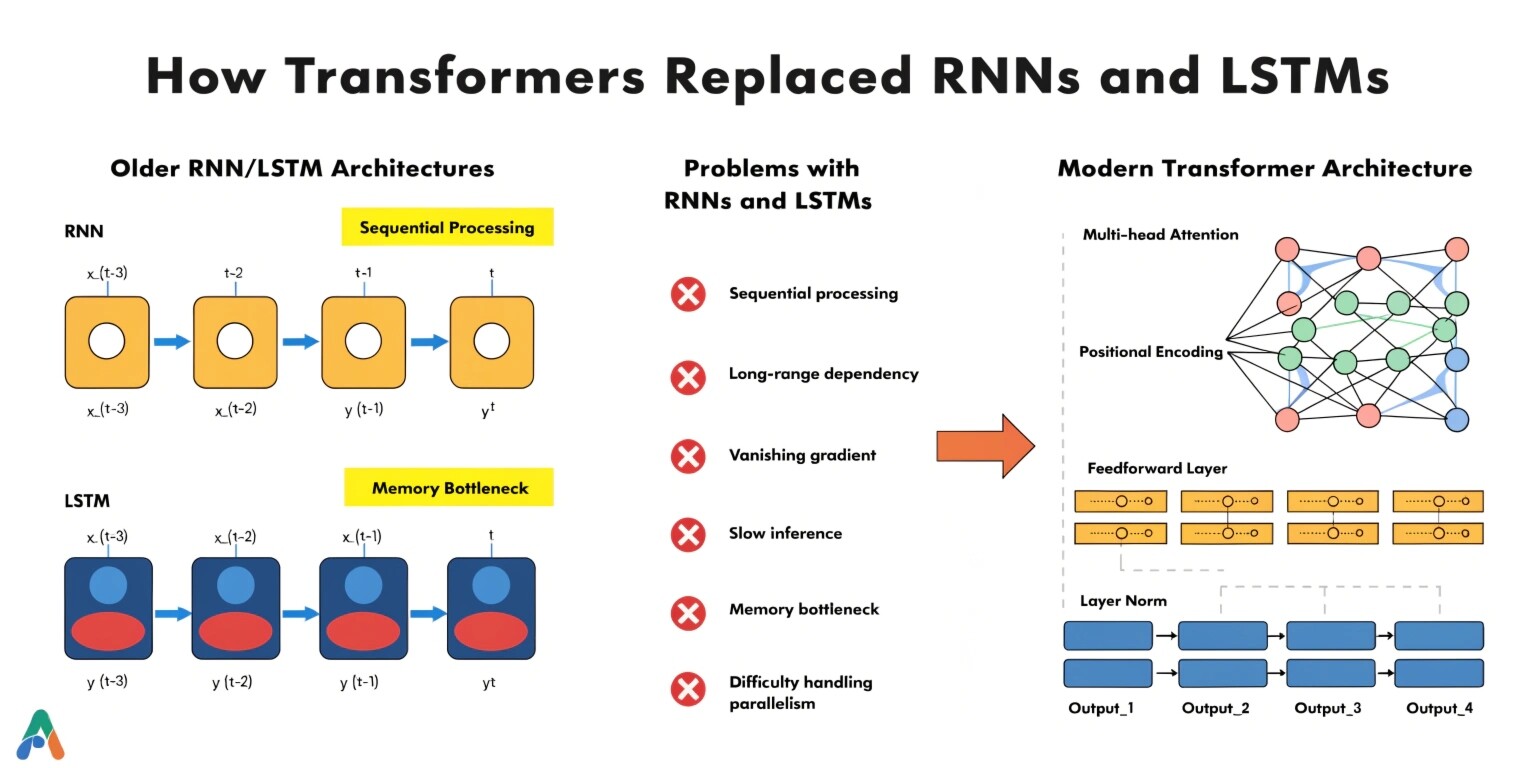
The field of deep learning has evolved rapidly over the past decade, especially in Natural Language Processing (NLP). Early breakthroughs were powered by models like Recurrent Neural Networks (RNNs) and Long Short-Term Memory (LSTM) networks. However, these architectures have largely been replaced by a more powerful and efficient approach: Transformers.
Understanding why this shift happened is key to grasping modern AI systems.
The Era of RNNs and LSTMs
RNNs were designed to process sequential data by maintaining a hidden state that captures information from previous inputs. This made them suitable for tasks like:
- Language translation
- Speech recognition
- Text generation
However, RNNs had a major limitation: they processed data sequentially. This meant each step depended on the previous one, making training slow and difficult to parallelize.
To address this, LSTMs were introduced. They improved RNNs by adding gates that controlled the flow of information, helping the model retain long-term dependencies.
While LSTMs were a significant improvement, they still suffered from:
- Slow training due to sequential processing
- Difficulty handling very long sequences
- Complex architecture and tuning
The Breakthrough: Transformers
In 2017, researchers introduced the Transformer architecture in the paper “Attention Is All You Need.” This marked a turning point in AI.
Unlike RNNs and LSTMs, Transformers do not process data sequentially. Instead, they rely on a mechanism called self-attention, which allows the model to look at all parts of a sequence simultaneously.
This change brought several advantages.
What is Self-Attention?
Self-attention allows a model to weigh the importance of different words in a sentence relative to each other.
For example, in the sentence:
"The cat sat on the mat because it was tired."
The model can understand that “it” refers to “the cat” by analyzing relationships across the entire sentence—not just nearby words.
This ability to capture global context is what makes Transformers so powerful.
Why Transformers Replaced RNNs and LSTMs
1. Parallel Processing
Transformers process all words at once, unlike RNNs which process them one by one. This makes training significantly faster and more efficient.
2. Better Long-Range Dependency Handling
Transformers can capture relationships between distant words without the vanishing gradient problem seen in RNNs.
3. Scalability
Transformers scale extremely well with data and computational power, making them ideal for large datasets.
4. Simpler Architecture
Despite their power, Transformers are often easier to train and optimize compared to complex LSTM structures.
Real-World Impact
Transformers have become the foundation of modern AI models, including:
- BERT – Used for search and language understanding
- GPT – Powers conversational AI and content generation
- T5 – Handles multiple NLP tasks in a unified way
These models outperform traditional approaches in tasks like translation, summarization, and question answering.
Limitations of Transformers
Despite their advantages, Transformers are not perfect:
High Computational Cost
Self-attention requires significant memory and processing power, especially for long sequences.
Data Hungry
They require large datasets to perform well.
Latency Issues
In real-time applications, large Transformer models can introduce delays.
However, ongoing research is addressing these challenges with optimized architectures like sparse attention and efficient Transformers.
The Shift Beyond NLP
Originally designed for NLP, Transformers are now used in:
- Computer vision (image recognition)
- Audio processing
- Game AI
- Multimodal systems (text + image + audio)
This versatility further solidifies their dominance over older architectures.
The Bigger Picture
The transition from RNNs and LSTMs to Transformers represents a shift from sequential thinking to contextual understanding.
Instead of processing data step-by-step, modern AI systems analyze relationships holistically. This mirrors how humans understand language—by considering context, not just order.
Conclusion
Transformers didn’t just improve upon RNNs and LSTMs—they redefined how sequence modeling works. By eliminating sequential bottlenecks and introducing self-attention, they unlocked new possibilities in AI.
Today, nearly every state-of-the-art NLP model is built on Transformer architecture. As research continues, these models will only become more efficient, accessible, and powerful.
For developers and AI enthusiasts, understanding this evolution is essential. It highlights how innovation in architecture can completely reshape an industry—and why Transformers are at the heart of today’s AI revolution.