Transformers have transformed AI by replacing RNNs and LSTMs with faster, more scalable architectures. Learn how self-attention, parallel processing, and superior contextual understanding made Transformers the foundation of modern AI systems.
Artificial Intelligence has advanced rapidly over the past decade, particularly in Natural Language Processing (NLP). Tasks that once seemed impossible—such as real-time language translation, intelligent chatbots, content generation, and code completion—are now powered by sophisticated deep learning models.
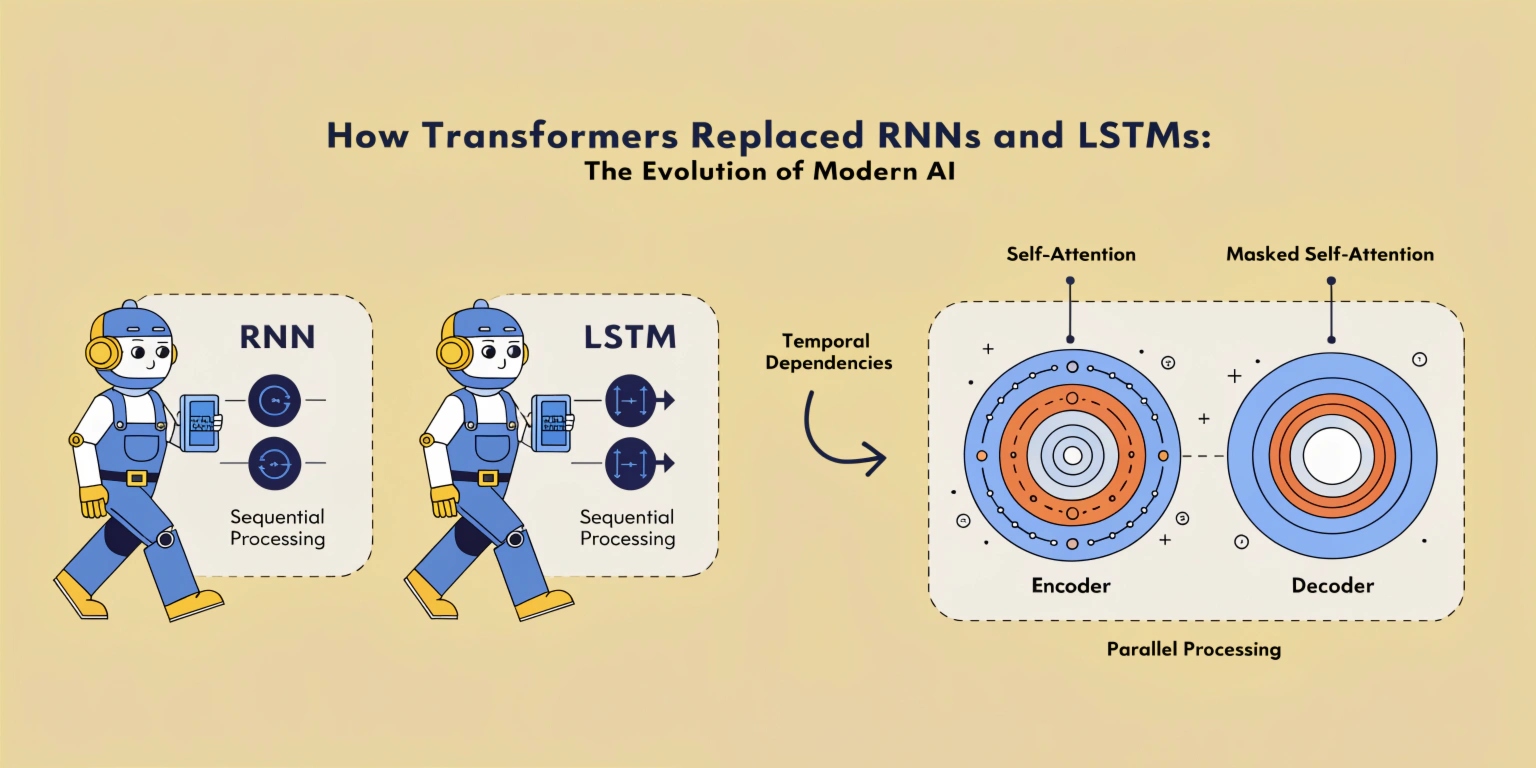
Before the rise of Transformers, Recurrent Neural Networks (RNNs) and Long Short-Term Memory (LSTM) networks were the dominant architectures for processing sequential data. They enabled significant progress in machine translation, speech recognition, and text generation. However, as datasets and application complexity grew, their limitations became increasingly apparent.
The introduction of the Transformer architecture fundamentally changed deep learning. By replacing sequential processing with self-attention and parallel computation, Transformers became faster, more scalable, and significantly more accurate. Today, they power many of the world's most advanced AI systems.
Understanding RNNs
Recurrent Neural Networks were designed to process sequential information.
Unlike traditional neural networks, RNNs maintain information from previous inputs through hidden states, making them suitable for:
- Language modeling
- Speech recognition
- Sentiment analysis
- Time-series forecasting
- Machine translation
For example, when reading a sentence, an RNN processes one word at a time while attempting to remember previous words.
Although this represented a major breakthrough, RNNs faced several practical challenges.
Limitations of RNNs
Despite their innovation, RNNs struggled with:
Vanishing and Exploding Gradients
During training, gradients could become extremely small or excessively large, making learning unstable.
Difficulty Capturing Long-Term Dependencies
As sequences became longer, RNNs often forgot earlier information.
For example, understanding a word near the end of a long paragraph might require remembering information introduced much earlier.
Sequential Processing
Each word had to be processed one after another.
This prevented efficient parallel computation and significantly increased training time.
These limitations motivated researchers to develop improved architectures.
The Rise of LSTMs
Long Short-Term Memory (LSTM) networks were introduced to overcome many weaknesses of traditional RNNs.
LSTMs introduced specialized memory cells controlled by:
- Input gates
- Forget gates
- Output gates
These mechanisms allowed the network to retain important information while discarding irrelevant details.
Compared to RNNs, LSTMs offered:
- Better long-term memory
- Improved stability during training
- Higher accuracy on sequence tasks
For many years, LSTMs became the industry standard for NLP and sequence modeling.
Why LSTMs Were Still Not Enough
Although LSTMs significantly improved performance, they still inherited one major limitation:
They processed information sequentially.
This created several problems:
- Slow training
- Limited parallelization
- High computational cost
- Difficulty scaling to massive datasets
As AI applications demanded larger models and more training data, researchers searched for a fundamentally different solution.
The Birth of Transformers
In 2017, researchers introduced the Transformer architecture in the landmark paper "Attention Is All You Need."
Rather than processing sequences one element at a time, Transformers introduced the concept of self-attention, allowing models to evaluate relationships between all words in a sequence simultaneously.
This innovation removed the need for recurrence entirely.
The result was a dramatic improvement in both speed and performance.
Understanding Self-Attention
Self-attention enables a model to determine which words in a sentence are most relevant to each other.
For example, in the sentence:
"The programmer optimized the application because it was slow."
The model learns that "it" refers to "application", even though several words separate them.
Instead of relying on sequential memory, Transformers examine all words simultaneously to understand context.
This capability greatly improves language understanding.
Advantages of Transformers
Parallel Processing
Unlike RNNs and LSTMs, Transformers process entire sequences simultaneously.
Benefits include:
- Faster training
- Better GPU utilization
- Lower training time
- Efficient large-scale learning
Superior Context Understanding
Self-attention captures relationships between distant words more effectively.
This improves:
- Translation quality
- Text summarization
- Question answering
- Content generation
Better Scalability
Transformers scale efficiently with larger datasets and more parameters.
This scalability enabled the development of billion-parameter and even trillion-parameter AI models.
Transfer Learning
Transformer models can be pre-trained on enormous datasets and fine-tuned for specialized tasks.
This significantly reduces development time while improving accuracy.
Applications Powered by Transformers
Today, Transformers support a wide range of AI applications, including:
- Large Language Models (LLMs)
- Machine translation
- Conversational AI
- Speech recognition
- Image captioning
- Document summarization
- Code generation
- Visual recognition
- Recommendation systems
- Medical AI
Their flexibility extends well beyond text processing.
Transformers Beyond NLP
Initially designed for language, Transformers are now widely used in:
Computer Vision
Vision Transformers (ViTs) process images using attention mechanisms.
Audio Processing
Transformers improve speech recognition and music generation.
Healthcare
Medical researchers use Transformers for:
- Disease prediction
- Medical imaging
- Drug discovery
- Clinical documentation
Robotics
Robots leverage Transformer-based models for:
- Motion planning
- Decision-making
- Environmental understanding
Their versatility has made them a foundational architecture across AI disciplines.
Challenges of Transformers
Despite their advantages, Transformers present several challenges:
- High computational requirements
- Significant memory consumption
- Expensive training costs
- Large infrastructure demands
- Environmental impact due to energy usage
Researchers continue developing techniques such as sparse attention, model pruning, quantization, and efficient Transformer architectures to address these concerns.
Future of Transformer Models
Transformer technology continues evolving rapidly.
Emerging innovations include:
- Multimodal AI models
- Long-context Transformers
- Efficient attention mechanisms
- Retrieval-Augmented Generation (RAG)
- Mixture-of-Experts (MoE) architectures
- Smaller edge AI models
- Real-time inference optimization
These advancements aim to make Transformer-based AI faster, more efficient, and accessible across industries.
RNNs, LSTMs, and Transformers: A Quick Comparison
FeatureRNNLSTMTransformerSequential ProcessingYesYesNoParallel TrainingNoNoYesLong-Term MemoryLimitedStrongExcellentTraining SpeedSlowModerateFastScalabilityLimitedModerateExcellentContext UnderstandingModerateGoodOutstandingModern AI AdoptionRareLimitedIndustry Standard
Conclusion
The transition from RNNs and LSTMs to Transformers represents one of the most significant milestones in the history of artificial intelligence. While RNNs introduced sequence modeling and LSTMs improved long-term memory, Transformers fundamentally reimagined how machines process information through self-attention and parallel computation.
Today, Transformers form the backbone of modern AI applications, powering advanced language models, intelligent assistants, computer vision systems, and multimodal platforms. As research continues to refine efficiency and scalability, Transformer-based architectures are expected to remain at the forefront of AI innovation, enabling smarter, faster, and more capable systems across countless industries.
We build scalable web, mobile, and game products for clients worldwide — combining modern frameworks, cloud infrastructure, and best engineering practices.
-1.jpg)