RAG gives LLMs access to relevant, up-to-date external knowledge, helping AI applications deliver more accurate, contextual, and reliable responses while reducing hallucinations and improving enterprise AI performance.
Main Content
Artificial intelligence is moving from experimental chatbots to intelligent applications that support real business operations. In 2027, organizations will increasingly expect AI systems to provide answers that are not only fluent but also accurate, current, contextual, and trustworthy.
Large Language Models (LLMs) have become the foundation of many modern AI applications. However, an LLM alone may not always have access to the latest company information, private documents, product data, or specialized knowledge. This is where Retrieval-Augmented Generation (RAG) becomes important.
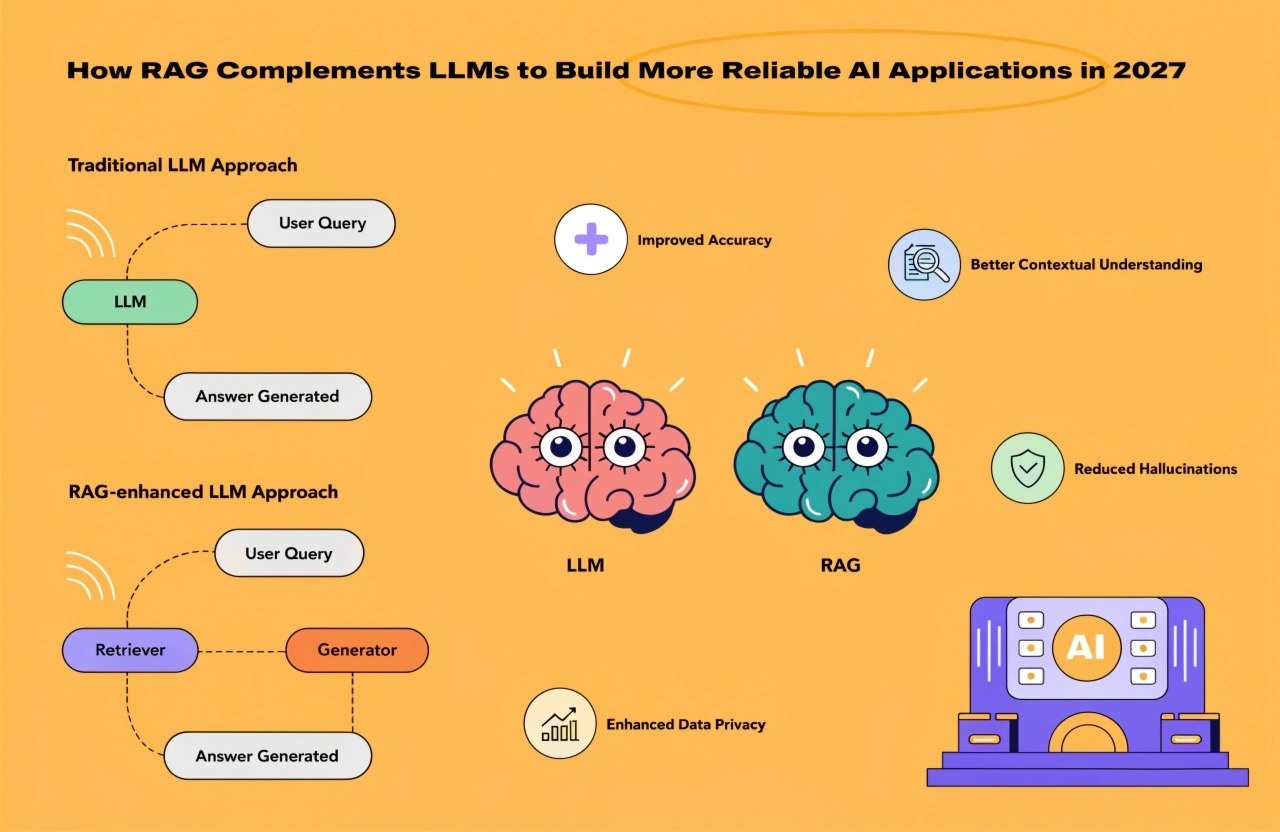
RAG complements LLMs by connecting them with external knowledge sources and retrieving relevant information before generating an answer. Instead of relying entirely on what the model learned during training, a RAG-based application can search a knowledge base and provide the retrieved context to the LLM.
Understanding the Role of LLMs
LLMs are designed to understand and generate human-like language. They can summarize documents, answer questions, write content, generate code, analyze information, and support conversational applications.
However, traditional LLMs have limitations. Their knowledge may become outdated, and they may sometimes generate information that sounds convincing but is incorrect. This behavior is commonly referred to as AI hallucination.
For businesses, these limitations can become serious when AI is used for customer support, internal knowledge management, finance, healthcare, legal information, or technical assistance.
How RAG Complements LLMs
RAG adds a retrieval layer between the user's question and the LLM's response.
A typical RAG workflow looks like this:
User Query → Search/Retrieval → Relevant Information → LLM → Generated Response
When a user asks a question, the system first searches connected knowledge sources. These may include company documents, databases, websites, product catalogs, FAQs, manuals, or internal knowledge bases.
The retrieved information is then provided to the LLM as additional context. The model uses that context to generate a more relevant response.
This approach allows businesses to combine the language intelligence of LLMs with the current and domain-specific knowledge of external data sources.
Reducing AI Hallucinations
One of the biggest advantages of RAG is its ability to reduce unsupported answers.
Without retrieval, an LLM may attempt to answer a question using patterns learned during training. With RAG, the system can first retrieve relevant information from an approved knowledge source.
For example, an e-commerce company could build an AI assistant connected to its latest product database. When customers ask about product availability, specifications, or policies, the application can retrieve current information before generating the response.
RAG does not completely eliminate hallucinations, but properly designed retrieval, source validation, prompt engineering, and response evaluation can significantly improve reliability.
Keeping AI Knowledge Up to Date
Another major advantage of RAG is that organizations do not necessarily need to retrain an LLM every time their information changes.
Suppose a company updates its pricing, employee policies, technical documentation, or product catalog. Instead of retraining the entire language model, the updated information can be added to the organization's knowledge repository.
This makes RAG particularly valuable for businesses where information changes frequently.
RAG and Vector Databases
Modern RAG systems commonly use vector databases and embedding models to find information based on meaning rather than exact keyword matches.
Documents are converted into numerical representations called embeddings. When a user asks a question, the query is also converted into an embedding. The system then searches for information that is semantically similar to the query.
This enables AI applications to retrieve relevant information even when the user's wording differs from the wording in the original document.
RAG in Enterprise Applications
By 2027, RAG is expected to remain an important architecture for enterprise AI applications.
Businesses can use RAG-powered systems for:
- AI customer-support assistants
- Internal knowledge management
- Document analysis
- HR policy assistants
- Technical support
- E-commerce recommendation systems
- Legal and compliance information retrieval
- Software development assistants
- Business intelligence applications
- AI-powered search systems
For example, an employee could ask an internal AI assistant about a company policy. The RAG system can retrieve the relevant HR document and allow the LLM to generate a concise answer based on the available information.
RAG + LLM + AI Agents
In 2027, another important development will be the combination of RAG, LLMs, and AI agents.
AI agents can use tools, access databases, retrieve documents, perform tasks, and make decisions within defined boundaries. RAG can provide these agents with the knowledge they need to complete tasks more effectively.
This combination can create applications capable of understanding a request, retrieving relevant information, using external tools, and producing an actionable result.
Building More Trustworthy AI
The future of enterprise AI will not be determined only by how intelligent an LLM appears. Businesses will also focus on accuracy, traceability, security, data governance, and reliability.
RAG supports this direction by allowing organizations to control which knowledge sources are used to generate responses. Developers can also design systems that display supporting sources or references, helping users understand where an answer originated.
Conclusion
LLMs provide powerful language and reasoning capabilities, but they should not always work alone. RAG complements LLMs by giving AI applications access to relevant, current, and domain-specific information.
In 2027, the combination of RAG and LLM technology will help businesses build AI applications that are more contextual, adaptable, and reliable. From customer service and enterprise search to AI agents and business automation, RAG will play an important role in transforming general-purpose language models into practical business intelligence systems.
The key is not choosing RAG vs. LLM, but understanding how RAG and LLMs work together to create better AI experiences.
We build scalable web, mobile, and game products for clients worldwide — combining modern frameworks, cloud infrastructure, and best engineering practices.
-1.jpg)