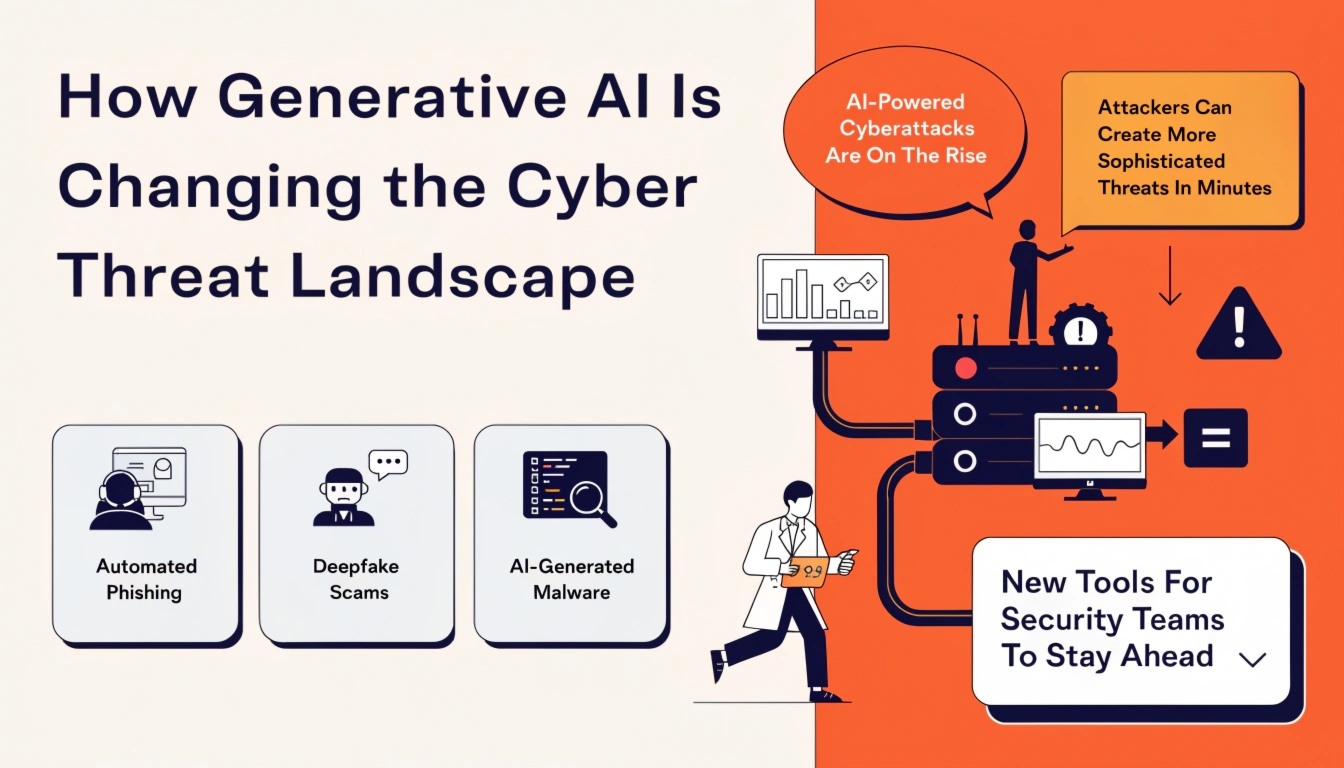
Generative AI is revolutionizing cybersecurity by introducing both opportunities and risks. While AI-powered tools enhance threat detection and automate defense mechanisms, cybercriminals are also exploiting generative AI to create sophisticated phishing campaigns, deepfakes, and malware. Understanding these evolving threats and adopting AI-driven security strategies are essential for protecting digital assets and maintaining cyber resilience.
Main Content
Introduction
Generative AI has emerged as one of the most transformative technologies of the digital era. From content creation and customer service automation to software development and research, AI models are revolutionizing industries worldwide. However, as organizations embrace artificial intelligence, cybercriminals are also leveraging these technologies to develop more advanced and sophisticated attacks.
The rise of generative AI is dramatically changing the cyber threat landscape. Traditional cybersecurity challenges are evolving into highly automated and intelligent threats, forcing businesses and security professionals to rethink their defense strategies.
AI-Powered Phishing Attacks
Phishing has long been one of the most common forms of cybercrime. Generative AI now enables attackers to create highly convincing emails, messages, and websites with perfect grammar and personalized content.
Unlike traditional phishing campaigns that often contain obvious mistakes, AI-generated phishing messages can imitate writing styles, company branding, and even communication patterns. These sophisticated attacks make it increasingly difficult for individuals and organizations to distinguish between legitimate and malicious communications.
As a result, businesses must invest in employee awareness programs and advanced email security solutions to combat these evolving threats.
Deepfakes and Social Engineering
Deepfake technology powered by generative AI represents another growing cybersecurity concern. AI can generate realistic audio, video, and images that mimic real individuals with remarkable accuracy.
Cybercriminals are using deepfakes to impersonate executives, employees, and public figures to manipulate victims into transferring money or revealing confidential information. Voice cloning attacks have already resulted in significant financial losses for businesses worldwide.
Organizations need robust identity verification processes and multi-factor authentication to reduce the risks associated with AI-driven social engineering attacks.
AI-Assisted Malware Development
Generative AI can accelerate software development, but the same capabilities can also be misused to create malicious code. Attackers can automate malware creation, modify existing code, and generate scripts that bypass traditional detection mechanisms.
Although major AI providers implement safeguards to prevent abuse, cybercriminals continue to experiment with AI-assisted techniques to enhance ransomware and exploit vulnerabilities more efficiently.
This trend highlights the importance of continuous monitoring, endpoint protection, and proactive threat intelligence to detect emerging threats before they cause significant damage.
Automated Cyber Attacks
Artificial intelligence enables cybercriminals to automate large-scale attacks. AI-powered bots can scan networks, identify vulnerabilities, and launch attacks at speeds that far exceed human capabilities.
Automated attacks increase the volume and sophistication of cyber threats while reducing the resources required by attackers. This creates a more challenging environment for security teams that already face skill shortages and increasing workloads.
Security operations centers are therefore adopting AI-driven tools to automate threat detection and response, helping analysts focus on high-priority incidents.
AI as a Cybersecurity Defender
Despite the risks, generative AI also provides powerful opportunities for strengthening cybersecurity. Modern security platforms increasingly rely on machine learning and AI to analyze massive volumes of data and detect suspicious behavior in real time.
AI-powered security solutions can:
- Identify anomalies across networks.
- Detect malware and ransomware patterns.
- Automate incident response.
- Predict potential vulnerabilities.
- Reduce false positives in threat detection.
- Enhance fraud prevention capabilities.
These capabilities enable organizations to improve cyber resilience and respond to attacks more effectively.
Challenges and Ethical Concerns
The growing use of generative AI raises several ethical and regulatory concerns. Issues such as misinformation, privacy violations, data misuse, and bias in AI systems present additional risks.
Governments and technology companies are actively developing regulations and frameworks to ensure responsible AI development and usage. Balancing innovation with security and ethical considerations will remain a critical challenge in the coming years.
Organizations must establish AI governance policies, conduct regular risk assessments, and ensure transparency in AI deployments to maintain trust and compliance.
Future of Cybersecurity in the AI Era
As generative AI technologies continue to evolve, cyber threats will become increasingly sophisticated. Businesses can no longer rely solely on traditional security methods. Instead, they must adopt a proactive and adaptive approach that combines human expertise with AI-powered defense mechanisms.
Future cybersecurity strategies will emphasize:
- Zero Trust Architecture.
- Behavioral analytics.
- AI-driven threat intelligence.
- Continuous monitoring.
- Automated response systems.
- Strong identity and access management.
Companies that embrace these technologies will be better equipped to defend against emerging cyber risks.
Conclusion
Generative AI is fundamentally transforming the cyber threat landscape. While attackers are exploiting AI to create smarter phishing campaigns, deepfakes, and automated malware, defenders are also using AI to strengthen cybersecurity capabilities.
Success in the AI era will depend on striking the right balance between innovation and protection. Organizations that invest in AI-powered security solutions, employee awareness, and proactive risk management will be better prepared to navigate the rapidly evolving world of cyber threats.
We build scalable web, mobile, and game products for clients worldwide — combining modern frameworks, cloud infrastructure, and best engineering practices.
-1.jpg)