Learn the hidden challenges organizations face when transforming AI MVPs into scalable production systems, including infrastructure, reliability, data quality, and operational complexity.
Building an AI MVP (Minimum Viable Product) is often exciting and fast-paced. A small team creates a proof of concept, trains a machine learning model, demonstrates promising results, and generates enthusiasm across the organization.
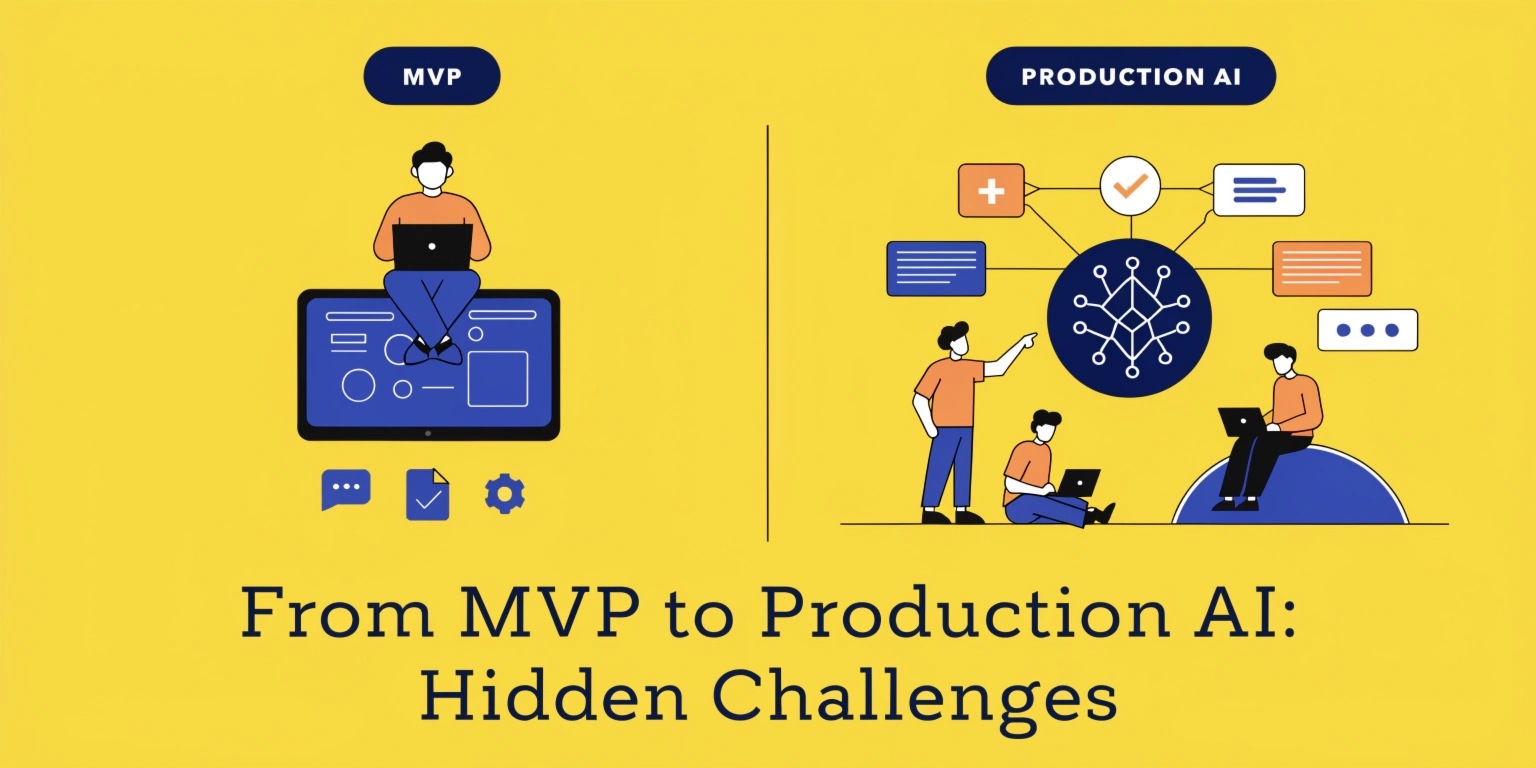
However, moving from an experimental AI prototype to a reliable production-grade system is a completely different challenge.
Many AI initiatives fail not because the model itself is inaccurate, but because organizations underestimate the complexity of deploying, scaling, monitoring, and maintaining AI systems in real-world environments.
An AI MVP may work perfectly in controlled testing conditions, but production AI must operate reliably under unpredictable workloads, changing data patterns, security requirements, and business constraints.
The journey from MVP to production is where the real engineering challenge begins.
What is an AI MVP?
An AI MVP is an early-stage version of an AI solution built to validate an idea quickly.
The primary objective is to:
- Test feasibility
- Demonstrate business value
- Collect feedback
- Secure stakeholder approval
AI MVPs usually focus on:
- Limited datasets
- Simplified workflows
- Controlled environments
- Rapid experimentation
Examples include:
- Basic recommendation engines
- Prototype chatbots
- Predictive analytics dashboards
- Image recognition demos
- AI-powered search systems
While MVPs prove concepts effectively, they rarely represent the complexity of production environments.
Why AI Production Systems Are Different
Production AI systems must handle:
- Large-scale data processing
- Real-time requests
- Security and compliance
- Infrastructure scaling
- Continuous monitoring
- System reliability
- Integration with business operations
Unlike traditional software, AI systems also depend heavily on:
- Data quality
- Model behavior
- Training pipelines
- Statistical performance
This creates additional operational complexity.
Hidden Challenges When Scaling AI to Production
1. Data Quality and Data Drift
AI models are only as good as the data they receive.
In MVP environments, teams often use:
- Clean datasets
- Structured samples
- Limited edge cases
However, production environments introduce:
- Incomplete data
- Noisy inputs
- Changing user behavior
- Real-world inconsistencies
Over time, models may experience data drift, where incoming data changes significantly from the original training data.
This can reduce:
- Prediction accuracy
- Recommendation quality
- Business performance
Continuous monitoring and retraining become essential for maintaining reliability.
2. Infrastructure and Scalability
An MVP may run on a single server or local machine, but production AI systems often require distributed infrastructure.
Challenges include:
- GPU resource management
- Cloud scalability
- Low-latency inference
- Load balancing
- High availability
AI workloads can become extremely expensive when scaled improperly.
Cloud providers such as Amazon Web Services, Google Cloud, and Microsoft Azure offer specialized AI infrastructure, but managing cost and performance optimization remains challenging.
3. Model Monitoring and Reliability
Traditional software systems usually behave predictably, but AI systems can degrade silently.
A machine learning model may continue operating while:
- Accuracy declines
- Bias increases
- Predictions become unstable
- User satisfaction decreases
Without proper monitoring, these problems may remain undetected for long periods.
Production AI systems require monitoring for:
- Prediction quality
- Latency
- Data anomalies
- Drift detection
- Model health metrics
This has led to the rise of MLOps (Machine Learning Operations), which focuses on managing AI systems throughout their lifecycle.
4. Security and Privacy Risks
AI systems introduce new security concerns that many MVPs ignore.
Risks include:
- Sensitive data exposure
- Adversarial attacks
- Model theft
- API abuse
- Unauthorized access
Privacy regulations such as GDPR and other global compliance frameworks require organizations to handle user data responsibly.
Production AI systems must implement:
- Encryption
- Access control
- Secure authentication
- Audit logging
- Privacy-preserving data practices
Security becomes especially important for industries like healthcare, finance, and enterprise SaaS platforms.
5. Integration with Existing Systems
Many AI MVPs operate independently as isolated prototypes.
However, production deployment requires integration with:
- APIs
- Databases
- Legacy systems
- CRMs
- ERP platforms
- Customer workflows
Integration complexity often slows deployment significantly.
AI systems must work seamlessly within existing business ecosystems rather than functioning as standalone demos.
6. Cost Management
AI systems can become expensive very quickly.
Costs may include:
- GPU infrastructure
- Cloud storage
- Data pipelines
- Model retraining
- Inference processing
- Monitoring systems
Generative AI applications powered by large language models can create especially high operational costs at scale.
Businesses must carefully balance:
- Performance
- Accuracy
- Infrastructure spending
- User demand
Cost optimization becomes a major production challenge.
7. Explainability and Trust
Business stakeholders increasingly demand explainable AI systems.
Organizations need to understand:
- Why predictions were made
- How recommendations are generated
- Whether decisions are biased
Black-box AI systems create trust issues, particularly in regulated industries.
Explainability is essential for:
- Compliance
- Risk management
- Customer trust
- Ethical AI adoption
Production systems often require additional tooling to improve transparency.
8. Team and Operational Complexity
AI production systems require collaboration across multiple disciplines:
- Data scientists
- ML engineers
- Backend developers
- DevOps teams
- Security specialists
- Product managers
Many organizations underestimate the operational coordination required to maintain production AI successfully.
Building AI models is only one part of the process. Operating them reliably is an ongoing engineering effort.
The Rise of MLOps
To address production challenges, organizations are adopting MLOps practices.
MLOps combines:
- Machine learning
- DevOps
- Data engineering
- Automation
Its goal is to streamline:
- Model deployment
- Monitoring
- Retraining
- Version control
- CI/CD pipelines for AI systems
Platforms such as Databricks and NVIDIA provide infrastructure solutions for large-scale AI operations.
MLOps is becoming essential for enterprise AI scalability.
Best Practices for Moving AI into Production
Start with Clear Business Objectives
AI should solve measurable business problems rather than existing as experimental technology.
Build Scalable Data Pipelines
Reliable data infrastructure is critical for maintaining model performance.
Invest in Monitoring Early
Production monitoring should not be added later. It must be part of the architecture from the beginning.
Design for Reliability
AI systems should handle failures gracefully and maintain stable user experiences.
Prioritize Security and Compliance
Privacy and security considerations must be integrated throughout the development lifecycle.
The Future of Production AI
As AI adoption accelerates, production AI systems will become increasingly sophisticated.
Future trends include:
- Autonomous AI agents
- Real-time adaptive learning
- Edge AI deployment
- AI observability platforms
- Automated model optimization
- Self-healing AI infrastructure
Organizations that master production AI operations will gain major competitive advantages in scalability, innovation, and customer experience.
Conclusion
Building an AI MVP is only the first step in the AI journey. The true challenge lies in transforming experimental models into secure, scalable, and reliable production systems capable of delivering long-term business value.
From infrastructure scaling and data drift to monitoring, security, and operational complexity, production AI introduces challenges that many organizations underestimate.
Businesses that invest in strong AI engineering practices, MLOps, scalable infrastructure, and responsible AI governance will be better prepared to move beyond prototypes and build successful enterprise-grade AI solutions.
We build scalable web, mobile, and game products for clients worldwide — combining modern frameworks, cloud infrastructure, and best engineering practices.
-1.jpg)