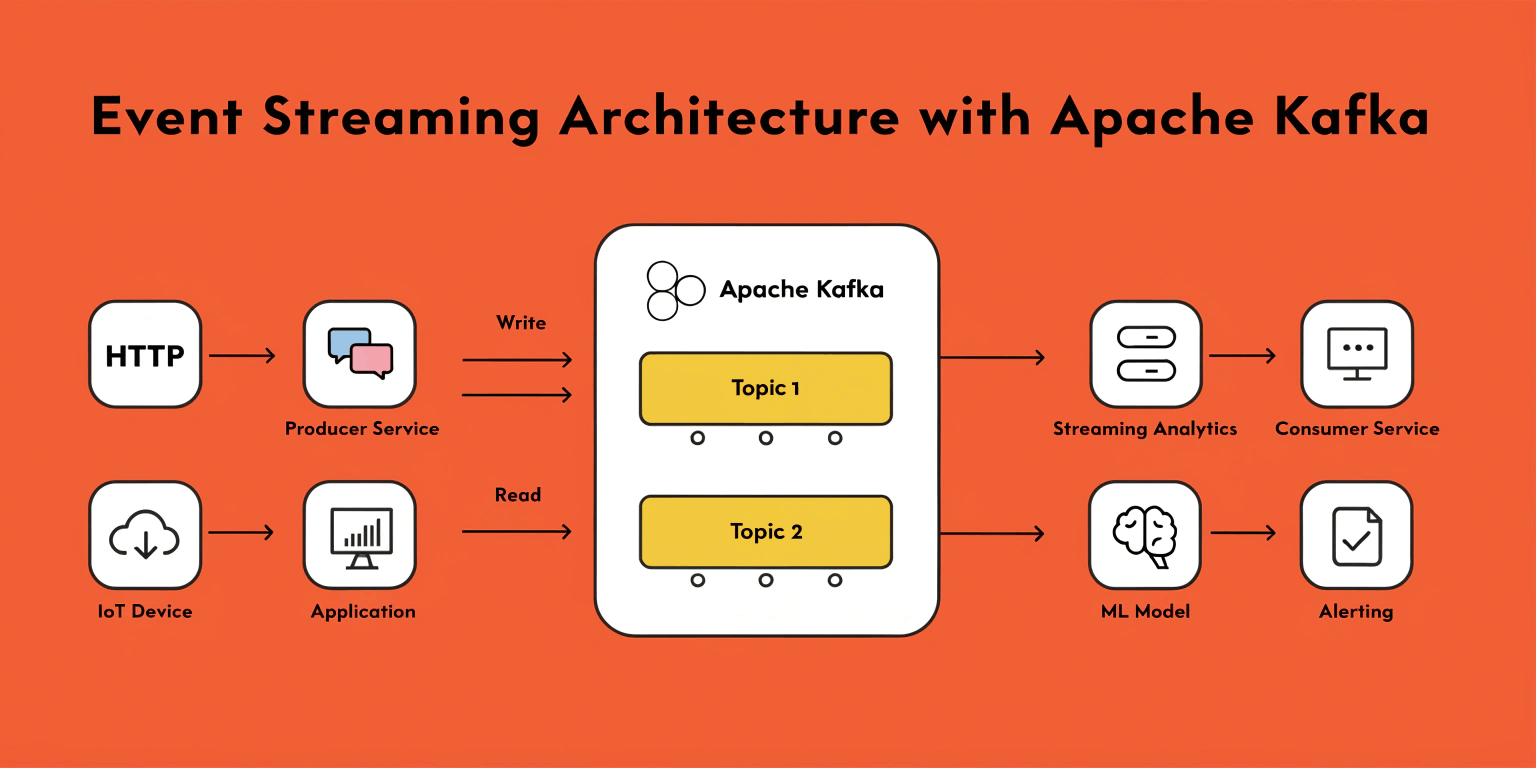
Apache Kafka provides a scalable foundation for real-time event streaming. This blog explains Kafka architecture, producers, consumers, partitions, replication, consumer groups, stream processing, and best practices for building reliable event-driven applications.
Modern applications generate enormous volumes of data through user interactions, transactions, IoT devices, APIs, application logs, and business processes. Traditional request-response architectures can struggle when this information must be processed in real time across multiple systems. Event streaming architecture provides an alternative by allowing applications to continuously publish, process, and consume events as they occur.
Apache Kafka is one of the most widely adopted platforms for implementing event streaming architectures. It provides a distributed infrastructure capable of handling high-throughput workloads while supporting scalability, fault tolerance, and real-time data processing.
Understanding Event Streaming Architecture
Event streaming is an architectural approach where business and system activities are represented as continuous streams of events. An event records something that happened, such as an order being created, a payment being completed, or a user updating their profile.
Instead of sending data directly from one application to another, a producer publishes an event to a streaming platform. Multiple consumers can then independently process that event.
This creates a loosely coupled architecture where services do not need direct dependencies on one another.
For example, when an e-commerce customer places an order, the order service can publish an OrderCreated event. Inventory management can consume it to update stock, a notification service can send confirmation, and an analytics system can process the event for reporting.
Core Components of Apache Kafka
Kafka follows a distributed architecture consisting of several important components.
Producers are applications that publish events to Kafka topics. A producer determines which topic receives an event and can influence partition selection.
Topics logically organize events. For example, an organization might create topics such as orders, payments, user-events, and notifications.
Partitions divide topics into ordered sequences of events. Partitioning allows Kafka to distribute data across multiple brokers and process events concurrently.
Brokers are Kafka servers responsible for storing and serving event data. A Kafka cluster generally contains multiple brokers to provide scalability and resilience.
Consumers read events from Kafka topics and process them according to application requirements.
Consumer groups allow multiple consumer instances to work together. Kafka distributes partitions among members of a consumer group, enabling parallel processing.
Why Partitions Matter
Partitions are fundamental to Kafka scalability.
Suppose a topic contains ten partitions. Multiple consumers can process those partitions concurrently, allowing the application to handle significantly higher workloads than a single consumer.
Kafka maintains ordering within a partition, rather than guaranteeing global ordering across an entire topic. Therefore, partitioning strategies must be carefully designed when event ordering is important.
For example, an application can use a customer ID as a partition key to ensure that events belonging to the same customer are consistently routed to the same partition.
Replication and Fault Tolerance
Distributed systems must continue operating even when individual servers fail. Kafka addresses this through replication.
Partitions can have multiple replicas distributed across brokers. One replica acts as the leader while other replicas maintain copies of the data.
If a broker hosting a partition leader fails, Kafka can elect another eligible replica as the new leader.
Replication therefore improves system availability and protects event data against individual broker failures.
Event-Driven Microservices
Kafka is particularly useful in microservice architectures.
Instead of tightly coupling services through synchronous APIs, services can communicate through events. This allows individual services to evolve independently and reduces dependencies between applications.
For example:
Order Service → Kafka → Inventory Service
Order Service → Kafka → Notification Service
Order Service → Kafka → Analytics Service
The order service does not need to know how every downstream service processes the event.
This architecture can improve scalability and resilience, particularly when different services have different processing requirements.
Stream Processing with Kafka
Kafka is not limited to storing and transporting events. Applications can also process streams of data continuously.
Kafka Streams enables developers to build applications that transform, filter, aggregate, join, and analyze event streams.
For example, a financial application could process transaction events continuously to calculate account activity, detect unusual patterns, or generate real-time metrics.
Organizations can also integrate Kafka with broader stream-processing technologies depending on their requirements.
Schema Management
As event-driven systems grow, maintaining consistent event structures becomes increasingly important.
A producer might initially publish an event containing customer ID and order ID. Later, additional fields may be introduced. Without proper schema management, changes can cause compatibility problems for consumers.
Schema management solutions can help organizations define event structures and enforce compatibility rules. Common serialization formats include JSON, Avro, Protobuf, and JSON Schema.
A well-designed schema strategy allows producers and consumers to evolve independently while reducing integration failures.
Security and Reliability
Production Kafka deployments require more than simply creating topics and producers.
Organizations should consider authentication, authorization, encryption, network security, access controls, data retention, monitoring, and disaster recovery.
Kafka workloads should also be monitored for metrics such as consumer lag, broker health, partition distribution, throughput, request latency, and under-replicated partitions.
Consumer lag is particularly important because it indicates how far a consumer is behind the latest available events.
Best Practices for Kafka Architecture
A production-ready Kafka architecture should follow several principles:
- Design partitioning around scalability and ordering requirements.
- Choose replication settings based on availability requirements.
- Define clear event schemas and compatibility policies.
- Monitor consumer lag and broker performance continuously.
- Establish appropriate retention policies.
- Use meaningful topic naming conventions.
- Implement authentication and authorization.
- Design consumers to handle duplicate events when necessary.
- Plan capacity based on expected throughput and growth.
- Test failure scenarios before production deployment.
Conclusion
Apache Kafka provides a powerful foundation for building modern event streaming architectures. Its distributed design, partitioning model, replication capabilities, consumer groups, and stream-processing ecosystem make it suitable for high-volume real-time workloads.
When properly designed, Kafka can connect microservices, power real-time analytics, support data pipelines, and enable responsive applications without creating tightly coupled system dependencies.
However, successful Kafka adoption requires careful consideration of partitioning, schemas, ordering, reliability, security, monitoring, and operational management. With the right architecture and engineering practices, event streaming can become a scalable backbone for modern distributed applications.
We build scalable web, mobile, and game products for clients worldwide — combining modern frameworks, cloud infrastructure, and best engineering practices.
.jpg)
.jpg)