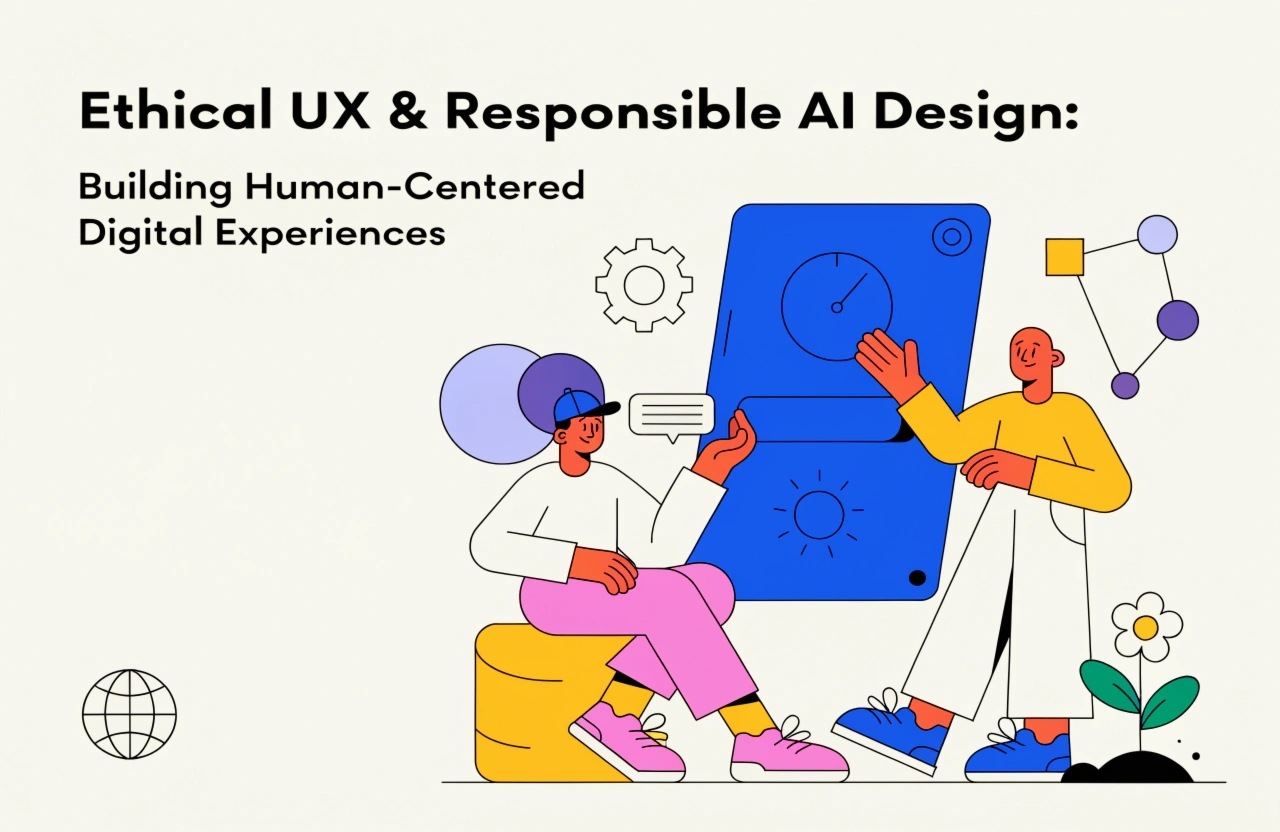
Ethical UX and Responsible AI Design combine user-centered thinking with transparency, privacy, fairness, accessibility, and accountability to create digital products that users can trust and businesses can depend on.
Ethical UX & Responsible AI Design: Building Human-Centered Digital Experiences
Artificial intelligence is rapidly changing the way people interact with websites, mobile applications, software platforms, and digital services. AI-powered recommendations, chatbots, personalized experiences, automated decisions, and generative AI features are becoming common across industries.
However, building an AI-powered product is not only a technical challenge. It is also a responsibility.
As AI becomes more influential in everyday decisions, businesses and product teams need to consider how their technology affects users. This is where Ethical UX and Responsible AI Design become essential.
Ethical UX focuses on creating experiences that respect users, while Responsible AI focuses on developing and deploying AI systems in ways that are fair, transparent, secure, accountable, and aligned with human values.
What Is Ethical UX?
Ethical UX is an approach to user experience design that considers more than usability and visual appeal. It focuses on whether a product genuinely respects the people who use it.
Traditional UX often asks:
- Is the product easy to use?
- Can users complete their tasks quickly?
- Is the interface intuitive?
Ethical UX adds important questions:
- Does the design manipulate users?
- Is the user clearly informed about what is happening?
- Is personal information being collected unnecessarily?
- Can users make informed choices?
- Is the experience accessible to different types of users?
For example, hiding an unsubscribe button, using confusing consent options, or intentionally making cancellation difficult may improve short-term business metrics but creates a poor and potentially unethical user experience.
Ethical UX aims to create products that are useful for both the business and the user.
What Is Responsible AI Design?
Responsible AI Design means considering ethical, social, and human consequences throughout the AI development lifecycle.
AI systems learn from data, and that data can contain errors, gaps, or biases. If these problems are ignored, AI systems may produce unfair or inaccurate results.
Responsible AI therefore considers several principles:
Fairness: AI systems should avoid unfair discrimination and reduce harmful bias.
Transparency: Users should understand when they are interacting with AI and, where appropriate, how AI-generated decisions are made.
Privacy: Personal and sensitive information should be collected, processed, stored, and shared responsibly.
Security: AI systems should be designed to reduce misuse, unauthorized access, and data exposure.
Accountability: Organizations should have clear responsibility for the behavior and impact of their AI systems.
Human Oversight: Important decisions should not always be left entirely to automated systems. Humans should remain involved where judgment and accountability are important.
Why Ethical UX and Responsible AI Matter
Trust is becoming one of the most valuable assets for digital businesses.
Users are more likely to adopt an AI-powered application when they understand how it works and feel that their information is being handled responsibly.
Consider an AI recommendation system. Instead of simply displaying a recommendation, the application could explain why the recommendation was generated.
For example:
"Recommended because you recently viewed similar products."
This small explanation can make an AI system feel more understandable and less mysterious.
Similarly, an AI chatbot should clearly identify itself as an AI assistant instead of making users believe they are communicating with a human employee.
Transparency helps users make informed decisions.
Designing AI Experiences Around Humans
AI should support people rather than unnecessarily replace human control.
Good AI UX provides users with appropriate levels of control. Depending on the application, this may include options to:
- Review AI-generated content
- Edit or reject recommendations
- Provide feedback
- Request human assistance
- Understand why an AI decision was made
- Change personalization settings
- Delete stored information
For high-impact applications, human oversight becomes even more important.
An AI system may assist with decision-making, but organizations should carefully determine where automated decisions are appropriate and where human review is necessary.
Avoiding Dark Patterns in AI Interfaces
Dark patterns are design techniques that manipulate users into making decisions they may not otherwise choose.
AI can make these patterns more sophisticated.
For example, an application could use personalized AI recommendations to aggressively encourage users to purchase something, subscribe to a service, or share additional personal information.
Responsible UX should avoid exploiting users' vulnerabilities.
Instead, interfaces should present choices clearly, use understandable language, and allow users to decline optional features without unnecessary friction.
Privacy by Design
Privacy should not be treated as an afterthought.
AI applications often require significant amounts of data. Product teams should determine what information is genuinely necessary and avoid collecting excessive data simply because it is technically possible.
Privacy-focused UX can include:
- Clear privacy explanations
- Simple consent controls
- Data deletion options
- Transparent personalization settings
- Minimal data collection
- Secure data handling
- Clear explanations of how AI uses user information
Privacy by design can also strengthen customer confidence and reduce potential regulatory and reputational risks.
Accessibility and Inclusive AI
Ethical digital experiences should work for as many people as reasonably possible.
AI-powered interfaces should consider users with different abilities, languages, technical backgrounds, and accessibility requirements.
Design teams can improve inclusivity through:
- Keyboard-friendly navigation
- Screen-reader compatibility
- Clear typography and contrast
- Voice interaction where appropriate
- Simple language
- Multilingual experiences
- Alternative ways to complete important tasks
Inclusive design is not only about compliance. It can help businesses reach broader audiences and create better experiences for everyone.
Building Responsible AI Into the Development Process
Ethical UX and Responsible AI should begin before development.
Product managers, UX designers, developers, data scientists, security teams, and business stakeholders should collaborate from the planning stage.
A responsible development process can include:
- Identify potential user and societal risks.
- Determine what data the AI system actually needs.
- Evaluate training and testing data for potential bias.
- Design transparent user interactions.
- Conduct accessibility and usability testing.
- Test AI outputs across different scenarios.
- Provide mechanisms for user feedback and correction.
- Monitor the system after launch.
- Establish clear ownership and accountability.
- Continuously improve the product based on evidence and feedback.
Responsible design is not a one-time checklist. AI systems can change as models, data, users, and business requirements evolve.
The Future of Ethical UX and Responsible AI
The future of digital product development will not be defined only by how powerful AI becomes. It will also depend on how responsibly organizations use that power.
Businesses that combine strong technology with ethical UX can create products that are more transparent, inclusive, secure, and trustworthy.
As AI becomes increasingly integrated into applications, websites, customer service platforms, healthcare solutions, financial services, education, and enterprise software, responsible design will become an important competitive advantage.
The goal should not simply be to build products that can make decisions.
The goal should be to build products that help people make better decisions while respecting their rights, choices, privacy, and dignity.
Ethical UX and Responsible AI Design provide a practical foundation for achieving that goal. By placing humans at the center of AI-powered experiences, businesses can innovate confidently while building long-term trust with their users.
We build scalable web, mobile, and game products for clients worldwide — combining modern frameworks, cloud infrastructure, and best engineering practices.
-1.jpg)