Learn how an AI SaaS product is built from end to end. Explore the complete architecture, including frontend, backend, APIs, AI models, cloud infrastructure, MLOps, security, databases, and deployment strategies for scalable AI applications.
Artificial Intelligence has transformed Software-as-a-Service (SaaS) products across industries. From AI-powered chatbots and intelligent document processing to predictive analytics and recommendation engines, organizations are embedding AI into cloud applications to improve efficiency and user experiences.
However, building a successful AI SaaS product involves much more than integrating a machine learning model. It requires a carefully designed architecture that combines frontend technologies, backend services, AI models, cloud infrastructure, security, databases, and continuous deployment pipelines. Each component must work seamlessly to deliver scalable, reliable, and secure AI-driven experiences.
This guide explores the end-to-end architecture of a modern AI SaaS product and explains how its core components interact.
What Is an AI SaaS Product?
An AI SaaS product is a cloud-based software application that delivers artificial intelligence capabilities through a subscription model.
Examples include:
- AI writing assistants
- Customer support chatbots
- Image generation platforms
- Fraud detection systems
- Predictive analytics dashboards
- AI-powered CRM solutions
- Document intelligence platforms
Unlike traditional software, AI SaaS products continuously process data and generate intelligent outputs based on machine learning models.
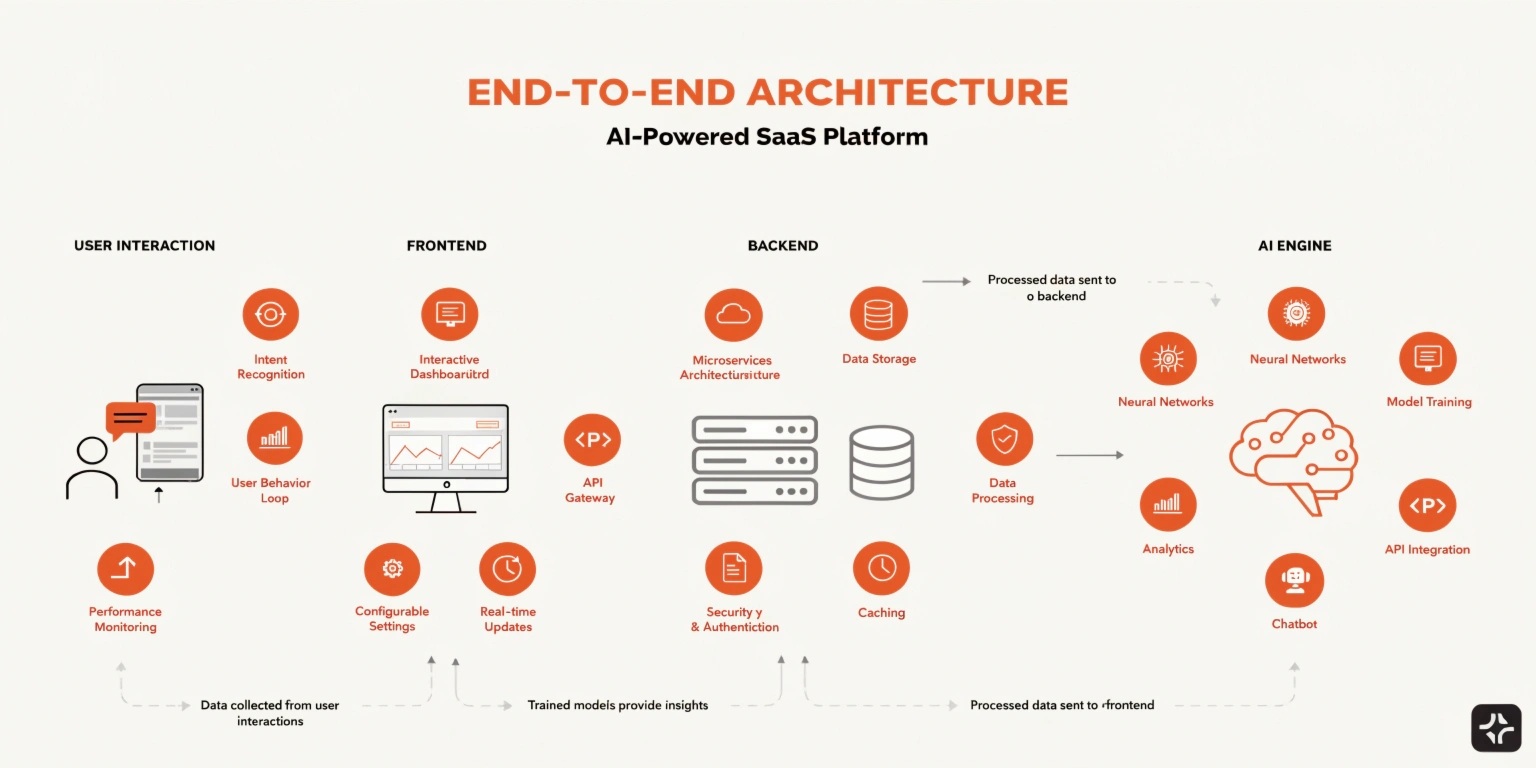
High-Level Architecture Overview
A modern AI SaaS application typically consists of the following layers:
- Frontend application
- API Gateway
- Backend services
- Authentication and authorization
- AI inference services
- Databases
- Vector databases
- Object storage
- Message queues
- Monitoring systems
- Cloud infrastructure
- CI/CD and MLOps pipelines
Each layer performs a specialized role while remaining loosely coupled for scalability and maintainability.
Frontend Layer
The frontend provides the interface through which users interact with the AI application.
Typical technologies include:
- React
- Next.js
- Angular
- Vue.js
- Flutter for mobile apps
The frontend is responsible for:
- User authentication
- Dashboard rendering
- Prompt submission
- Displaying AI-generated responses
- File uploads
- Real-time notifications
Responsive design and intuitive user experiences are essential for improving customer satisfaction.
API Gateway
The API Gateway acts as the entry point for all client requests.
Its responsibilities include:
- Request routing
- Authentication
- Rate limiting
- Logging
- Load balancing
- API version management
This layer protects backend services while improving scalability and reliability.
Backend Services
The backend manages business logic and application workflows.
Common responsibilities include:
- User management
- Subscription handling
- Billing integration
- Data validation
- Workflow orchestration
- Usage tracking
- Audit logging
Backend services are commonly built using:
- ASP.NET Core
- Node.js
- FastAPI
- Django
- Spring Boot
A microservices architecture is often preferred for enterprise-scale AI applications.
AI Inference Layer
This layer performs AI processing.
Depending on the application, it may host:
- Large Language Models (LLMs)
- Computer vision models
- Recommendation engines
- Speech recognition models
- Classification algorithms
- Forecasting models
The inference service receives requests from the backend, processes them through AI models, and returns predictions or generated content.
To improve scalability, many organizations separate inference workloads from core application services.
Databases
Multiple databases are often used to optimize different workloads.
Typical choices include:
- PostgreSQL for transactional data
- MongoDB for document storage
- Redis for caching
- Elasticsearch for search
- Vector databases for semantic search
This approach, known as Polyglot Persistence, enables each database to handle the workload it is best suited for.
Vector Databases
Modern AI products increasingly use vector databases.
They store numerical embeddings generated by AI models.
Common use cases include:
- Semantic search
- Recommendation engines
- Retrieval-Augmented Generation (RAG)
- Similarity matching
- Knowledge retrieval
Vector databases significantly improve the quality of AI-generated responses by providing relevant contextual information.
Object Storage
Large AI applications manage numerous files, including:
- Images
- Videos
- Audio recordings
- PDFs
- Training datasets
- Generated documents
Cloud object storage provides scalable and cost-effective file management.
Asynchronous Processing
Certain AI operations require considerable processing time.
Instead of blocking users, applications often use message queues and background workers.
Examples include:
- Model training
- Video processing
- Large document analysis
- Image generation
- Batch predictions
This architecture improves responsiveness and user experience.
MLOps Pipeline
Machine Learning Operations (MLOps) streamline the deployment and maintenance of AI models.
A typical pipeline includes:
- Data collection
- Data preprocessing
- Model training
- Validation
- Deployment
- Performance monitoring
- Model retraining
Automation ensures models remain accurate as data evolves.
Security Considerations
AI SaaS applications often process sensitive business information.
Security best practices include:
- Multi-factor authentication
- Role-based access control
- End-to-end encryption
- Secure API authentication
- Data anonymization
- Compliance with regulations such as GDPR and HIPAA
- Continuous vulnerability monitoring
Security should be integrated throughout the development lifecycle rather than added later.
Monitoring and Observability
Continuous monitoring ensures system reliability.
Key metrics include:
- API response time
- Model latency
- GPU utilization
- Error rates
- Resource consumption
- User activity
- Infrastructure health
Observability platforms help teams detect issues before they affect customers.
Scalability Strategies
AI workloads can vary significantly throughout the day.
Scalable AI architectures use:
- Containerization
- Kubernetes orchestration
- Auto-scaling
- Load balancing
- Distributed caching
- CDN integration
These techniques maintain performance during periods of high demand.
Future Trends
AI SaaS architectures continue to evolve rapidly.
Emerging trends include:
- Agentic AI systems
- Multi-model AI platforms
- Serverless AI inference
- Edge AI deployment
- Retrieval-Augmented Generation (RAG)
- AI observability platforms
- Energy-efficient inference
- Federated learning
These innovations will make AI applications faster, more intelligent, and more cost-effective.
Conclusion
Building an AI SaaS product requires far more than deploying a machine learning model. A successful solution combines frontend applications, backend services, cloud infrastructure, databases, AI inference, security, monitoring, and MLOps into a cohesive architecture capable of delivering reliable and scalable experiences.
As AI adoption accelerates across industries, organizations that invest in well-designed, cloud-native architectures will be better positioned to build intelligent products that scale efficiently, protect user data, and adapt to future technological advancements. Understanding the complete architecture is the first step toward creating AI-powered SaaS applications that are both innovative and enterprise-ready.
We build scalable web, mobile, and game products for clients worldwide — combining modern frameworks, cloud infrastructure, and best engineering practices.
-1.jpg)