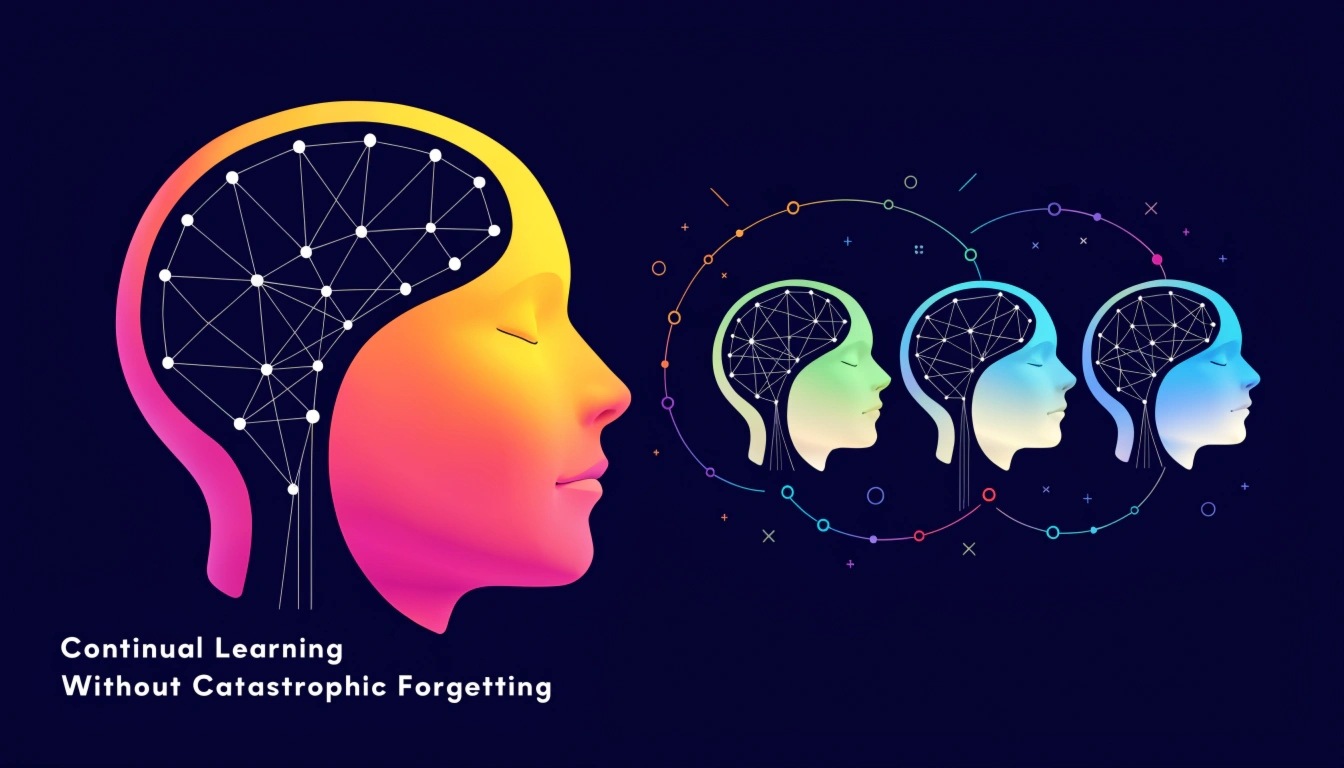
Learn how continual learning enables AI systems to adapt to new information without losing previously learned knowledge, solving the challenge of catastrophic forgetting in machine learning.
Artificial intelligence systems are becoming increasingly capable of solving complex tasks, from image recognition and natural language processing to robotics and autonomous decision-making. However, despite these advancements, most AI systems still struggle with one major limitation: learning continuously without forgetting previously acquired knowledge.
This challenge is known as catastrophic forgetting.
Traditional machine learning models are typically trained once using static datasets. When these models are retrained on new tasks or new data, they often overwrite earlier knowledge, causing performance on previous tasks to decline dramatically.
Humans, in contrast, can continuously learn throughout life while retaining earlier experiences and skills. Replicating this capability in AI systems has become one of the most important research areas in modern artificial intelligence.
Continual learning aims to solve this problem by enabling AI models to adapt to new information while preserving past knowledge.
What is Continual Learning?
Continual learning, also known as lifelong learning, is a machine learning approach where AI systems learn incrementally over time instead of relying on a single training phase.
In continual learning:
- Models continuously receive new data
- AI adapts to changing environments
- Previously learned knowledge is retained
- Systems improve dynamically over time
This approach is especially important for real-world AI systems operating in:
- Robotics
- Autonomous vehicles
- Healthcare systems
- Personalized recommendations
- Cybersecurity
- Conversational AI
Unlike traditional static models, continual learning systems evolve continuously.
Understanding Catastrophic Forgetting
Catastrophic forgetting occurs when a neural network learns a new task and unintentionally loses performance on previously learned tasks.
For example:
- An AI trained to recognize animals learns a new vehicle dataset
- After retraining, the model may perform well on vehicles
- But accuracy on animals drops significantly
This happens because neural networks update weights and parameters during training. New learning can overwrite earlier representations stored in the model.
Catastrophic forgetting is one of the biggest obstacles preventing truly adaptive AI systems.
Why Continual Learning Matters
Real-world environments constantly change.
AI systems deployed in production often encounter:
- New user behavior
- Updated business requirements
- Emerging threats
- Changing market trends
- New data patterns
Without continual learning, AI models become outdated quickly.
Retraining models from scratch repeatedly is:
- Expensive
- Time-consuming
- Computationally intensive
Continual learning offers a more scalable and adaptive solution.
Types of Continual Learning
1. Task-Incremental Learning
In this approach, the model learns multiple tasks sequentially while knowing which task it is currently solving.
Example:
- Language translation tasks
- Different image classification datasets
The challenge is maintaining performance across all tasks.
2. Domain-Incremental Learning
The task remains similar, but the input data distribution changes over time.
Examples include:
- Changing lighting conditions in computer vision
- Evolving customer behavior in recommendation systems
The AI must adapt without forgetting earlier patterns.
3. Class-Incremental Learning
The model gradually learns entirely new classes over time.
For example:
- Initially recognizing cats and dogs
- Later learning birds and horses
- Without forgetting earlier categories
This is one of the most difficult continual learning challenges.
Techniques to Prevent Catastrophic Forgetting
Researchers have developed several strategies to reduce forgetting in neural networks.
Regularization-Based Methods
Regularization approaches prevent important neural network parameters from changing too much during new learning.
One popular technique is Elastic Weight Consolidation (EWC).
The idea is:
- Identify critical weights for previous tasks
- Restrict large modifications during retraining
This helps preserve previously learned knowledge while allowing adaptation.
Replay-Based Methods
Replay methods store samples from earlier tasks and replay them during new training phases.
There are two main approaches:
Experience Replay
Old training data is stored and mixed with new data during retraining.
Generative Replay
Instead of storing raw data, AI models generate synthetic samples representing earlier knowledge.
Replay techniques are highly effective but may require additional memory and storage resources.
Dynamic Architecture Methods
Some continual learning systems expand neural network architecture dynamically.
Instead of overwriting old parameters:
- New neurons or layers are added
- Older knowledge remains protected
This approach improves memory retention but increases computational complexity over time.
Transfer Learning and Knowledge Distillation
Transfer learning helps AI systems apply previously learned knowledge to related tasks.
Knowledge distillation allows smaller models to preserve information from larger pretrained systems.
These techniques improve:
- Learning efficiency
- Generalization
- Adaptability
Companies such as Google and OpenAI actively research continual learning systems for advanced AI applications.
Continual Learning in Real-World Applications
Autonomous Vehicles
Self-driving systems must continuously adapt to:
- New road conditions
- Traffic patterns
- Environmental changes
Continual learning enables safer and more adaptive navigation systems.
Cybersecurity
Threat landscapes evolve constantly.
AI security systems must learn:
- New attack patterns
- Malware behaviors
- Fraud techniques
without forgetting previous threats.
Healthcare AI
Medical AI systems continuously receive:
- New patient data
- Emerging disease patterns
- Updated diagnostic information
Continual learning improves long-term diagnostic accuracy.
Recommendation Systems
Streaming and e-commerce platforms rely heavily on changing user preferences.
AI recommendation systems must adapt continuously to:
- Viewing behavior
- Purchase history
- Trending content
without losing earlier personalization knowledge.
Challenges in Continual Learning
Despite significant progress, continual learning still faces major challenges.
Memory Constraints
Replay methods require storing previous data or model states, increasing memory usage.
Computational Cost
Dynamic architectures and retraining pipelines can become computationally expensive.
Balancing Stability and Plasticity
AI systems must balance:
- Stability (retaining old knowledge)
- Plasticity (learning new information)
Finding the optimal balance remains difficult.
Evaluation Complexity
Measuring continual learning performance is more complex than evaluating traditional machine learning models.
Researchers must assess:
- Knowledge retention
- Adaptation speed
- Long-term generalization
Role of MLOps in Continual Learning
Continual learning systems require strong operational infrastructure.
Modern MLOps pipelines help manage:
- Continuous retraining
- Data versioning
- Model monitoring
- Performance evaluation
- Automated deployment
Production AI systems increasingly depend on continual learning frameworks for scalability and reliability.
The Future of Continual Learning
The future of AI will likely depend heavily on continual learning capabilities.
Future advancements may include:
- Self-adaptive AI agents
- Real-time autonomous learning
- Brain-inspired neural architectures
- Memory-efficient lifelong learning models
- Personalized adaptive AI systems
Researchers are also exploring neuromorphic computing and biologically inspired learning methods to mimic human memory systems more effectively.
Conclusion
Continual learning represents one of the most important steps toward building truly intelligent and adaptive AI systems. Solving catastrophic forgetting is essential for enabling AI to operate effectively in dynamic real-world environments where data, behavior, and requirements constantly evolve.
By combining memory retention techniques, adaptive architectures, replay systems, and scalable MLOps infrastructure, researchers and organizations are gradually moving closer to lifelong learning AI systems.
As artificial intelligence continues advancing, continual learning will play a central role in creating smarter, more resilient, and continuously evolving machine learning systems capable of learning throughout their operational lifetime.
We build scalable web, mobile, and game products for clients worldwide — combining modern frameworks, cloud infrastructure, and best engineering practices.
-1.jpg)