Efficient context management is essential for scalable LLM applications. Learn how summarization, prompt compression, RAG, semantic filtering, caching, context prioritization, and dynamic retrieval can reduce token usage while preserving relevant information and improving AI application performance.
Large Language Models have transformed how developers build intelligent applications. From AI assistants and document analysis platforms to coding tools and enterprise knowledge systems, LLMs can process and generate remarkably sophisticated responses.
However, LLM applications face an important limitation: context windows.
A context window defines how much information a model can process during a single interaction. Although modern models support increasingly large context windows, simply sending more information is not always the best solution.
Large contexts can increase latency, token consumption, infrastructure costs, and sometimes even reduce response quality.
Effective context window optimization is therefore an essential skill for building production-ready LLM applications.
What Is a Context Window?
A context window represents the total amount of information an LLM can consider during a request.
It may include:
- System instructions
- User messages
- Conversation history
- Retrieved documents
- Tool outputs
- Previous model responses
- Current prompts
All of this information consumes tokens.
For example, an AI customer-support assistant may accumulate thousands of messages during a long conversation. Sending the entire history with every request can become inefficient.
The goal is not to maximize context usage but to provide the model with the most relevant information required to produce a high-quality response.
Why Context Optimization Matters
Poor context management can cause several problems.
Higher Costs
LLM APIs commonly charge based on token usage. Sending unnecessary information increases costs.
Higher Latency
Larger prompts require more processing and can increase response times.
Reduced Relevance
A massive amount of irrelevant information can make it harder for the model to focus on important details.
Context Limits
Every model has a maximum context capacity. Applications can eventually exceed that limit.
Context optimization addresses these challenges.
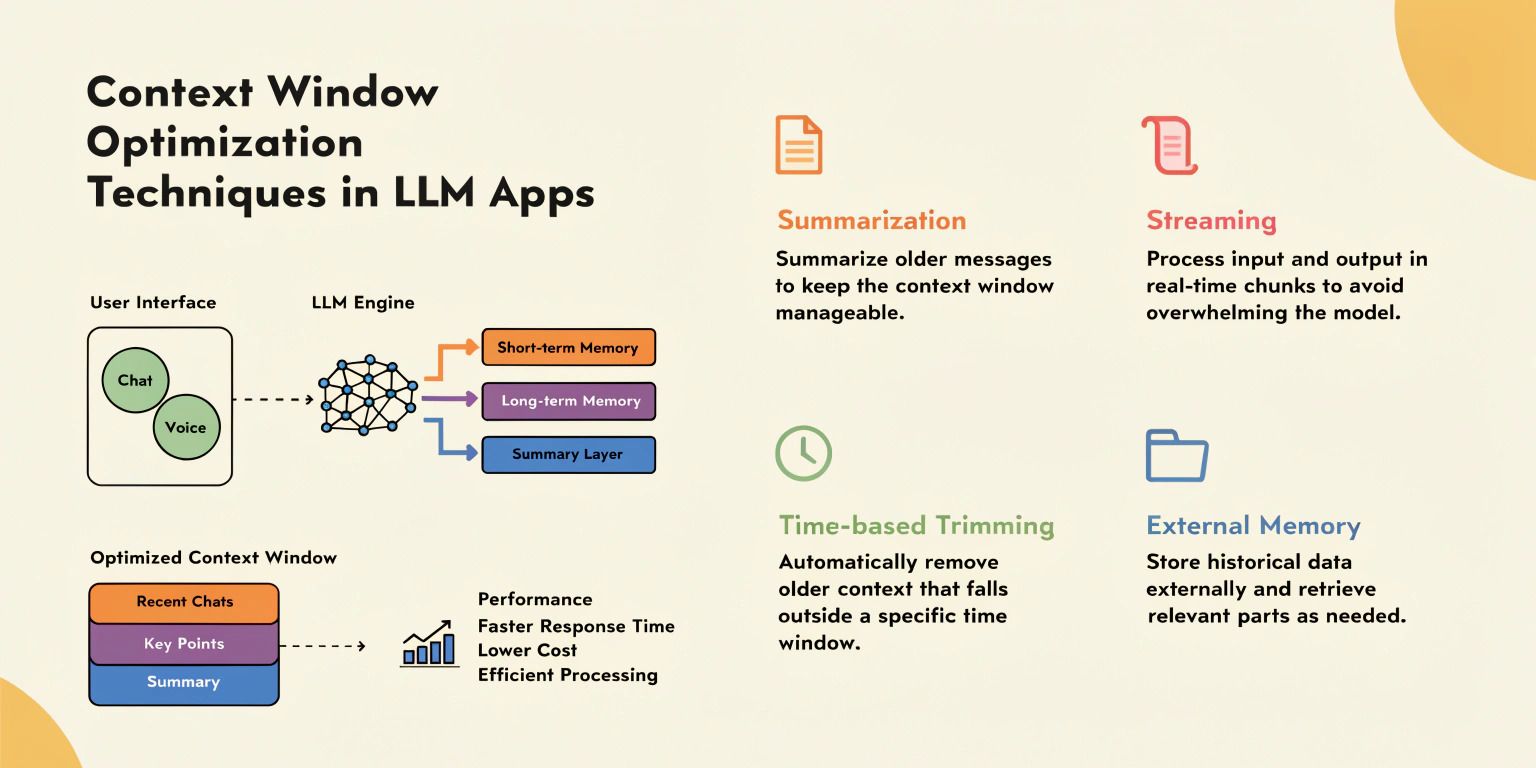
1. Conversation Summarization
Long conversations can be compressed into concise summaries.
Instead of sending hundreds of previous messages, the application can maintain a structured summary containing:
- User preferences
- Important decisions
- Key facts
- Current objectives
- Unresolved questions
For example, an AI project-management assistant could summarize a lengthy discussion into:
"User is building a SaaS platform using React and Node.js. Authentication is complete. The remaining task is payment integration."
The summary preserves useful information while significantly reducing token consumption.
2. Sliding Context Windows
Applications do not always need the entire conversation history.
A sliding window keeps only the most recent messages.
For example:
Full history: 100 messages
Active context: Most recent 10–20 messages
This approach works well for conversational applications where recent interactions are more relevant than old messages.
Older information can be moved into long-term memory or summarized separately.
3. Retrieval-Augmented Generation
Retrieval-Augmented Generation, commonly known as RAG, is one of the most effective strategies for controlling context size.
Instead of sending an entire knowledge base to the model, the application retrieves only the documents relevant to the current query.
The typical workflow is:
User Query → Retrieval → Relevant Documents → LLM → Response
This dramatically reduces unnecessary context.
RAG is particularly useful for:
- Enterprise knowledge bases
- Documentation assistants
- Customer support
- Legal document search
- Research systems
- Internal company chatbots
4. Semantic Chunking
Large documents should be divided into meaningful sections before being indexed.
Poor chunking can produce incomplete or irrelevant retrieval results.
Instead of splitting documents solely by character count, semantic chunking considers:
- Paragraphs
- Sections
- Headings
- Topics
- Logical boundaries
Better chunks generally lead to better retrieval quality.
5. Context Prioritization
Not every piece of information deserves equal importance.
A context-management system can prioritize information based on relevance.
For example:
High Priority
- User's current question
- System instructions
- Relevant retrieved documents
Medium Priority
- Recent conversation history
- Previous decisions
Low Priority
- Old unrelated messages
The application can allocate context space accordingly.
6. Prompt Compression
Prompt compression removes unnecessary language while preserving meaning.
Instead of sending:
"Please carefully analyze the following information and provide a detailed answer based on all the information presented below..."
A system can use a much shorter instruction when appropriate.
Compression can be performed manually through prompt engineering or automatically using specialized techniques.
The objective is to reduce token usage without damaging task performance.
7. Remove Redundant Information
Duplicate information frequently appears in LLM workflows.
For example, an application might retrieve multiple documents containing the same explanation.
Deduplication techniques can eliminate repeated content before it reaches the model.
This reduces:
- Token consumption
- Processing time
- Context noise
8. Dynamic Context Selection
Context should be selected dynamically based on the current task.
A coding assistant might need:
- Current source file
- Related functions
- Error message
- Relevant documentation
It does not necessarily need the entire repository.
Similarly, a customer-support assistant should retrieve information relevant to the customer's specific issue rather than loading the entire product documentation.
9. Token Budgeting
Developers should establish explicit token budgets.
For example, an application could reserve context space for:
- System instructions
- Conversation history
- Retrieved information
- User query
- Model response
Budgeting prevents one component from consuming the entire context window.
10. Caching Repeated Context
Some information appears repeatedly across requests.
Examples include:
- System instructions
- Product documentation
- Frequently accessed policies
- Common tool definitions
Caching strategies can reduce unnecessary processing and potentially improve application performance and cost efficiency, depending on the model provider and infrastructure.
11. Structured Context
Instead of providing large amounts of unstructured text, developers can organize information clearly.
For example:
User Goal: Build an eCommerce platform
Technology: Next.js
Current Task: Payment integration
Issue: Webhook verification failing
Structured information makes the context easier for the model to interpret.
12. Context-Aware Memory
Advanced LLM applications can separate memory into different categories.
Short-Term Memory
Recent conversation details.
Long-Term Memory
Persistent user preferences and important historical information.
Task Memory
Information relevant to the current workflow.
This architecture prevents applications from repeatedly sending irrelevant historical data.
Measuring Context Optimization
Optimization should be evaluated using measurable metrics.
Important metrics include:
- Input token count
- Output token count
- Cost per request
- Response latency
- Retrieval precision
- Retrieval recall
- Answer accuracy
- Context utilization
- User satisfaction
Reducing token usage is not enough if answer quality decreases significantly.
The best optimization balances cost, latency, and quality.
Common Mistakes
Developers often make several context-management mistakes.
These include:
- Sending entire conversation histories
- Retrieving too many documents
- Using oversized chunks
- Including duplicate content
- Ignoring token budgets
- Storing everything as permanent memory
- Optimizing tokens without measuring quality
Context optimization should be treated as an engineering problem rather than simply a prompt-writing exercise.
Future of Context Management
As LLM applications become more sophisticated, context management will become increasingly intelligent.
Future systems may automatically:
- Select relevant memories
- Compress conversations
- Rank retrieved information
- Predict useful context
- Remove redundant information
- Dynamically adjust token budgets
This will allow AI agents to operate across complex workflows without continuously expanding their context requirements.
Conclusion
Context window optimization is a critical component of production-grade LLM engineering. Simply providing an AI model with more information does not guarantee better results. In many cases, carefully selecting and structuring relevant information produces better responses while reducing latency and cost.
Techniques such as conversation summarization, RAG, semantic chunking, prompt compression, context prioritization, dynamic retrieval, caching, and structured memory allow developers to build efficient AI applications that operate within practical context limits.
The fundamental principle is simple: give the model the right information, not all the information. By treating context as a limited engineering resource, developers can create LLM applications that are faster, more reliable, cost-effective, and scalable.
We build scalable web, mobile, and game products for clients worldwide — combining modern frameworks, cloud infrastructure, and best engineering practices.
-1.jpg)