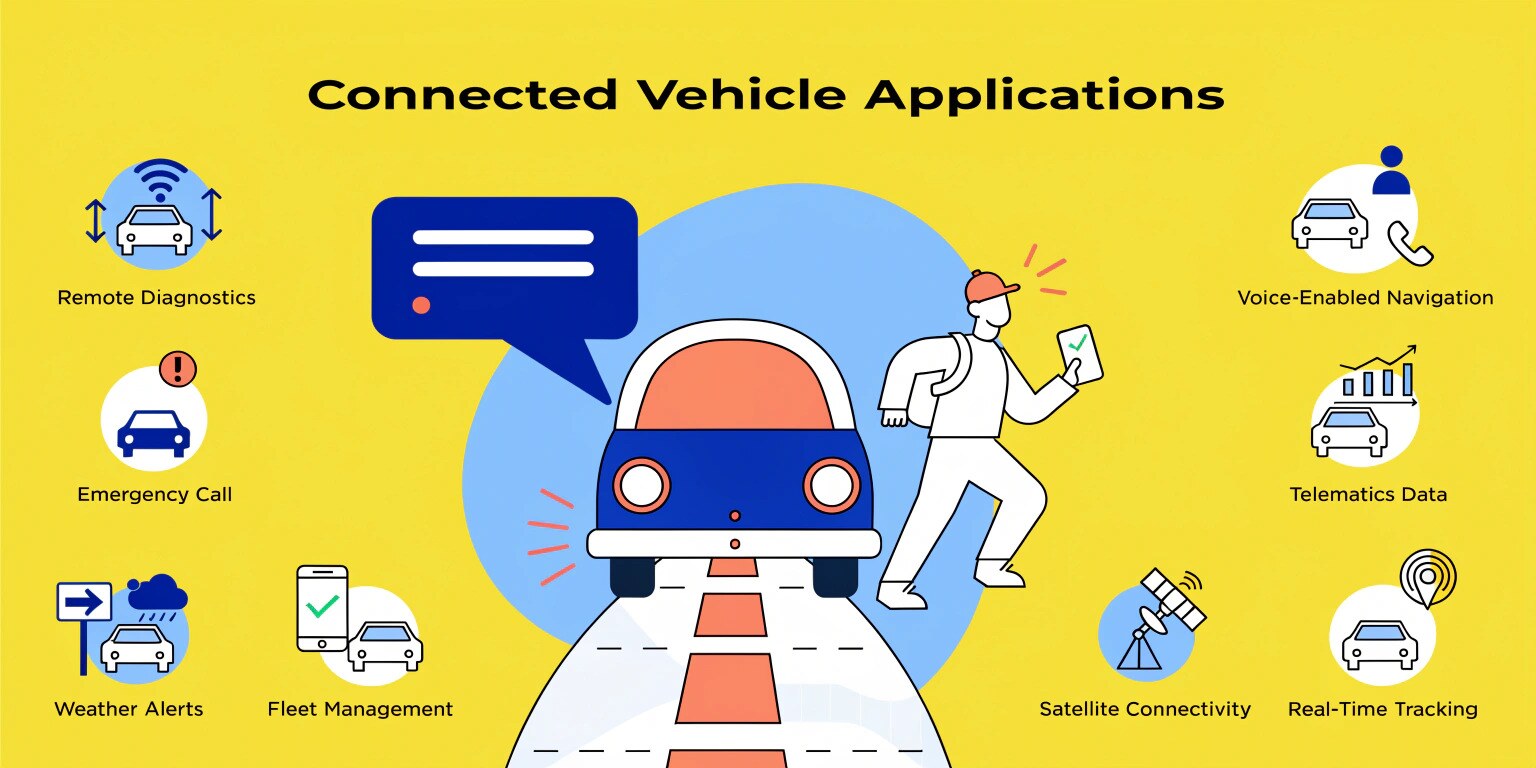
Connected vehicle applications combine IoT, cloud computing, AI, GPS, sensors, and real-time communication to create smarter transportation experiences. They enable vehicle monitoring, predictive maintenance, fleet management, safety services, remote control, navigation, and data-driven mobility solutions.
automotive industry is moving beyond traditional vehicles toward intelligent, connected transportation ecosystems. Modern vehicles can communicate with smartphones, cloud platforms, infrastructure, other vehicles, and external services. This transformation is creating new opportunities for automotive manufacturers, software companies, fleet operators, and mobility providers.
Connected vehicle applications use technologies such as IoT, GPS, sensors, cellular networks, cloud computing, artificial intelligence, and data analytics to collect and exchange information in real time.
From remote vehicle monitoring to predictive maintenance and intelligent navigation, connected applications are changing how vehicles are operated, maintained, and experienced.
What Are Connected Vehicle Applications?
Connected vehicle applications are software systems that allow vehicles to exchange information with external devices, platforms, or services.
A connected vehicle ecosystem can include:
- Vehicle sensors
- Mobile applications
- Cloud platforms
- GPS systems
- Telematics units
- IoT gateways
- Automotive APIs
- Data analytics platforms
- Backend services
For example, a mobile application can display a vehicle's location, fuel level, battery status, tire pressure, or maintenance alerts by receiving data from the connected vehicle platform.
How Connected Vehicle Systems Work
A typical connected vehicle architecture consists of several layers.
Vehicle Layer
Sensors and electronic control units collect information about the vehicle.
Data may include:
- Speed
- Engine status
- Battery level
- Fuel consumption
- Tire pressure
- Temperature
- Location
- Driving behavior
Connectivity Layer
Vehicle data is transmitted through technologies such as cellular networks, Wi-Fi, Bluetooth, or other communication systems.
Cloud Layer
Cloud infrastructure receives, processes, stores, and analyzes vehicle data.
Application Layer
Users and businesses access the information through mobile applications, web dashboards, APIs, and other interfaces.
This architecture enables real-time communication between vehicles and digital services.
Remote Vehicle Monitoring
One of the most common connected vehicle applications is remote monitoring.
Vehicle owners can use mobile applications to check information such as:
- Current location
- Fuel level
- Battery status
- Vehicle temperature
- Lock status
- Maintenance notifications
Remote monitoring provides convenience while helping users understand the condition of their vehicles without physically inspecting them.
Remote Vehicle Control
Connected applications can also enable certain remote vehicle functions, depending on the vehicle and manufacturer's capabilities.
Examples include:
- Remote locking and unlocking
- Climate control
- Vehicle start
- Horn activation
- Light control
- Charging management
Strong authentication and authorization are essential because remote control features can create significant security risks if improperly implemented.
Predictive Maintenance
Connected vehicle data can help identify potential mechanical or electrical problems before they become major failures.
Machine learning models can analyze:
- Engine performance
- Battery behavior
- Temperature changes
- Vibration patterns
- Error codes
- Driving conditions
Instead of relying entirely on fixed maintenance schedules, vehicles can provide condition-based maintenance recommendations.
This can reduce unexpected breakdowns and improve vehicle availability.
Fleet Management
Connected vehicle applications are particularly valuable for commercial fleets.
Fleet managers can monitor:
- Vehicle locations
- Driver behavior
- Fuel consumption
- Route efficiency
- Vehicle utilization
- Maintenance schedules
- Idle time
Fleet analytics can help businesses reduce operating costs and improve logistics efficiency.
For delivery companies, real-time tracking can also improve customer communication by providing more accurate delivery estimates.
Intelligent Navigation
Connected vehicles can combine GPS information with cloud-based traffic and road data.
Applications can provide:
- Real-time traffic updates
- Route optimization
- Accident alerts
- Weather information
- Parking information
- Charging station locations
AI-powered navigation systems can analyze historical and real-time data to recommend more efficient routes.
Vehicle-to-Everything Communication
V2X communication enables vehicles to exchange information with their surrounding environment.
This can include:
- Vehicle-to-Vehicle communication
- Vehicle-to-Infrastructure communication
- Vehicle-to-Pedestrian communication
- Vehicle-to-Network communication
V2X technology has the potential to support advanced safety systems and intelligent transportation infrastructure.
For example, vehicles could receive information about road hazards or traffic conditions before the driver reaches a particular location.
Infotainment Applications
Connected vehicle platforms also support modern infotainment experiences.
Applications can provide:
- Music streaming
- Podcasts
- Voice assistants
- Navigation
- Personalized content
- Connected services
- Smartphone integration
Cloud connectivity allows applications and services to receive updates without requiring traditional manual installation processes.
Electric Vehicle Applications
Connected applications are particularly important for electric vehicles.
Drivers can monitor:
- Battery charge
- Estimated range
- Charging progress
- Energy consumption
- Charging station availability
- Charging schedules
Mobile applications can notify users when charging is complete or help them identify charging locations along a planned route.
AI and Data Analytics
Connected vehicles generate enormous amounts of data.
Artificial intelligence can convert this data into useful insights.
AI applications may support:
- Predictive maintenance
- Driver behavior analysis
- Traffic prediction
- Energy optimization
- Personalized recommendations
- Anomaly detection
As vehicle data becomes more sophisticated, AI will play an increasingly important role in connected mobility.
Cybersecurity Challenges
Connectivity also creates new security risks.
Potential threats include:
- Unauthorized vehicle access
- API vulnerabilities
- Data theft
- Malware
- Credential attacks
- GPS manipulation
- Communication interception
Connected vehicle developers should implement:
- Strong authentication
- Encryption
- Secure APIs
- Access controls
- Secure firmware updates
- Continuous monitoring
- Vulnerability testing
Security must be integrated throughout the vehicle software lifecycle rather than added after development.
Data Privacy
Connected vehicles collect highly sensitive information about users and their activities.
Potentially sensitive data can include:
- Location history
- Driving patterns
- Vehicle usage
- User identifiers
- Mobile device information
Organizations should establish clear policies around data collection, processing, storage, sharing, and retention.
Users should understand what information is being collected and how it is being used.
Development Challenges
Building connected vehicle applications requires coordination between multiple technologies.
Development teams may need expertise in:
- Mobile development
- Cloud computing
- IoT
- Embedded systems
- Automotive protocols
- AI and machine learning
- Cybersecurity
- Real-time data processing
Reliability is particularly important because vehicle applications may operate in environments with intermittent connectivity.
Systems should therefore support appropriate offline behavior, retry mechanisms, and fault tolerance.
Future of Connected Vehicle Applications
Connected vehicle technology is expected to become increasingly integrated with broader smart-city ecosystems.
Future applications may include:
- Autonomous vehicle coordination
- AI-powered driving assistance
- Smart parking
- Intelligent traffic management
- Vehicle-to-grid communication
- Connected public transportation
- Advanced fleet automation
- Personalized mobility services
As 5G, edge computing, AI, and automotive software platforms evolve, vehicles will increasingly function as intelligent computing platforms rather than standalone transportation machines.
Conclusion
Connected vehicle applications are transforming automobiles into intelligent, data-driven systems capable of communicating with users, cloud platforms, infrastructure, and other vehicles. From remote monitoring and predictive maintenance to fleet management, intelligent navigation, EV charging, and V2X communication, connected technologies are creating new opportunities across the automotive industry.
However, successful connected vehicle development requires more than connectivity. Developers must prioritize cybersecurity, privacy, reliability, scalability, and real-time data processing.
As automotive and software technologies continue to converge, connected vehicle applications will become an increasingly important component of smart mobility, creating safer, more efficient, personalized, and intelligent transportation experiences.
We build scalable web, mobile, and game products for clients worldwide — combining modern frameworks, cloud infrastructure, and best engineering practices.
.jpg)
.jpg)