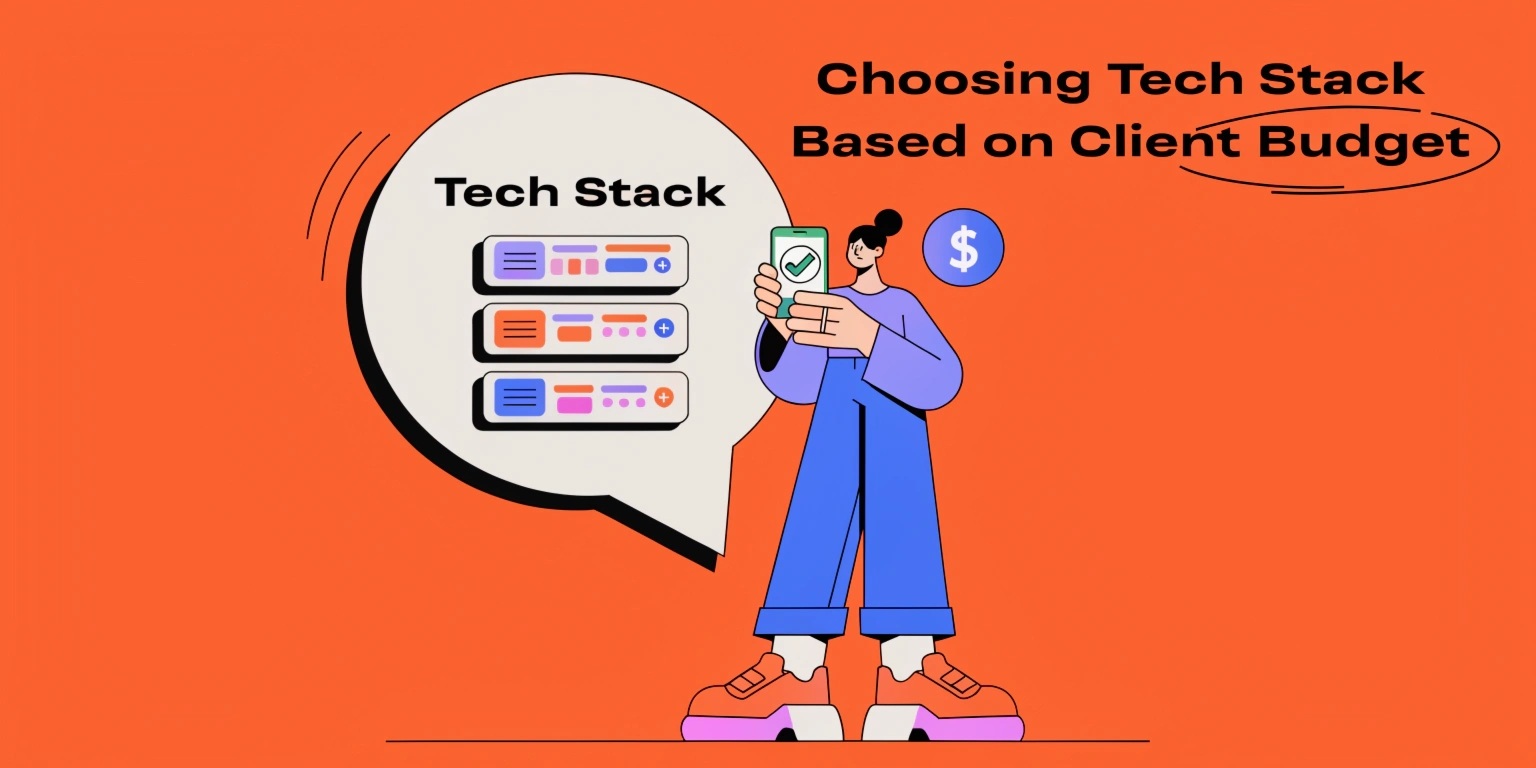
Choosing the right tech stack isn't about selecting the newest technology—it's about balancing client budget, business goals, scalability, and maintenance. Discover how to make cost-effective technology decisions that deliver long-term value.
One of the most critical decisions in any software development project is selecting the right technology stack. While developers often prefer the latest frameworks or technologies they enjoy working with, the ideal tech stack should align with the client's budget, project requirements, timeline, and future business goals.
Choosing an expensive or overly complex technology for a small project can significantly increase development and maintenance costs. On the other hand, selecting a stack solely because it is inexpensive may limit scalability and future growth. The key is finding the right balance between affordability and long-term value.
This guide explains how IT agencies and software development teams can choose the most suitable technology stack based on client budgets while ensuring performance, reliability, and scalability.
Understanding the Client's Budget
Before discussing programming languages or frameworks, understand the client's financial expectations.
Questions to ask include:
- What is the total project budget?
- Is this an MVP or a full-scale product?
- How many users are expected initially?
- What is the expected launch timeline?
- Is there a budget for future enhancements?
- Will the application require ongoing maintenance?
These answers provide valuable context for selecting technologies that fit both technical and financial requirements.
Categorizing Projects by Budget
Different budgets call for different development approaches.
Small Budget Projects
Typical budget: Startup MVPs, small business websites, internal tools, or proof-of-concept applications.
Goals:
- Fast development
- Lower development costs
- Minimal infrastructure expenses
- Easy maintenance
Suitable technologies include:
- Laravel
- PHP
- WordPress (where appropriate)
- React
- Vue.js
- Flutter for cross-platform mobile apps
- MySQL
- Firebase
These technologies have large developer communities, extensive documentation, and lower hiring costs.
Medium Budget Projects
Businesses with moderate budgets often require custom applications with room for growth.
Common requirements include:
- Custom dashboards
- API integrations
- Authentication systems
- Payment gateways
- CRM functionality
Recommended technologies:
- React
- Angular
- Node.js
- Laravel
- ASP.NET Core
- PostgreSQL
- Docker
- AWS or Microsoft Azure
This combination offers flexibility while keeping infrastructure and maintenance manageable.
Enterprise Budget Projects
Large organizations prioritize scalability, security, and long-term sustainability over initial development costs.
Common characteristics:
- High traffic
- Large databases
- Multiple integrations
- Regulatory compliance
- High availability
Enterprise-ready technologies include:
- Java Spring Boot
- ASP.NET Core
- Node.js
- Kubernetes
- Microservices architecture
- PostgreSQL
- MongoDB
- Redis
- Kafka
- AWS, Azure, or Google Cloud Platform
Although these technologies require higher investment, they provide greater reliability and flexibility for business growth.
Prioritize Business Requirements Over Technology Trends
Not every project needs artificial intelligence, blockchain, or microservices.
Many businesses can achieve their goals using simpler solutions that are easier to build and maintain.
For example:
A local retail business needing inventory management does not require a distributed microservices architecture. A Laravel-based monolithic application may deliver the same functionality faster and at a lower cost.
Technology should solve business problems—not create unnecessary complexity.
Consider Development Speed
Development time directly affects project cost.
Frameworks with built-in features often reduce development effort.
Examples include:
- Laravel for authentication and CRUD operations
- Flutter for cross-platform mobile apps
- React with reusable components
- Firebase for backend services
- Next.js for server-side rendering
Faster development means lower costs for clients and quicker product launches.
Evaluate Long-Term Maintenance Costs
Initial development is only part of the total investment.
Consider:
- Server expenses
- Developer availability
- Framework updates
- Security patches
- Feature enhancements
- Technical support
A slightly higher upfront investment in a widely supported technology may reduce maintenance costs over several years.
Think About Scalability
Some applications begin with a few hundred users but eventually grow into platforms serving thousands or even millions.
When selecting a tech stack, ask:
- Can it scale horizontally?
- Does it support cloud deployment?
- Are caching solutions available?
- Can APIs be expanded later?
- Is database scaling straightforward?
Building for reasonable future growth avoids expensive migrations later.
Balance Open-Source and Commercial Solutions
Open-source technologies help reduce licensing costs.
Popular choices include:
- Laravel
- React
- Node.js
- PostgreSQL
- MySQL
- Docker
- Kubernetes
Commercial platforms may provide enterprise support but often include licensing fees.
The decision should depend on the client's budget, compliance requirements, and operational needs.
Build an MVP First
For startups and budget-conscious clients, developing a Minimum Viable Product (MVP) is often the smartest strategy.
An MVP includes only the core features required to validate the business idea.
Benefits include:
- Lower investment
- Faster launch
- Real user feedback
- Reduced business risk
- Easier feature prioritization
Once the product gains traction, additional technologies and advanced architecture can be introduced.
Common Mistakes to Avoid
Many projects exceed budgets due to poor technology choices.
Avoid these common mistakes:
- Choosing technologies based on popularity alone.
- Ignoring future maintenance costs.
- Overengineering simple applications.
- Selecting unfamiliar frameworks without business justification.
- Underestimating hosting and infrastructure expenses.
- Failing to consider developer availability.
- Building complex architectures for small projects.
A practical technology strategy always prioritizes business value over technical novelty.
Best Practices for Tech Stack Selection
Follow these guidelines to make informed decisions:
- Clearly understand the client's business objectives.
- Align technology choices with the available budget.
- Consider development speed and delivery timelines.
- Evaluate long-term maintenance requirements.
- Select technologies with strong community support.
- Plan for future scalability without unnecessary complexity.
- Prefer open-source solutions when appropriate.
- Recommend an MVP for startups and early-stage businesses.
- Document the reasoning behind technology decisions.
- Regularly review the stack as business needs evolve.
Conclusion
Choosing the right tech stack is not about selecting the most advanced or trending technologies—it is about making informed decisions that align with a client's budget, business goals, and long-term vision. A successful technology strategy balances cost, development speed, scalability, maintenance, and future growth while avoiding unnecessary complexity.
Whether developing a startup MVP, a custom business application, or a large-scale enterprise platform, the right stack should deliver maximum value within the available resources. By understanding project requirements, planning for future expansion, and prioritizing practical solutions over hype, software development teams can create reliable, scalable, and cost-effective applications that support lasting business success.
We build scalable web, mobile, and game products for clients worldwide — combining modern frameworks, cloud infrastructure, and best engineering practices.
.jpg)
.jpg)