Main Content
Artificial intelligence systems are becoming an important part of modern applications, from recommendation engines and fraud detection to chatbots, search systems, and intelligent automation. However, deploying a new AI model directly to 100% of production users can introduce significant risks. A model may perform well during testing but behave differently when exposed to real-world data.
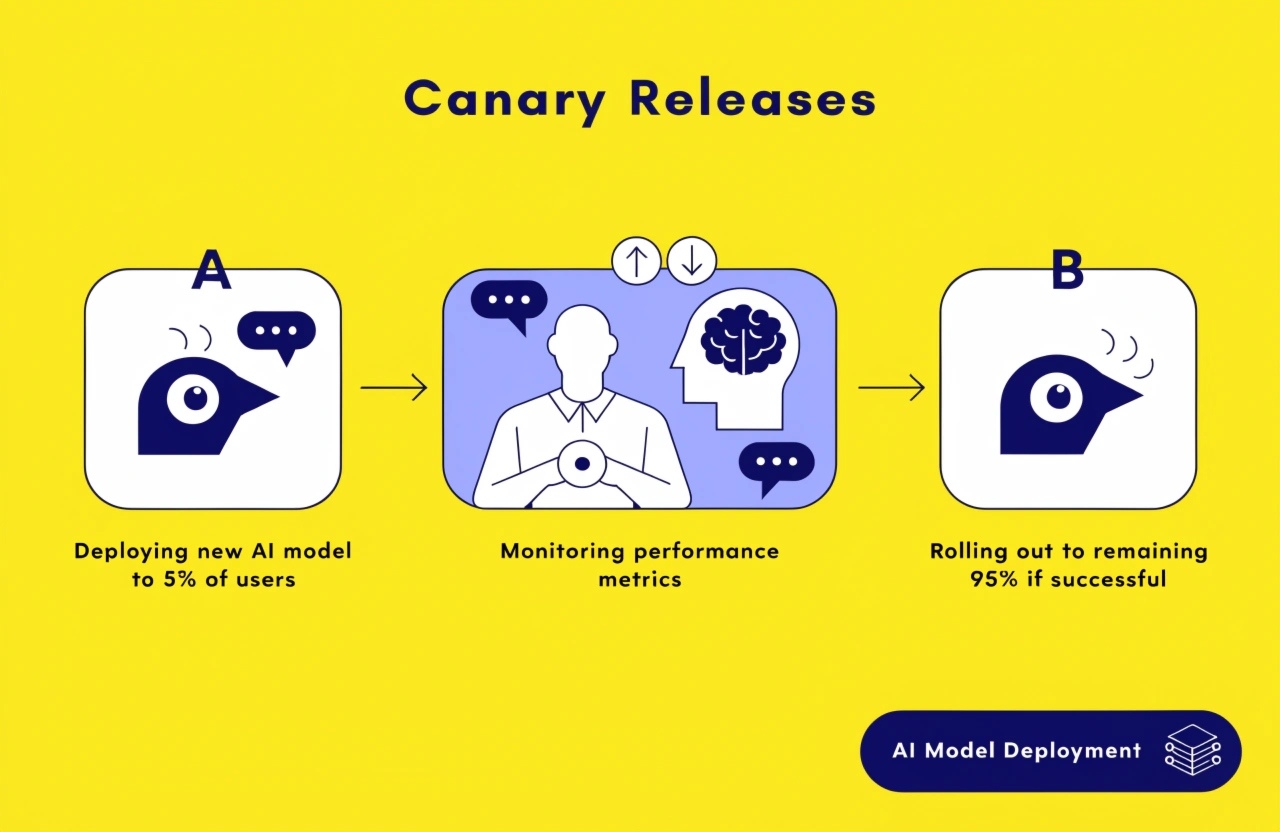
Canary releases provide a safer approach. Instead of replacing the existing production model immediately, organizations gradually introduce the new model to a small percentage of real users or requests. Teams can then evaluate its behavior before increasing traffic.
What Is a Canary Release?
A canary release is a progressive deployment strategy where a new software version, service, or AI model is initially exposed to a limited portion of production traffic.
For AI systems, the existing model can remain active as the stable model, while the new model becomes the canary model.
For example, an organization may deploy a new recommendation model and initially route:
- 95% of traffic to the existing model
- 5% of traffic to the new model
If the new model performs well, traffic might gradually increase to 10%, 25%, 50%, and eventually 100%.
If significant problems appear, traffic can immediately return to the stable model.
Why Canary Releases Matter for AI
Traditional software can often be evaluated using predictable functional tests. AI models are more complicated because their performance depends heavily on real-world data.
A new model may experience:
- Unexpected input patterns
- Data distribution changes
- Increased inference latency
- Higher infrastructure costs
- Unexpected prediction behavior
- Reduced accuracy
- Model drift
- Higher error rates
- Negative user interactions
A canary deployment gives engineering and MLOps teams an opportunity to identify these problems before they affect the entire user base.
How AI Canary Deployment Works
A typical AI canary release involves several stages.
1. Train the new model
The data science team develops and validates a new model using appropriate training and evaluation datasets.
2. Deploy the model alongside the existing model
The new model is deployed without immediately replacing the production version.
3. Route limited traffic
A traffic management system sends a small percentage of requests to the canary model.
4. Monitor performance
Teams monitor technical, model, and business-level metrics.
5. Compare models
The canary model is compared with the stable model to determine whether it provides meaningful improvements.
6. Increase traffic gradually
If the model meets predefined thresholds, traffic is progressively increased.
7. Complete or roll back
The deployment is either promoted to full production or rolled back to the stable model.
What Should Teams Monitor?
Successful AI canary releases require more than monitoring application errors.
Teams should monitor model-specific metrics, including prediction quality, confidence scores, precision, recall, F1 score, and other task-specific evaluation metrics when ground truth is available.
Technical metrics are also important. These can include:
- Inference latency
- CPU and GPU utilization
- Memory consumption
- Request volume
- Timeout rates
- API errors
- Throughput
- Infrastructure costs
Business metrics can provide another important layer of validation. For example, an e-commerce recommendation model could be evaluated using click-through rate, conversion rate, engagement, or revenue-related metrics.
Automated Rollback
One of the strongest benefits of canary deployment is the ability to automate rollback decisions.
Organizations can define deployment thresholds such as:
- Error rate exceeds a defined limit
- Latency increases significantly
- Prediction quality falls below the baseline
- Infrastructure costs exceed expectations
- Important business KPIs decline
If these conditions occur, the deployment platform can automatically reduce canary traffic or return traffic to the stable model.
Automation reduces the time between detecting a problem and mitigating its impact.
Canary Releases vs. A/B Testing
Canary releases and A/B testing are related but have different objectives.
Canary deployment primarily focuses on reducing deployment risk. Teams want to determine whether a new model is safe and reliable enough for broader production use.
A/B testing is generally designed to compare user or business outcomes between different versions.
In some AI systems, both approaches can be combined. A canary deployment can validate technical stability first, while controlled experimentation can evaluate user-facing performance.
Best Practices for AI Canary Releases
Organizations should establish clear success criteria before deployment. Teams should know exactly which metrics determine whether the canary model should proceed or be rolled back.
Start with a small traffic percentage and increase it gradually. The appropriate percentage depends on the application's risk level, traffic volume, and infrastructure architecture.
Maintain a reliable rollback mechanism. A deployment is not truly safe if teams cannot quickly return to the previous model.
Use comprehensive observability. Logs, metrics, traces, model-quality measurements, and business KPIs should work together to provide a complete picture of model behavior.
Finally, maintain versioned models and reproducible deployment pipelines. Teams should be able to identify exactly which model, dataset, configuration, and infrastructure version is running in production.
The Future of AI Model Deployment
As AI applications become more complex, progressive delivery will become increasingly important. Large language models, recommendation systems, computer vision applications, and intelligent automation platforms all require reliable methods for introducing model updates.
Canary releases provide a practical bridge between experimentation and production. Instead of treating deployment as a single high-risk event, organizations can turn it into a controlled and measurable process.
For modern MLOps teams, the combination of canary deployment, automated monitoring, observability, model evaluation, and rollback automation can significantly improve production reliability.
Ultimately, the goal is not simply to deploy a new AI model faster. It is to deploy it safely, measure its real-world performance, and continuously improve the system without unnecessarily exposing users or businesses to deployment risks.