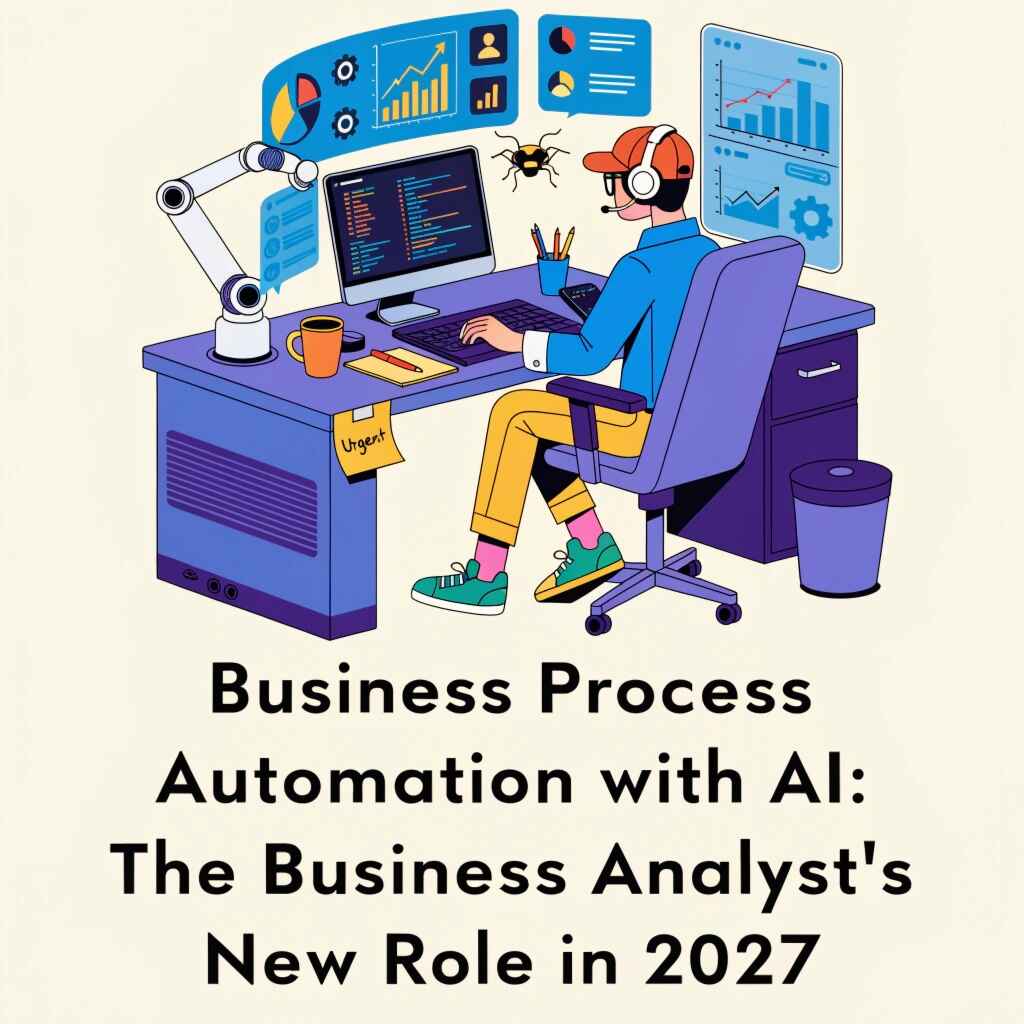
Artificial Intelligence is redefining business operations by automating repetitive processes and improving decision-making. In 2027, Business Analysts are evolving from requirement gatherers into AI strategists who bridge business goals with intelligent automation. This blog explores how AI-powered business process automation is changing the Business Analyst's role, the skills required, benefits, challenges, and future opportunities.
Business Process Automation with AI: The Business Analyst's New Role
Artificial Intelligence (AI) has moved beyond being an emerging technology—it's now a driving force behind modern business transformation. Companies across industries are increasingly adopting Business Process Automation (BPA) powered by AI to improve efficiency, reduce operational costs, and deliver better customer experiences.
As businesses automate repetitive workflows, the role of the Business Analyst (BA) is evolving significantly. Rather than spending most of their time documenting requirements and analyzing manual processes, Business Analysts are now becoming strategic advisors who help organizations identify automation opportunities, evaluate AI solutions, and ensure technology aligns with business objectives.
Let's explore how AI-powered Business Process Automation is redefining the Business Analyst's role in 2027.
What is Business Process Automation with AI?
Business Process Automation (BPA) refers to using technology to automate routine business activities with minimal human intervention.
When AI is integrated into BPA, automation becomes significantly smarter by enabling systems to:
- Analyze large amounts of business data
- Learn from historical patterns
- Make intelligent recommendations
- Predict future outcomes
- Automate complex decision-making
- Improve workflows continuously
Unlike traditional automation that follows predefined rules, AI-driven automation adapts to changing business conditions and becomes more accurate over time.
Why Businesses are Investing in AI Automation
Organizations are rapidly adopting AI because it delivers measurable business value.
Key benefits include:
- Faster business operations
- Reduced human error
- Lower operational costs
- Better compliance management
- Improved customer satisfaction
- Real-time reporting
- Data-driven decision-making
- Higher employee productivity
From finance and healthcare to retail, logistics, manufacturing, and IT services, AI automation is becoming a competitive necessity rather than an optional investment.
The Changing Role of the Business Analyst
Traditionally, Business Analysts focused on:
- Gathering requirements
- Preparing documentation
- Creating process diagrams
- Coordinating between clients and developers
- Managing project requirements
Today, AI is automating many documentation and reporting tasks.
Instead of replacing Business Analysts, AI is enabling them to focus on higher-value responsibilities.
The modern Business Analyst now acts as:
1. Automation Opportunity Identifier
Business Analysts evaluate existing workflows to identify repetitive, time-consuming tasks suitable for automation.
They answer questions like:
- Which processes consume the most resources?
- Where do delays occur?
- Which manual tasks create bottlenecks?
These insights help organizations prioritize automation initiatives.
2. AI Solution Evaluator
With numerous AI platforms available, selecting the right solution is challenging.
Business Analysts compare tools based on:
- Business requirements
- Integration capabilities
- Scalability
- Security
- Cost
- ROI
Their recommendations help organizations maximize technology investments.
3. Data Interpreter
AI systems rely heavily on quality data.
Business Analysts ensure:
- Data accuracy
- Data completeness
- Process consistency
- Reliable business metrics
Clean, structured data enables AI systems to generate meaningful insights and accurate predictions.
4. Process Optimization Specialist
AI can automate inefficient processes—but automating a poor workflow simply accelerates inefficiency.
Business Analysts redesign workflows before automation begins by eliminating unnecessary approvals, reducing manual steps, and simplifying business operations.
5. Strategic Decision Partner
Business leaders increasingly rely on predictive analytics rather than historical reporting.
Business Analysts interpret AI-generated insights to support strategic decisions involving:
- Sales forecasting
- Customer behavior
- Resource allocation
- Risk assessment
- Market opportunities
This positions the Business Analyst as a strategic business consultant rather than just a project contributor.
Essential Skills for Future Business Analysts
To succeed in an AI-driven environment, Business Analysts should develop both technical and business skills.
Important competencies include:
- AI fundamentals
- Machine Learning concepts
- Business Intelligence tools
- Process Mapping
- Data Visualization
- SQL basics
- Predictive Analytics
- Workflow Automation Platforms
- Cloud Technologies
- Agile methodologies
- Critical Thinking
- Communication Skills
- Change Management
Understanding how AI works—not necessarily building AI models—is becoming an essential skill for modern analysts.
Popular AI Automation Technologies
Several technologies are driving intelligent business automation in 2027:
Robotic Process Automation (RPA)
Automates repetitive rule-based tasks such as invoice processing, data entry, and report generation.
Machine Learning
Learns from historical business data to improve predictions and automate decision-making.
Natural Language Processing (NLP)
Allows AI to understand emails, documents, contracts, and customer conversations.
Intelligent Document Processing
Extracts information from invoices, PDFs, forms, and contracts automatically.
Conversational AI
Chatbots and virtual assistants automate customer support and employee services while improving response times.
Challenges of AI Business Automation
Although AI delivers significant benefits, businesses should address several challenges:
- Poor data quality
- Employee resistance to change
- Integration with legacy systems
- Security concerns
- Compliance requirements
- AI governance
- High implementation costs for complex projects
Business Analysts play a crucial role in managing these challenges by ensuring successful adoption and aligning automation initiatives with business goals.
The Future of Business Analysis
Business Analysis is no longer limited to writing requirement documents.
The future Business Analyst will combine business expertise with AI knowledge to drive digital transformation across organizations.
Emerging responsibilities include:
- AI governance
- Ethical AI evaluation
- Automation strategy
- Data-driven business consulting
- Digital innovation planning
- Customer journey optimization
Rather than being replaced by AI, Business Analysts who embrace intelligent automation will become more valuable than ever.
Final Thoughts
Business Process Automation powered by Artificial Intelligence is transforming the way organizations operate. Routine tasks are increasingly handled by intelligent systems, allowing professionals to focus on innovation, strategy, and business growth.
For Business Analysts, this evolution presents an exciting opportunity to become key drivers of digital transformation. By understanding AI technologies, improving business processes, and translating organizational needs into intelligent automation strategies, Business Analysts can play a pivotal role in shaping the future of modern enterprises.
As AI continues to advance, businesses that successfully combine automation with skilled Business Analysts will be better positioned to improve efficiency, enhance customer experiences, and remain competitive in an increasingly digital world.
We build scalable web, mobile, and game products for clients worldwide — combining modern frameworks, cloud infrastructure, and best engineering practices.
-1.jpg)