Production-grade AI agents combine LLM reasoning with reliable tool calling, persistent memory, security controls, observability, and evaluation. A robust architecture enables agents to execute real-world tasks, retain relevant context, recover from failures, and operate safely at scale.
AI agents are evolving from simple chatbot interfaces into systems capable of planning tasks, calling external tools, retrieving information, interacting with applications, and maintaining context across multiple interactions. However, building a prototype agent is very different from building one that can reliably operate in a production environment.
A production-grade AI agent needs more than a powerful language model. It requires a carefully designed architecture covering tool calling, memory, security, orchestration, observability, error handling, evaluation, and scalability.
1. Understand the AI Agent Architecture
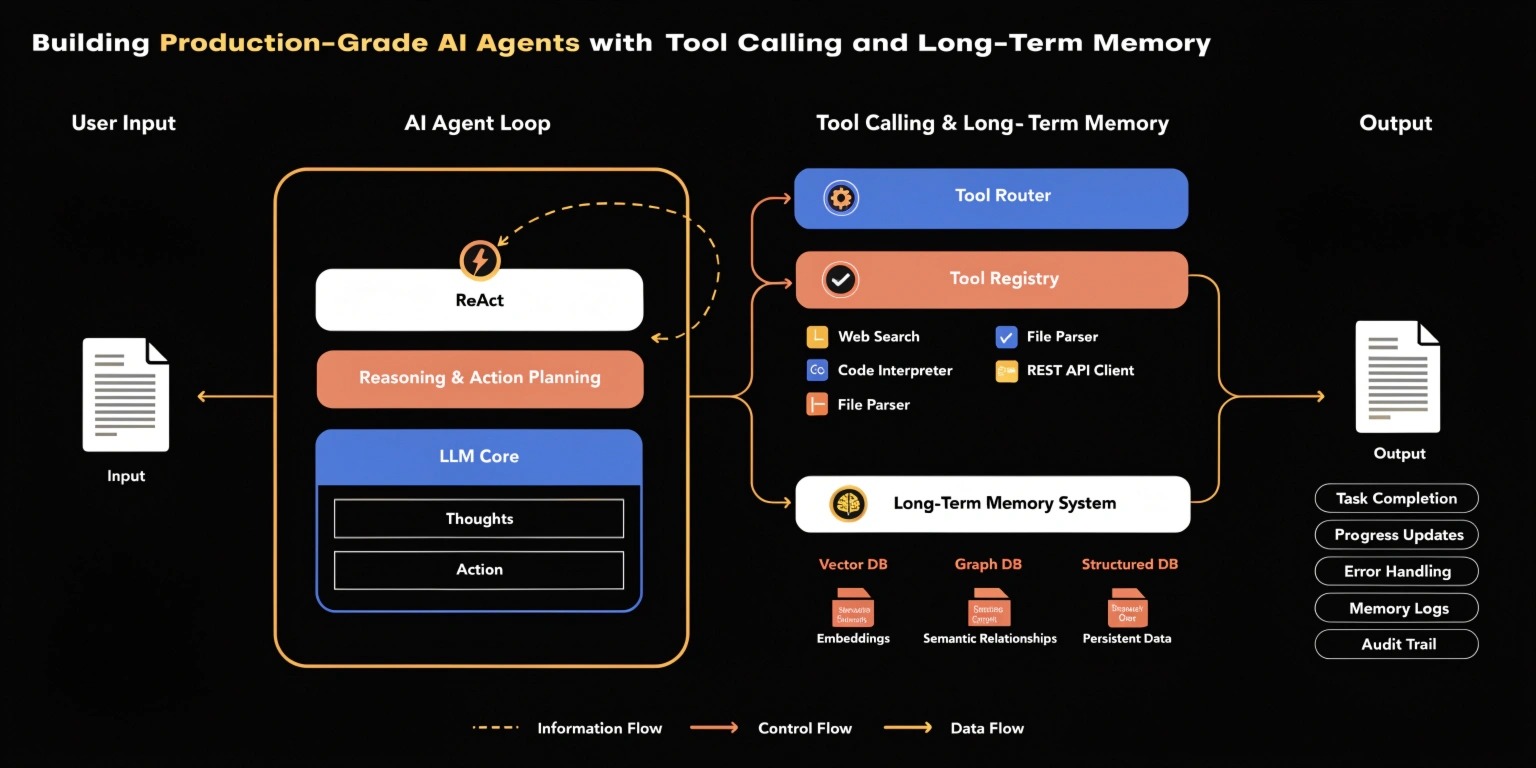
A typical production AI agent consists of several components:
User → Agent Orchestrator → LLM → Tools / Memory / Knowledge → Response
The LLM handles reasoning and decision-making, while the surrounding system controls what the agent can access and what actions it can perform.
Common components include:
- Language model
- Agent orchestrator
- Tool registry
- Memory service
- Retrieval system
- Database
- Authentication layer
- Guardrails
- Monitoring and evaluation systems
Keeping these components modular makes the system easier to maintain and scale.
2. Implement Reliable Tool Calling
Tool calling allows an AI agent to interact with external systems.
For example, an agent might use tools to:
- Query a database
- Search documents
- Retrieve customer information
- Create calendar events
- Send notifications
- Execute calculations
- Call APIs
- Update business records
The model should not directly receive unrestricted access to backend systems. Instead, each capability should be exposed through a controlled tool interface with clearly defined inputs, outputs, permissions, and validation rules.
3. Design Strong Tool Schemas
Tool definitions should be explicit and predictable.
A tool schema should define:
- Tool name
- Purpose
- Required parameters
- Optional parameters
- Data types
- Validation rules
- Expected response format
- Permission requirements
Poorly designed tool schemas can lead to incorrect arguments and unreliable agent behavior.
For example, a customer lookup tool should clearly define whether it accepts a customer ID, email address, or another identifier.
4. Add Long-Term Memory
Short-term conversation context is not the same as long-term memory.
Short-term memory helps an agent understand the current conversation, while long-term memory allows it to retain useful information across sessions.
Long-term memory can store:
- User preferences
- Previous interactions
- Important decisions
- Frequently used settings
- Business context
- Historical tasks
However, storing everything is usually a mistake. Memory should be selective, relevant, and governed by clear retention policies.
5. Use Structured Memory Architecture
A production memory system can combine multiple storage approaches.
For example:
Working Memory: Current conversation and task state.
Semantic Memory: Useful facts and preferences retrieved when relevant.
Episodic Memory: Previous events, interactions, or completed tasks.
Knowledge Base: External organizational information.
Vector databases can support semantic retrieval, while traditional databases can store structured user or application data.
The agent should retrieve only the information required for the current task.
6. Control What the Agent Remembers
Long-term memory introduces privacy and security concerns.
Agents should not automatically retain sensitive information without appropriate controls.
Organizations should define:
- What can be stored
- How long it is retained
- Who can access it
- How it can be deleted
- How memory is audited
- Which data requires additional protection
Memory should be treated as a governed data system rather than simply another prompt component.
7. Build an Agent Orchestration Layer
The orchestration layer controls the agent's execution loop.
A typical workflow may look like:
Understand → Plan → Select Tool → Execute → Observe → Reassess → Complete
The system should define limits on the number of steps, tool calls, execution time, and resource usage.
This prevents an agent from entering an endless reasoning or tool-calling loop.
8. Implement Error Handling and Recovery
External tools can fail for many reasons. APIs can time out, databases can become unavailable, authentication can expire, or tools can return unexpected results.
Production agents need structured error handling.
Useful strategies include:
- Retry policies
- Exponential backoff
- Timeouts
- Fallback tools
- Circuit breakers
- Partial-result handling
- Human escalation
The agent should distinguish between recoverable failures and actions that require user intervention.
9. Add Guardrails and Permission Controls
An AI agent capable of taking real-world actions needs strong boundaries.
Implement controls such as:
- Tool-level permissions
- User authentication
- Role-based access control
- Input validation
- Output validation
- Action approval
- Rate limits
- Sensitive-data filtering
High-impact actions, such as financial transactions or deleting business data, may require explicit human confirmation.
10. Design for Observability
Traditional application monitoring is not enough for AI agents.
Teams should track:
- Model latency
- Token consumption
- Tool-call frequency
- Tool failures
- Agent execution time
- Retrieval quality
- Memory retrieval
- Task completion rate
- Error frequency
- Cost per task
Trace-based observability is particularly useful because a single user request may involve multiple model calls, tool executions, database queries, and retrieval operations.
11. Evaluate Agent Behavior
AI agents can fail in ways that traditional software does not.
Evaluation should measure:
- Task completion
- Tool selection accuracy
- Argument correctness
- Response quality
- Retrieval accuracy
- Memory relevance
- Safety
- Hallucination rate
- Recovery behavior
Create realistic test scenarios and continuously evaluate the agent after model, prompt, tool, or infrastructure changes.
12. Optimize Cost and Scalability
Production agents can become expensive because one task may trigger multiple model calls and tool executions.
Cost optimization strategies include:
- Selecting models based on task complexity
- Limiting unnecessary tool calls
- Caching repeated results
- Summarizing long conversations
- Optimizing retrieval
- Setting execution budgets
- Using asynchronous processing where appropriate
Horizontal scaling, queues, stateless services, and independently scalable tool services can help support high workloads.
Conclusion
Building a production-grade AI agent requires significantly more than connecting an LLM to a few APIs. Reliable agents need structured tool calling, carefully designed memory, controlled orchestration, security guardrails, observability, evaluation, and resilient infrastructure.
Long-term memory can make agents more useful by allowing them to maintain relevant context across sessions, while tool calling enables them to interact with real-world systems. However, both capabilities introduce additional risks that must be managed through permissions, validation, privacy controls, and monitoring.
The most successful AI agents are not simply autonomous—they are controlled, observable, recoverable, and measurable. By treating the agent as a production software system rather than only an AI experiment, organizations can build scalable agentic applications capable of performing meaningful real-world tasks reliably and safely.
We build scalable web, mobile, and game products for clients worldwide — combining modern frameworks, cloud infrastructure, and best engineering practices.
-1.jpg)