Artificial Intelligence is revolutionizing animation production by automating repetitive tasks and accelerating creative workflows. From AI-assisted rigging and lip-syncing to intelligent rendering and motion capture, modern animation studios are reducing production time by nearly 70%. This blog explores how AI is transforming animation pipelines, improving efficiency, reducing costs, and allowing artists to focus on creativity instead of manual production work.
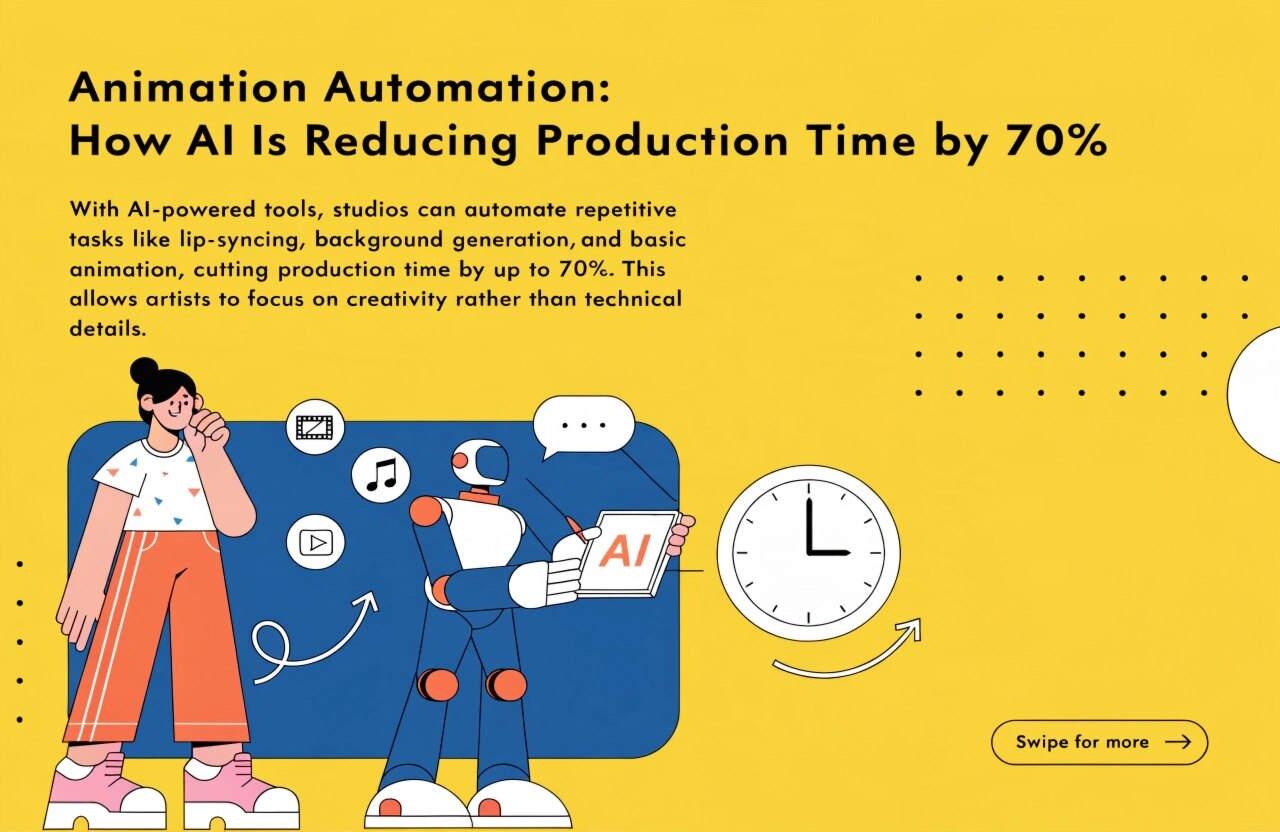
Animation Automation: How AI Is Reducing Production Time by 70%
The animation industry has always required significant time, creativity, and technical expertise. Whether producing animated films, video games, advertisements, or educational content, studios spend hundreds or even thousands of hours on character design, rigging, animation, rendering, and post-production.
Today, Artificial Intelligence (AI) is changing this traditional workflow dramatically. AI-powered automation is helping studios reduce production time by nearly 70%, allowing teams to create high-quality animations faster while maintaining artistic standards.
Rather than replacing artists, AI acts as an intelligent assistant that handles repetitive, technical, and time-consuming tasks, enabling creative professionals to focus on storytelling and design.
Why Traditional Animation Takes So Long
A typical animation project includes multiple stages:
- Storyboarding
- Character design
- Modeling
- Rigging
- Motion animation
- Lip synchronization
- Lighting
- Rendering
- Visual effects
- Editing
Each stage requires skilled professionals working together. Even small modifications often require updating several parts of the animation, making production slow and expensive.
AI significantly simplifies these processes through automation.
AI-Powered Automation Across the Animation Pipeline
1. Automatic Character Rigging
Rigging prepares a character skeleton for movement. Traditionally, artists manually place hundreds of bones and controls.
AI-based rigging tools automatically detect body structures and generate optimized rigs within minutes, saving countless production hours.
Benefits include:
- Faster setup
- Consistent rig quality
- Reduced manual adjustments
- Better scalability for large projects
2. Intelligent Motion Capture
Motion capture once required expensive hardware, multiple cameras, and dedicated studios.
Modern AI can generate motion data using:
- Smartphone videos
- Single-camera recordings
- Existing animation libraries
This dramatically reduces production costs while making realistic character movement accessible to smaller studios.
3. AI Lip Synchronization
Creating natural mouth movements used to be one of the most tedious animation tasks.
AI now analyzes dialogue automatically and generates accurate facial expressions and lip synchronization in minutes.
This technology is particularly valuable for:
- Animated movies
- Educational videos
- Marketing campaigns
- Game cinematics
- Multilingual content
4. Smart In-Between Animation
Traditional animation requires artists to draw or animate every intermediate frame.
AI automatically predicts missing frames and generates smooth transitions between key poses.
This process significantly accelerates both 2D and 3D animation production while maintaining visual quality.
5. Automated Background Generation
Generative AI can quickly produce:
- Forests
- Cities
- Fantasy worlds
- Space environments
- Interior scenes
Artists can refine these AI-generated assets instead of creating every element from scratch.
This shortens environment creation from days to just a few hours.
AI-Assisted Rendering
Rendering is one of the most computationally expensive stages.
Modern AI rendering technologies optimize:
- Lighting
- Shadows
- Texture enhancement
- Noise reduction
- Frame prediction
Studios can achieve cinematic-quality visuals while reducing rendering time significantly.
AI for Character Animation
Machine learning models analyze:
- Human movement
- Facial expressions
- Emotional behavior
- Eye contact
- Gesture patterns
The AI then produces realistic animation suggestions that artists can refine instead of animating everything manually.
This approach speeds up production while maintaining natural character performances.
Benefits for Animation Studios
Animation automation delivers measurable advantages across the entire production cycle.
Faster Delivery
Projects that previously required several months can now be completed much faster, enabling studios to handle more clients and meet tighter deadlines.
Lower Production Costs
Reduced manual work means fewer production hours, allowing businesses to optimize budgets without sacrificing quality.
Improved Creativity
Since AI handles repetitive technical tasks, artists spend more time on storytelling, visual design, and creative innovation.
Better Scalability
Studios can manage multiple projects simultaneously without significantly expanding their workforce.
Consistent Quality
AI ensures consistency across animations, reducing human error and maintaining uniform visual standards.
Applications Across Industries
AI-powered animation is no longer limited to entertainment.
Industries adopting animation automation include:
- Film production
- Video game development
- Advertising
- Healthcare education
- E-learning
- Architecture visualization
- Product demonstrations
- Social media marketing
- Virtual Reality (VR)
- Augmented Reality (AR)
As demand for animated content continues to grow, AI enables businesses of all sizes to create engaging visuals efficiently.
Challenges of AI Animation
Despite its benefits, AI animation still has certain limitations.
Creative direction remains a human responsibility.
AI may occasionally produce:
- Unrealistic movements
- Inconsistent facial expressions
- Generic artistic styles
- Limited emotional nuance
Professional artists are still essential for refining outputs, maintaining originality, and ensuring the final product aligns with the project's vision.
The Future of AI Animation
The next generation of animation tools will become even more intelligent.
Future innovations are expected to include:
- Fully AI-generated storyboards
- Real-time character generation
- Automatic cinematic camera control
- Emotion-aware animation
- AI voice-to-animation pipelines
- Instant multilingual lip synchronization
- Collaborative AI production assistants
Rather than replacing animators, AI will continue to enhance productivity and unlock new creative possibilities.
Conclusion
Animation automation is transforming the creative industry at an unprecedented pace. By automating rigging, motion capture, lip synchronization, rendering, and environment creation, AI is reducing production time by up to 70% while lowering costs and improving efficiency.
Studios that embrace AI-powered workflows can deliver projects faster, scale production more effectively, and allow artists to focus on creativity instead of repetitive technical work. As AI
technology continues to evolve, animation production will become smarter, faster, and more accessible, opening exciting opportunities for businesses, developers, and creative professionals worldwide.
We build scalable web, mobile, and game products for clients worldwide — combining modern frameworks, cloud infrastructure, and best engineering practices.
-1.jpg)