AI models can lose accuracy as real-world data and user behavior change. Model monitoring and drift detection help teams identify performance degradation, data inconsistencies, and changing patterns early, enabling timely retraining and keeping production AI systems reliable.
Machine learning models can perform extremely well during development and testing, but their performance may change after deployment. Real-world environments are dynamic: customer behavior changes, markets evolve, new products appear, and incoming data can differ from the data used during training.
This is why AI model monitoring and drift detection are essential parts of modern MLOps. They help organizations understand whether deployed models continue to produce reliable predictions and identify problems before they significantly affect business outcomes.
What Is AI Model Monitoring?
AI model monitoring is the continuous observation of a machine learning model after it has been deployed into production.
Traditional application monitoring focuses on metrics such as CPU usage, memory consumption, response time, and server availability. AI systems require additional monitoring because a model can be technically operational while producing increasingly inaccurate predictions.
Model monitoring can track metrics such as prediction distributions, input data quality, feature behavior, latency, error rates, confidence scores, and business outcomes.
For example, a fraud detection model may continue returning predictions successfully while gradually becoming less effective because fraud patterns have changed.
What Is Model Drift?
Model drift occurs when the relationship between data and model predictions changes over time, potentially causing model performance to decline.
Drift is common in production machine learning because the environment represented by the training dataset may not remain stable.
There are several important types of drift that developers and data scientists should understand.
Data Drift
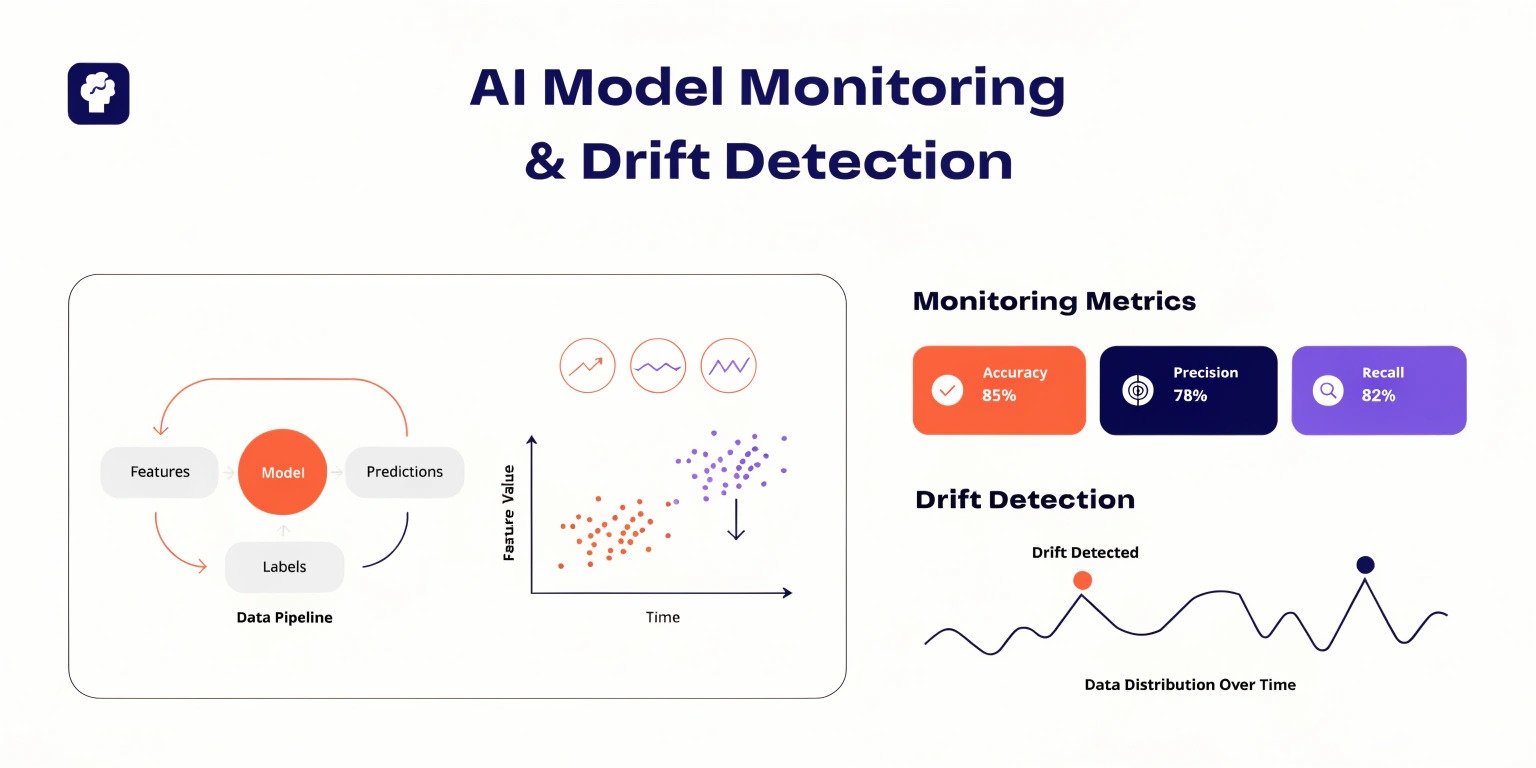
Data drift occurs when the statistical distribution of input data changes.
Suppose a customer churn model was trained using historical customer information. If the age distribution, purchasing behavior, subscription plans, or geographic distribution of new customers changes significantly, the model may receive data that looks different from its training data.
Monitoring feature distributions can help identify these changes.
Concept Drift
Concept drift occurs when the relationship between input features and the target variable changes.
For example, an e-commerce recommendation model may learn that certain products are frequently purchased together. Consumer preferences can change over time, causing previous relationships to become less accurate.
Even if the input data distribution remains relatively similar, the meaning of that data can change.
Prediction Drift
Prediction drift occurs when the distribution of model outputs changes significantly.
For instance, if a credit risk model historically classified around 10% of applications as high risk but suddenly begins classifying 30% as high risk, the change may require investigation.
Prediction drift does not automatically mean that the model is wrong. It is a signal that developers should examine the underlying causes.
Why Monitoring Matters in Production AI
Without monitoring, organizations may discover model degradation only after customers or business teams notice incorrect results.
A recommendation system may provide irrelevant products. A fraud detection model may miss suspicious transactions. A demand forecasting system may produce inaccurate inventory predictions.
These issues can affect revenue, customer satisfaction, operational efficiency, and regulatory compliance.
Continuous monitoring provides visibility into how the model behaves after deployment.
Key Metrics to Monitor
Different machine learning applications require different metrics, but several categories are commonly useful.
Data Quality: Monitor missing values, invalid values, unexpected categories, duplicates, and schema changes.
Feature Distribution: Track changes in the statistical distribution of important input features.
Prediction Distribution: Monitor how frequently different prediction classes or score ranges occur.
Model Performance: When ground-truth labels become available, measure accuracy, precision, recall, F1-score, mean absolute error, or other relevant metrics.
System Performance: Track inference latency, throughput, resource usage, and failed requests.
Business Metrics: Connect model performance to business outcomes such as conversion rate, fraud losses, customer retention, or revenue.
Establish Baselines
Effective drift detection requires a baseline.
A baseline represents the expected behavior of the model or data under normal conditions.
For example, teams can record the typical distribution of important features during a selected period after deployment.
Future observations can then be compared with this baseline.
However, baselines should not remain static forever. Business environments evolve, and monitoring systems should account for legitimate seasonal or long-term changes.
Set Alerts Carefully
Monitoring becomes useful when it helps teams take action.
Organizations can define thresholds for important metrics and trigger alerts when unusual changes occur.
For example, an alert could be generated when:
- A critical feature develops an unexpected distribution.
- Missing values exceed an acceptable threshold.
- Prediction distributions change significantly.
- Model accuracy falls below a defined level.
- Inference latency increases substantially.
- A production data pipeline changes its schema.
Alerts should be designed carefully to avoid excessive false positives. Too many unnecessary alerts can cause teams to ignore important warnings.
Automated Retraining
Drift detection can become part of an automated model lifecycle.
When significant drift or performance degradation is detected, the system can trigger an investigation or initiate a retraining workflow.
However, automatic retraining should not always happen immediately.
A detected change may be temporary, seasonal, caused by a data pipeline issue, or even represent a legitimate change in user behavior.
Organizations should therefore define clear policies for when retraining should be automatic and when human review is required.
Monitoring Without Immediate Ground Truth
One challenge in production AI is that ground-truth labels may not be available immediately.
For example, a loan default prediction model may require months before the actual outcome becomes known.
In such situations, teams can monitor input distributions, prediction distributions, confidence scores, data quality, and other proxy indicators.
Once ground-truth outcomes become available, actual model performance can be evaluated.
Building an Effective MLOps Monitoring Strategy
A strong monitoring architecture should connect data pipelines, model services, observability systems, alerting, and retraining workflows.
A typical process looks like this:
Data Collection → Data Validation → Model Inference → Monitoring → Drift Detection → Alerting → Investigation → Retraining → Model Validation → Deployment
This creates a continuous feedback loop around the machine learning lifecycle.
Teams should also maintain model versions, training datasets, configuration details, evaluation metrics, and deployment histories to make troubleshooting easier.
Best Practices for AI Model Monitoring
Organizations can improve monitoring effectiveness by following several practices:
- Monitor both technical and business metrics.
- Track important input features rather than every possible feature.
- Establish meaningful baselines.
- Monitor data quality before analyzing model drift.
- Use multiple drift detection signals.
- Maintain versioned models and datasets.
- Test retrained models before production deployment.
- Document model changes and monitoring thresholds.
- Create clear ownership for production AI systems.
- Review monitoring rules periodically.
Conclusion
AI models are not "set and forget" systems. Their performance depends on the data and environment in which they operate, and both can change over time.
AI model monitoring and drift detection provide the visibility needed to keep production machine learning systems reliable. By tracking data quality, feature distributions, prediction patterns, model performance, system health, and business outcomes, organizations can identify problems early.
When combined with strong MLOps practices, automated validation, controlled retraining, and effective alerting, model monitoring creates a continuous improvement cycle that helps AI systems remain accurate, dependable, and aligned with changing real-world conditions.
We build scalable web, mobile, and game products for clients worldwide — combining modern frameworks, cloud infrastructure, and best engineering practices.
-1.jpg)