Behavior Trees and GOAP are key AI systems in games. Learn their differences, strengths, and use cases to design smarter NPCs and dynamic gameplay experiences.
Artificial Intelligence is the backbone of engaging gameplay in modern video games. Whether it's enemies reacting strategically or NPCs behaving realistically, AI systems define the player experience.
Two of the most widely used approaches in game AI are Behavior Trees (BTs) and Goal-Oriented Action Planning (GOAP). While both are powerful, they differ significantly in structure, flexibility, and implementation.
Choosing the right system can greatly impact the quality and performance of your game.
Understanding Behavior Trees
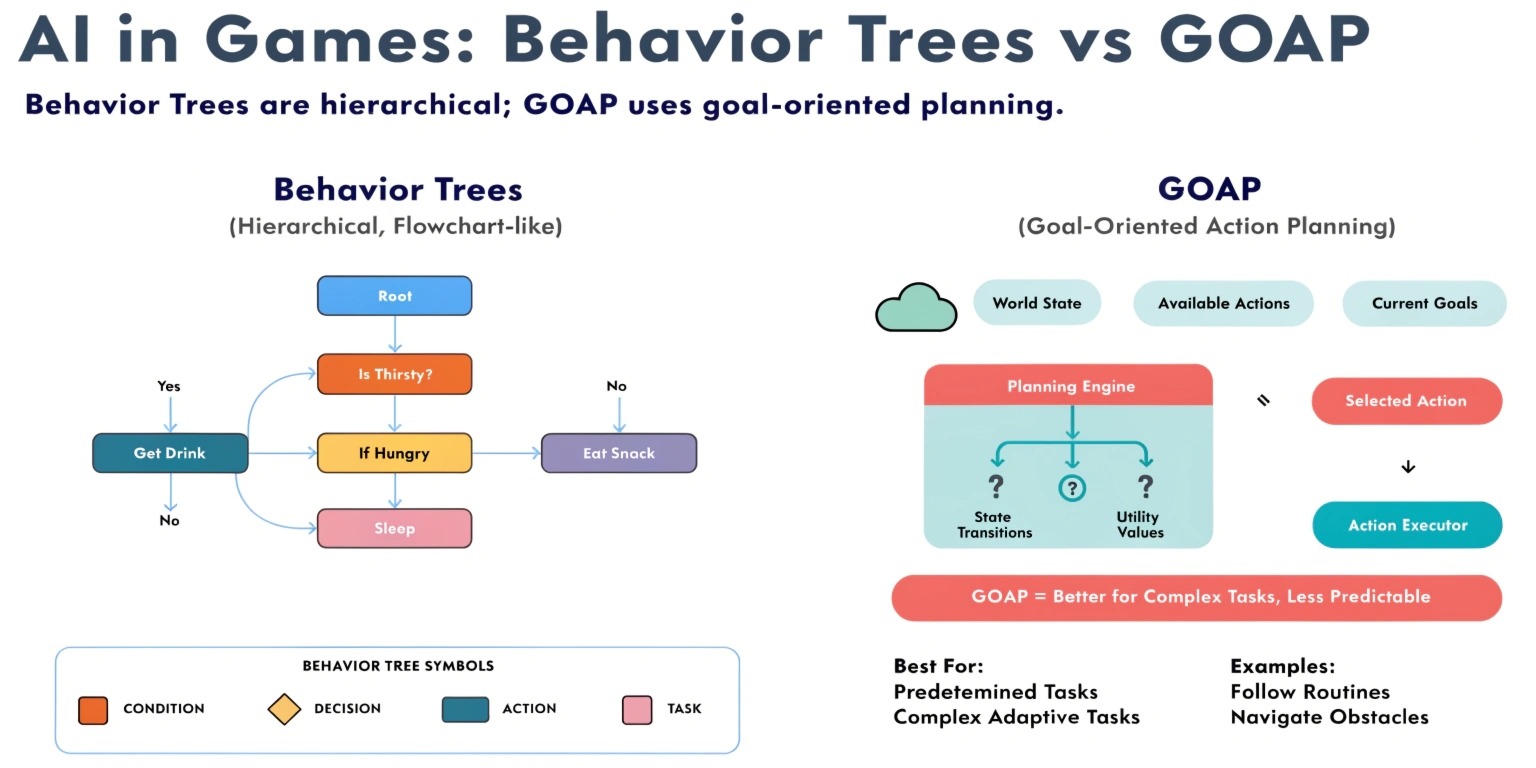
Behavior Trees are a hierarchical model used to control AI behavior through structured decision-making.
They consist of:
- Root node – starting point
- Composite nodes – control flow (selectors, sequences)
- Leaf nodes – actions or conditions
Behavior Trees evaluate conditions step-by-step and execute actions accordingly.
How Behavior Trees Work
- The tree starts at the root
- Nodes are evaluated in a specific order
- Conditions determine which actions run
- The process loops continuously
Example:
An enemy AI might:
- Check if the player is nearby
- If yes → chase
- If no → patrol
Strengths of Behavior Trees
- Easy to understand and debug
- Highly modular and reusable
- Efficient for real-time execution
- Supported by engines like Unity and Unreal Engine
Limitations of Behavior Trees
- Can become large and complex
- Less adaptive to dynamic environments
- Requires manual design for each behavior
Understanding GOAP (Goal-Oriented Action Planning)
GOAP is a planning-based AI system where agents make decisions based on goals rather than predefined behavior paths.
Instead of following fixed rules, GOAP:
- Defines goals (e.g., survive, attack, escape)
- Evaluates possible actions
- Dynamically creates a plan
How GOAP Works
- AI selects a goal
- Evaluates available actions
- Checks preconditions and effects
- Builds a sequence of actions
- Executes the plan
Example:
To “defeat enemy,” AI may:
- Find weapon
- Move to cover
- Attack strategically
Strengths of GOAP
- Highly flexible and adaptive
- Produces emergent gameplay
- Reduces manual scripting
- Ideal for complex AI behavior
Limitations of GOAP
- Computationally expensive
- Harder to implement and debug
- Requires well-defined action planning
Behavior Trees vs GOAP: Comparison
FeatureBehavior TreesGOAPApproachRule-basedGoal-basedFlexibilityModerateHighPerformanceFastSlowerComplexityLow to MediumHighAdaptabilityLimitedStrong
When to Use Behavior Trees
Behavior Trees are ideal when:
- AI behavior is predictable
- Performance is critical
- Simplicity is preferred
Use Cases:
- Enemy patrol systems
- Basic combat logic
- Scripted NPC interactions
When to Use GOAP
GOAP is better suited for:
- Complex, dynamic environments
- Strategic decision-making
- Emergent gameplay
Use Cases:
- Open-world games
- Strategy games
- Advanced NPC simulations
Hybrid Approach: Combining Both
Modern games often use a hybrid model:
- Behavior Trees handle high-level control
- GOAP manages detailed planning
This approach balances performance with flexibility.
Real-World Applications
- FPS games → Behavior Trees for combat AI
- RTS games → GOAP for strategic decisions
- Open-world games → Hybrid systems for realism
Game engines like Unity and Unreal Engine make it easier to implement both systems.
Best Practices for Developers
- Start simple with Behavior Trees
- Introduce GOAP for complex scenarios
- Optimize performance carefully
- Use visualization tools for debugging
- Continuously refine AI behavior
Future of Game AI
- Integration with machine learning
- More adaptive and self-learning AI
- Improved tools for AI design
- Greater realism and immersion
Conclusion
Behavior Trees and GOAP are essential tools for building intelligent game AI. While Behavior Trees provide structure and efficiency, GOAP offers flexibility and dynamic decision-making.
The best choice depends on your game’s requirements. In many cases, combining both systems can deliver the most effective and engaging AI behavior.
Understanding these approaches will help you design smarter NPCs and create more immersive gaming experiences.
We build scalable web, mobile, and game products for clients worldwide — combining modern frameworks, cloud infrastructure, and best engineering practices.
-1.jpg)