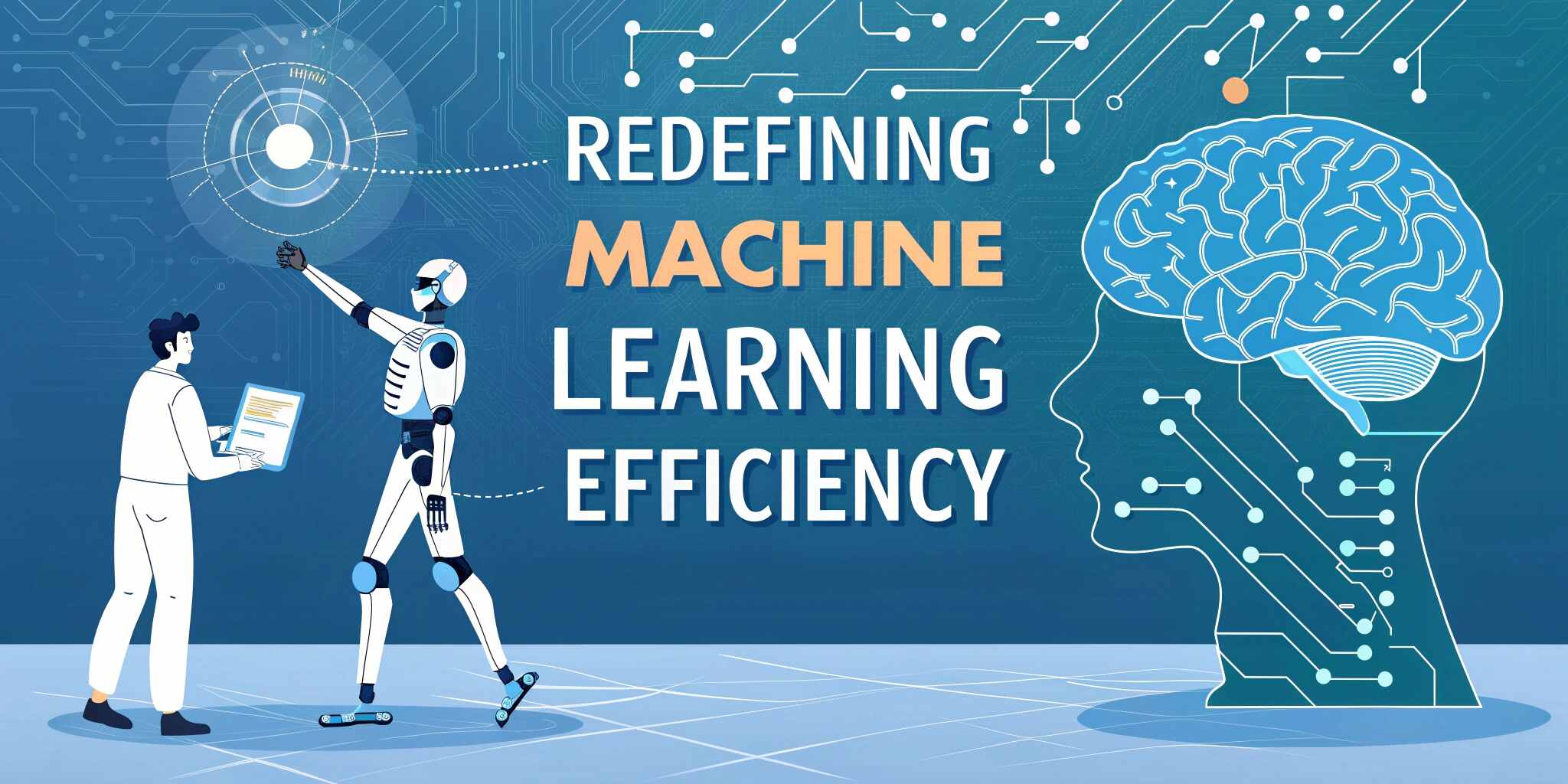
In traditional machine learning, models require massive amounts of labeled data to learn effectively. This dependency poses challenges for real-world applications where data collection and annotation are expensive, time-consuming, or even impractical. However, with the emergence of Zero-Shot Learning (ZSL) and Few-Shot Learning (FSL), artificial intelligence is breaking through these limitations. These innovative learning paradigms enable models to generalize knowledge to unseen classes or perform new tasks with minimal examples — marking a major leap toward more human-like learning efficiency.
Zero-Shot Learning refers to a model’s ability to make accurate predictions on tasks it has never encountered during training. Instead of learning from labeled data for every possible category, ZSL models rely on semantic relationships, contextual embeddings, and pre-trained knowledge to infer meaning. For example, a model trained to identify animals may correctly recognize a zebra, even if it has never seen one, by associating descriptive features like “striped horse-like mammal.” This is made possible through embedding spaces, where textual and visual features are represented in a shared dimensional context, allowing models to bridge gaps between known and unknown data.
A practical example of Zero-Shot Learning is found in Natural Language Processing (NLP). Models like OpenAI’s GPT, Google’s T5, and Meta’s LLaMA can perform a variety of tasks — translation, summarization, and sentiment analysis — without explicit task-specific training. These models leverage transfer learning and prompt engineering to adapt their responses dynamically. For instance, when given the instruction “translate this sentence to French,” the model doesn’t need prior examples of translations to execute the command effectively. This adaptability is what makes zero-shot learning so revolutionary in the era of large-scale AI systems.
Few-Shot Learning, on the other hand, is designed to help models learn effectively from just a handful of labeled examples. It bridges the gap between zero-shot and traditional supervised learning by combining meta-learning techniques and fine-tuning on small datasets. Few-shot learning models typically use frameworks like Siamese networks, Prototypical networks, and Matching networks that focus on measuring similarity between known and unknown data points.
One of the most popular implementations of few-shot learning comes from OpenAI’s GPT-3. When provided with a few examples of a desired output — such as “translate English to Spanish” with one or two pairs — the model generalizes the task for new inputs. This approach mimics how humans learn from limited experiences, showing that artificial intelligence can achieve high adaptability with minimal supervision.
The success of Zero-Shot and Few-Shot Learning lies in their foundation — pre-trained models. Massive models trained on diverse datasets capture broad patterns of language, vision, and reasoning. When fine-tuned or prompted appropriately, they can apply this knowledge to niche tasks. This approach not only saves time and computational resources but also democratizes AI development for industries that lack large-scale data resources.
However, these learning techniques are not without challenges. One major concern is bias propagation from pre-trained data. Since large language or vision models are trained on vast, uncurated datasets, they may inadvertently learn and reproduce biases present in the training material. Additionally, generalization remains imperfect — while models perform well on semantically related tasks, they may struggle with completely novel contexts or ambiguous queries. Addressing these issues requires advancements in model interpretability, data diversity, and ethical AI practices.
In real-world scenarios, the applications of Zero-Shot and Few-Shot Learning are rapidly expanding. In healthcare, these models assist in diagnosing rare diseases by identifying patterns from minimal case data. In cybersecurity, they help detect emerging threats by analyzing unseen attack signatures. Meanwhile, in autonomous systems, few-shot techniques improve adaptability to new environments without retraining from scratch.
The future of AI lies in reducing dependency on labeled data while improving cognitive adaptability. As models grow more sophisticated, the synergy between Zero-Shot and Few-Shot Learning will play a pivotal role in shaping general artificial intelligence (AGI). By enabling machines to think beyond explicit examples, we move closer to creating systems that can reason, infer, and act intelligently in complex, data-scarce environments.
Conclusion:
Zero-Shot and Few-Shot Learning represent a fundamental shift in how we train and deploy machine learning systems. By empowering AI to learn from minimal supervision, these techniques not only enhance efficiency but also open new frontiers in automation, adaptability, and intelligence. As researchers continue refining these models, the future promises AI that learns more like humans — intuitively, contextually, and with far less data.