Modern gamers expect vast, immersive worlds filled with detailed environments, dynamic events, and seamless exploration. From sprawling fantasy kingdoms to realistic urban landscapes, open-world games have become one of the most popular genres in the gaming industry. However, creating these massive virtual environments presents a significant technical challenge.
Game engines must render thousands of assets, terrain elements, NPCs, physics systems, and environmental effects while maintaining smooth performance. Loading an entire world into memory at once is often impossible due to hardware limitations. This challenge has led to the development of World Partitioning and Level Streaming Architectures, two essential technologies that power today's large-scale game worlds.
Understanding the Challenge of Massive Game Worlds
Every object in a game world consumes system resources. Trees, buildings, characters, textures, animations, sound effects, and physics calculations all require memory and processing power.
Consider a modern open-world game featuring:
- Hundreds of square kilometers of terrain
- Thousands of interactive objects
- Dynamic weather systems
- Real-time NPC behavior
- High-resolution textures
- Complex lighting systems
Loading all these elements simultaneously would overwhelm most gaming systems and lead to poor performance, long loading times, and memory crashes.
To solve this problem, developers divide game worlds into manageable sections that can be loaded dynamically.
What Is World Partitioning?
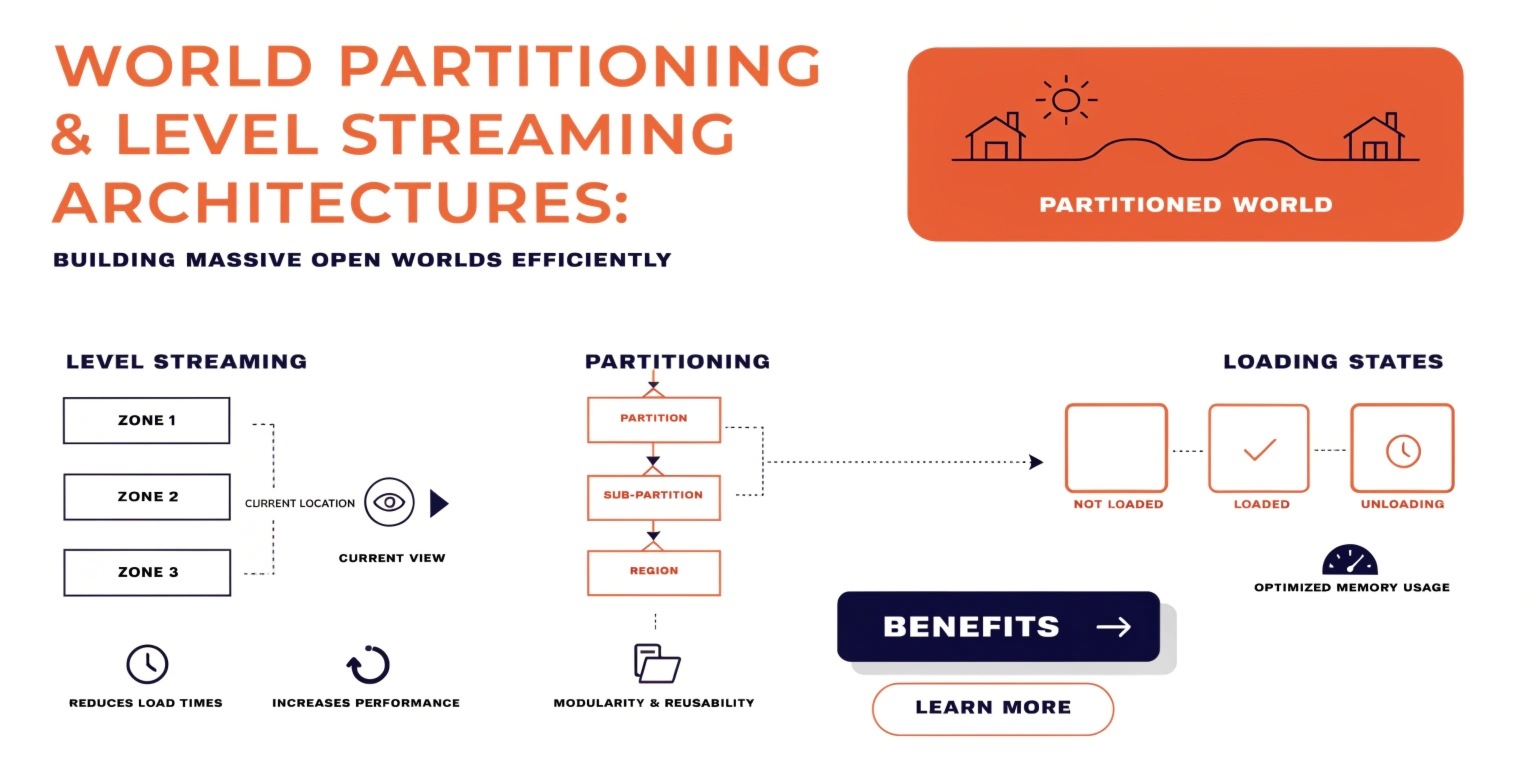
World partitioning is a technique that divides a large game world into smaller, manageable regions or cells.
Instead of treating the world as one giant level, the engine organizes content into grid-based sections. Each section contains specific assets, terrain data, NPCs, and environmental elements.
As players move through the world, the engine determines which regions are relevant and loads only those areas into memory.
Benefits of World Partitioning
Improved Memory Management
Only necessary portions of the game world remain active, significantly reducing memory consumption.
Faster Development Workflows
Large teams can work on separate world regions simultaneously without conflicts.
Better Scalability
Developers can create larger and more detailed worlds without exceeding hardware limitations.
Enhanced Performance
The engine avoids rendering distant objects that players cannot see or interact with.
Modern game engines such as Unreal Engine 5 utilize advanced world partition systems to simplify open-world development.
What Is Level Streaming?
Level streaming is the process of dynamically loading and unloading game content based on player position, gameplay events, or predefined conditions.
Instead of displaying loading screens between areas, level streaming allows content to appear seamlessly while the game continues running.
For example:
- A city district loads as the player approaches.
- Underground caves load when entering a tunnel.
- Distant regions unload once they are no longer needed.
This creates the illusion of a continuous world while efficiently managing system resources.
Types of Level Streaming
Distance-Based Streaming
The most common method.
The engine continuously monitors player location and loads nearby areas while unloading distant regions.
This approach works particularly well for open-world games.
Volume-Based Streaming
Invisible trigger zones activate loading events.
When players enter a specific area, the corresponding level is loaded automatically.
This technique is often used in indoor environments.
Event-Driven Streaming
Game events trigger content loading.
Examples include:
- Story progression
- Quest activation
- Boss encounters
- Cinematic sequences
This method ensures content appears only when required.
Predictive Streaming
Advanced engines analyze player movement patterns and predict future locations.
The system preloads assets before they are needed, reducing loading delays and improving immersion.
How World Partitioning and Level Streaming Work Together
Although often discussed separately, these technologies typically operate together.
The process generally follows these steps:
- The world is divided into partitions or cells.
- The player's location is continuously tracked.
- Nearby partitions are identified.
- Required assets are streamed into memory.
- Unused regions are unloaded.
- Gameplay continues without interruption.
This coordinated approach enables developers to create enormous game worlds without sacrificing performance.
Performance Optimization Benefits
Reduced Memory Usage
Only active world sections consume memory resources.
Lower CPU Workload
The engine processes fewer objects and systems at any given time.
Improved Frame Rates
Rendering workloads decrease significantly when unnecessary assets remain unloaded.
Faster Loading Times
Players experience smoother transitions and fewer interruptions.
Better Hardware Compatibility
Streaming architectures allow complex games to run on a wider range of devices.
Challenges in Streaming Large Worlds
Despite their advantages, world partitioning systems introduce new technical challenges.
Asset Pop-In
Objects may suddenly appear if content is not loaded quickly enough.
Streaming Latency
Slow storage devices can delay content loading.
Memory Fragmentation
Frequent loading and unloading may affect memory efficiency.
Multiplayer Synchronization
Different players occupying different regions require sophisticated synchronization systems.
Complex Testing
Developers must verify that all streamed content loads correctly under various gameplay scenarios.
Modern Innovations in Open-World Architecture
Today's game engines are introducing advanced technologies that complement world partitioning and streaming.
Procedural Generation
Algorithms create content dynamically, reducing storage requirements.
Virtualized Geometry
Technologies such as Nanite enable highly detailed environments without overwhelming hardware.
AI-Based Asset Management
Machine learning systems optimize loading priorities and resource allocation.
Cloud-Assisted Streaming
Cloud infrastructure supports large-scale multiplayer worlds with dynamic content delivery.
Dynamic World Simulation
Modern engines continue simulating unloaded regions, creating more realistic game worlds.
The Future of Open-World Game Development
As gaming hardware becomes more powerful and player expectations continue to grow, world partitioning and level streaming will become even more sophisticated.
Future developments may include:
- Fully persistent online worlds
- Real-time procedural environments
- AI-driven streaming systems
- Infinite-scale virtual worlds
- Seamless cross-platform experiences
These innovations will allow developers to build larger, richer, and more immersive worlds than ever before.
Conclusion
World partitioning and level streaming architectures have become foundational technologies in modern game development. By intelligently dividing and dynamically loading game content, developers can create massive open-world experiences while maintaining performance, stability, and visual quality.
As open-world games continue to evolve, these systems will remain critical for delivering seamless exploration, realistic environments, and engaging gameplay experiences that meet the demands of next-generation players.