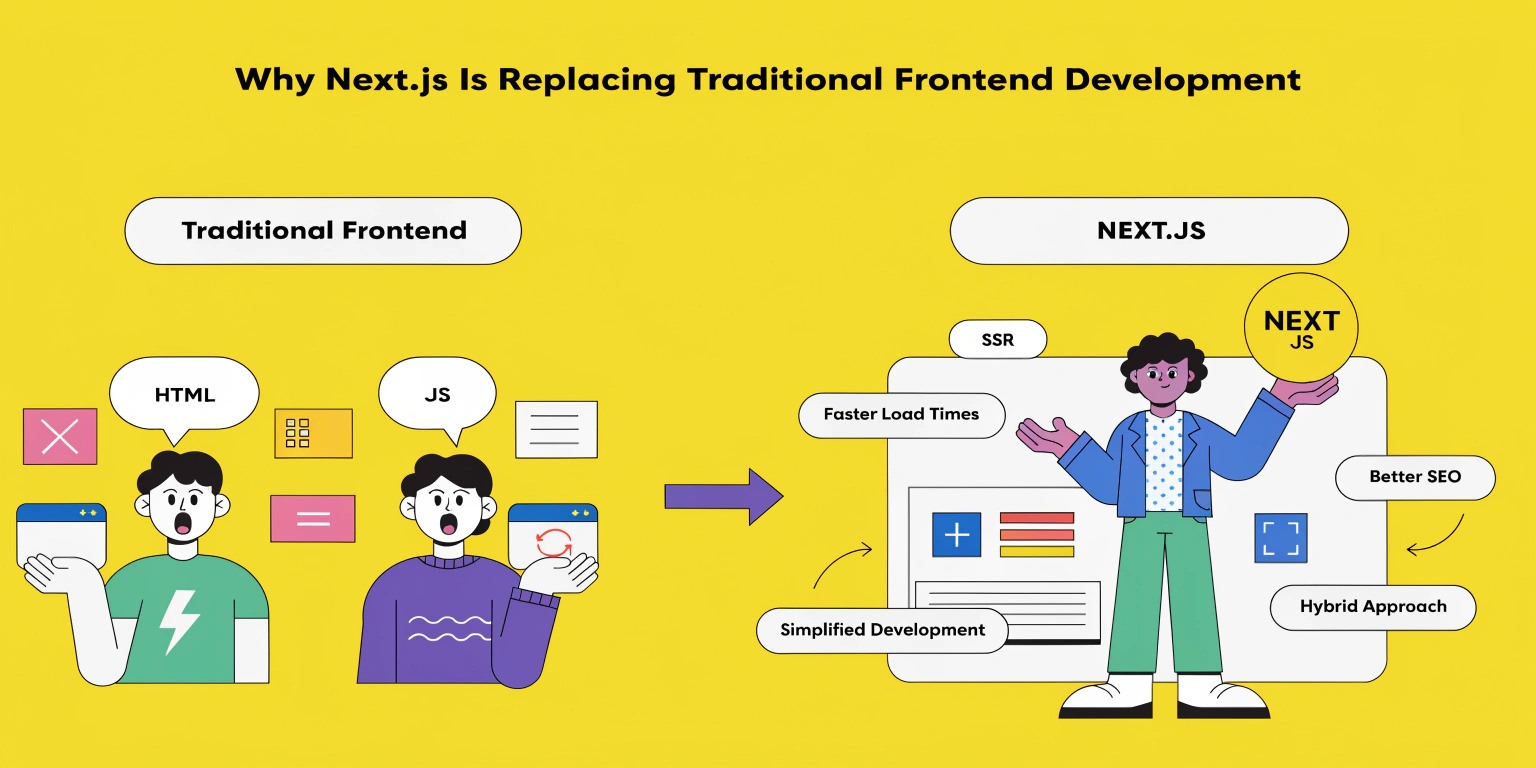
Next.js is transforming frontend development by combining React with server-side rendering, static generation, routing, caching, optimization, and full-stack capabilities. Its production-ready architecture helps developers build faster, scalable, SEO-friendly applications with less configuration than traditional frontend setups.
development has changed significantly over the last decade. Traditional approaches often required developers to combine multiple libraries, configure routing, manage rendering strategies, optimize assets, and build separate backend services.
Modern frameworks such as Next.js aim to simplify this process by providing many of these capabilities within a single application architecture.
Built on React, Next.js has become a popular choice for production web applications because it combines frontend development with server-side capabilities, performance optimization, and flexible rendering strategies.
What Is Next.js?
Next.js is a React framework designed for building modern web applications.
While React primarily provides tools for building user interfaces, Next.js adds additional capabilities required for production applications, including routing, server rendering, static generation, data fetching, caching, optimization, and backend functionality.
This means developers can build more complete applications without assembling every architectural component independently.
Traditional Frontend Development
A traditional React-based frontend project may require developers to select and configure several tools.
For example, a project might need separate solutions for:
- Client-side routing
- Server-side rendering
- API communication
- Image optimization
- Code splitting
- SEO
- Authentication
- Deployment
- Caching
This flexibility can be valuable, but it can also increase architectural complexity.
Next.js provides many of these capabilities as part of the framework, reducing the amount of initial configuration required.
Server-Side Rendering
One of Next.js's major advantages is its support for server-side rendering.
With traditional client-side rendering, the browser initially receives JavaScript and builds much of the page on the client.
With server-side rendering, appropriate content can be generated on the server and delivered to the browser.
This can improve initial page loading experiences and make important content available to search engines more effectively.
Static Generation
Next.js also supports static generation for pages that do not need to be generated dynamically for every request.
Static pages can be generated ahead of time and served efficiently through content delivery networks.
This approach is particularly useful for:
- Blogs
- Documentation
- Marketing websites
- Product pages
- Landing pages
- Corporate websites
Developers can therefore select a rendering strategy based on the requirements of each page.
React Server Components
Modern Next.js applications can use React Server Components, which allow certain components to execute on the server rather than sending all their logic to the browser.
This can reduce client-side JavaScript for appropriate components and allow developers to perform server-side operations closer to where data is accessed.
The result can be a more efficient architecture when Server Components and Client Components are used appropriately.
Built-In Routing
Traditional React projects often require an additional routing library.
Next.js provides file-system-based routing through its application architecture.
Developers can organize application routes using directories and files, making navigation structures easier to understand.
Dynamic routes can also be created for applications containing resources such as products, users, articles, or categories.
Performance Optimization
Modern websites need to deliver excellent performance across different devices and network conditions.
Next.js includes several performance-oriented capabilities, including code splitting, image optimization, caching mechanisms, and flexible rendering strategies.
Automatic code splitting allows the application to load the JavaScript required for specific pages rather than necessarily delivering the entire application bundle at once.
Next.js also provides optimized image handling that can help developers manage responsive images and loading behavior.
Better SEO Capabilities
Search engine optimization can be challenging for applications that rely heavily on client-side rendering.
Because Next.js supports server-side rendering and static generation, important page content can be generated in ways that are more accessible to search engines.
Developers can also manage page metadata using Next.js features, making it easier to create SEO-friendly applications.
This is especially valuable for businesses whose organic search traffic contributes significantly to customer acquisition.
Full-Stack Capabilities
Another major difference is that Next.js can support both frontend and backend functionality within the same project.
Developers can create server-side logic, route handlers, authentication flows, data access layers, and other backend functionality alongside the user interface.
This does not mean every application should eliminate a dedicated backend. Large systems may still benefit from separate services or specialized backend architectures.
However, for many applications, having frontend and server capabilities within one framework can simplify development.
Improved Developer Experience
Developer experience is another reason teams adopt Next.js.
The framework provides conventions for routing, project organization, rendering, data access, and deployment.
Instead of making every architectural decision from scratch, teams can start with established patterns and customize them when necessary.
This can reduce development time and make onboarding easier for new developers.
Edge and Modern Deployment
Modern web applications increasingly rely on distributed infrastructure.
Next.js applications can be deployed using platforms and architectures that support edge execution, content delivery networks, caching, and geographically distributed workloads.
This can help businesses deliver content and application functionality closer to users.
However, developers still need to understand deployment environments and choose infrastructure based on application requirements.
Next.js Is Not Always the Answer
Despite its advantages, Next.js is not automatically the best choice for every project.
A simple static website may not need the complexity of a full React framework.
Similarly, applications with specialized requirements may benefit from other technologies.
The right framework should be selected based on factors such as project complexity, team expertise, performance requirements, SEO needs, deployment architecture, and long-term maintenance.
The Future of Frontend Development
Frontend development is moving toward frameworks that combine UI development, server rendering, data access, performance optimization, and deployment capabilities.
Next.js represents this shift by providing a broader application platform rather than simply a client-side UI library.
The result is a development model where frontend and backend concerns can be coordinated more closely while still allowing teams to separate services when necessary.
Conclusion
Next.js is changing traditional frontend development by providing a complete framework around React rather than requiring developers to assemble multiple independent solutions.
Server-side rendering, static generation, React Server Components, routing, image optimization, caching, SEO capabilities, and full-stack functionality make it well suited for modern production applications.
However, the biggest advantage is not any single feature. It is the ability to choose different rendering and architectural strategies within one framework.
For businesses and development teams building scalable, high-performance, SEO-friendly web applications, Next.js offers a modern foundation that can reduce architectural complexity while improving development flexibility and user experience.
We build scalable web, mobile, and game products for clients worldwide — combining modern frameworks, cloud infrastructure, and best engineering practices.
.jpg)
.jpg)
.jpg)