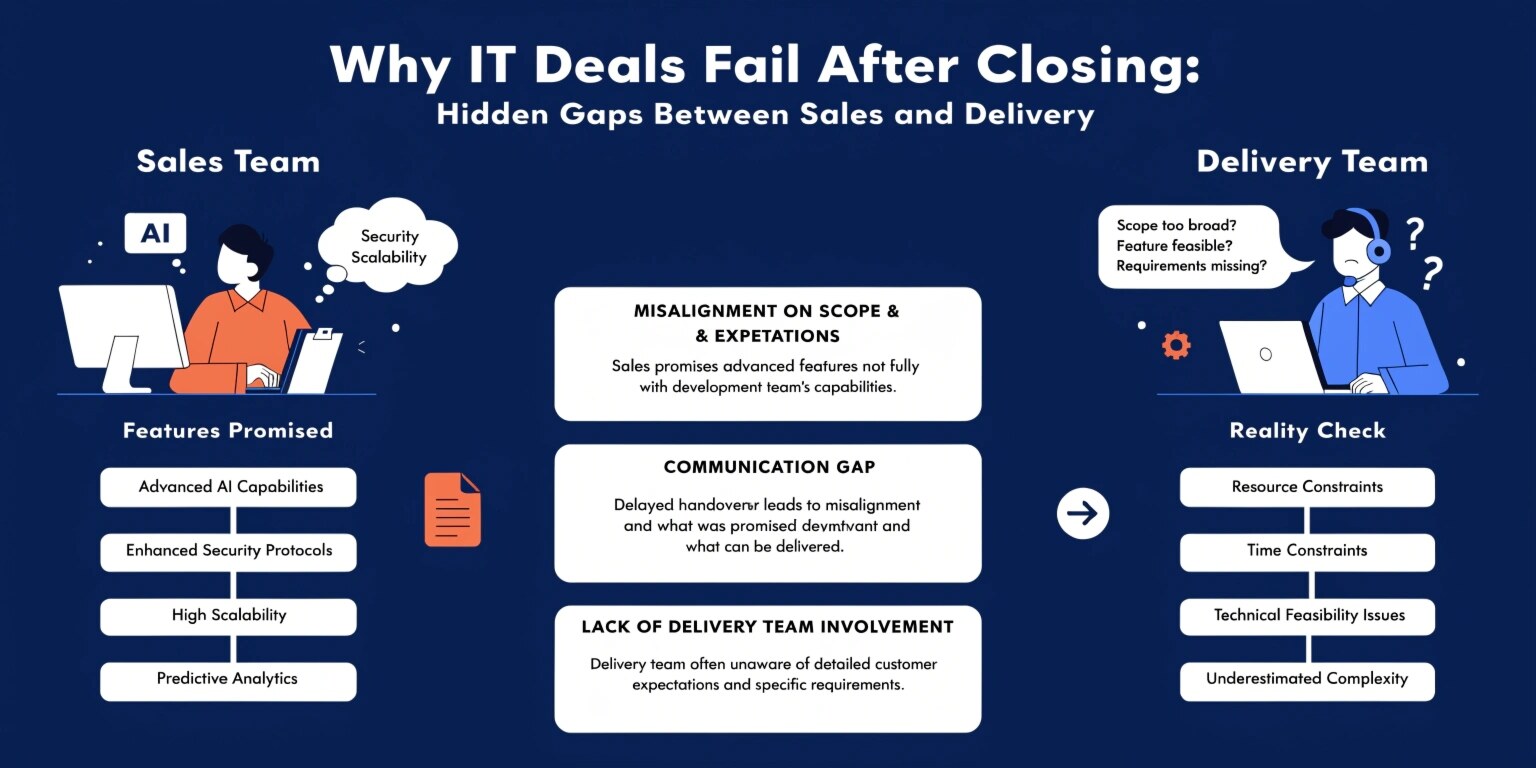
Closing an IT deal is often considered a major achievement for software companies, agencies, and business development teams. However, many companies realize that signing the contract is only the beginning of the real challenge. A large number of IT projects fail after closing because of poor communication, unrealistic expectations, weak execution strategies, and lack of coordination between sales and technical teams.
In the IT industry, losing a client after closing a deal not only affects revenue but also damages reputation, client trust, and future referrals. Understanding why deals fail after closing is essential for improving project success rates and building long-term partnerships.
1. Unclear Project Requirements
One of the biggest reasons IT deals fail is incomplete or unclear project requirements during the sales phase. In many cases, business development executives focus more on closing the deal quickly rather than deeply understanding the client’s actual needs.
When the development team starts working, they often discover missing information, unclear goals, or unrealistic expectations. This creates confusion, delays, budget issues, and dissatisfaction from the client side.
To prevent this problem:
- Conduct detailed discovery calls.
- Prepare proper documentation.
- Confirm project scope before signing agreements.
- Involve technical experts during client discussions.
Clear requirement gathering creates a strong foundation for successful project execution.
2. Overpromising During Sales
Many IT companies lose clients because sales teams promise unrealistic timelines, features, or budgets just to win the project. While this may help close deals faster, it creates serious problems later.
For example:
- Promising a complex mobile app in an unrealistic timeline.
- Offering features outside the agreed budget.
- Guaranteeing results without technical validation.
Once the delivery team begins working, they may struggle to fulfill those promises. This leads to missed deadlines, frustration, and damaged client relationships.
Successful IT companies maintain transparency from the beginning. Honest communication builds stronger trust than exaggerated promises.
3. Poor Communication Between Teams
A major gap in many software companies exists between the sales team and the delivery team. After the deal closes, project details are often transferred incompletely.
This causes issues such as:
- Developers misunderstanding client expectations.
- Missing project priorities.
- Incorrect feature implementation.
- Repeated revisions.
Internal communication is just as important as client communication. Companies should maintain:
- Proper handover meetings.
- Shared project documentation.
- Centralized communication tools.
- Regular coordination between departments.
When teams work together effectively, project success rates improve significantly.
4. Lack of Client Engagement
Some clients become less involved after signing the contract. Without regular feedback and communication, projects can move in the wrong direction.
In IT projects, continuous collaboration is essential because requirements may evolve during development. If clients do not participate actively:
- Approvals get delayed.
- Revisions increase.
- Misunderstandings grow.
- Final outputs may not meet expectations.
Companies should establish a structured communication process that includes:
- Weekly progress meetings.
- Milestone approvals.
- Demo sessions.
- Transparent reporting systems.
Engaged clients are more likely to remain satisfied throughout the project lifecycle.
5. Weak Project Management
Even with strong developers and good sales efforts, poor project management can destroy an IT deal. Weak planning, improper task allocation, and missed deadlines create operational chaos.
Common project management mistakes include:
- No clear timelines.
- Poor resource management.
- Lack of risk assessment.
- Ignoring project dependencies.
Using modern project management methodologies like Agile or Scrum helps companies maintain better workflow visibility and adaptability.
Effective project managers ensure:
- Timely communication.
- Team accountability.
- Issue resolution.
- Client satisfaction.
Strong project management acts as the bridge between planning and execution.
6. Scope Creep Problems
Scope creep occurs when clients continuously request additional features outside the original agreement without adjusting the timeline or budget.
This is extremely common in software development projects. Without proper scope management:
- Teams become overloaded.
- Deadlines shift repeatedly.
- Profit margins decrease.
- Client frustration increases.
Companies should define:
- Clear scope boundaries.
- Change request processes.
- Additional cost structures.
- Approval systems for new requirements.
Managing scope professionally protects both the company and the client relationship.
7. Lack of Post-Sales Support
Many IT companies focus heavily on acquiring new clients but neglect post-sales support. Once the project is delivered, communication decreases, and clients feel unsupported.
However, long-term success in IT depends heavily on:
- Maintenance support.
- Quick issue resolution.
- Technical assistance.
- Continuous relationship building.
Excellent post-sales service improves:
- Client retention.
- Upselling opportunities.
- Referrals.
- Brand reputation.
Clients are more likely to continue working with companies that provide reliable long-term support.
8. Misalignment of Business Goals
Sometimes clients and IT vendors have completely different expectations regarding project outcomes. While the client expects business growth and measurable ROI, the vendor may focus only on technical delivery.
Successful IT partnerships require alignment between:
- Business objectives.
- Technical execution.
- Performance expectations.
- Success metrics.
Understanding the client’s business vision helps IT companies deliver more meaningful solutions instead of just completing tasks.
Conclusion
Closing an IT deal is only the first step in building a successful client relationship. Many projects fail after closing because of unclear requirements, overpromising, communication gaps, weak project management, and poor post-sales support.
IT companies that focus on transparency, collaboration, structured execution, and long-term client success are more likely to build sustainable growth and strong market credibility.
In today’s competitive IT industry, client retention is just as important as client acquisition. The companies that master both sales and delivery processes become long-term industry leaders.