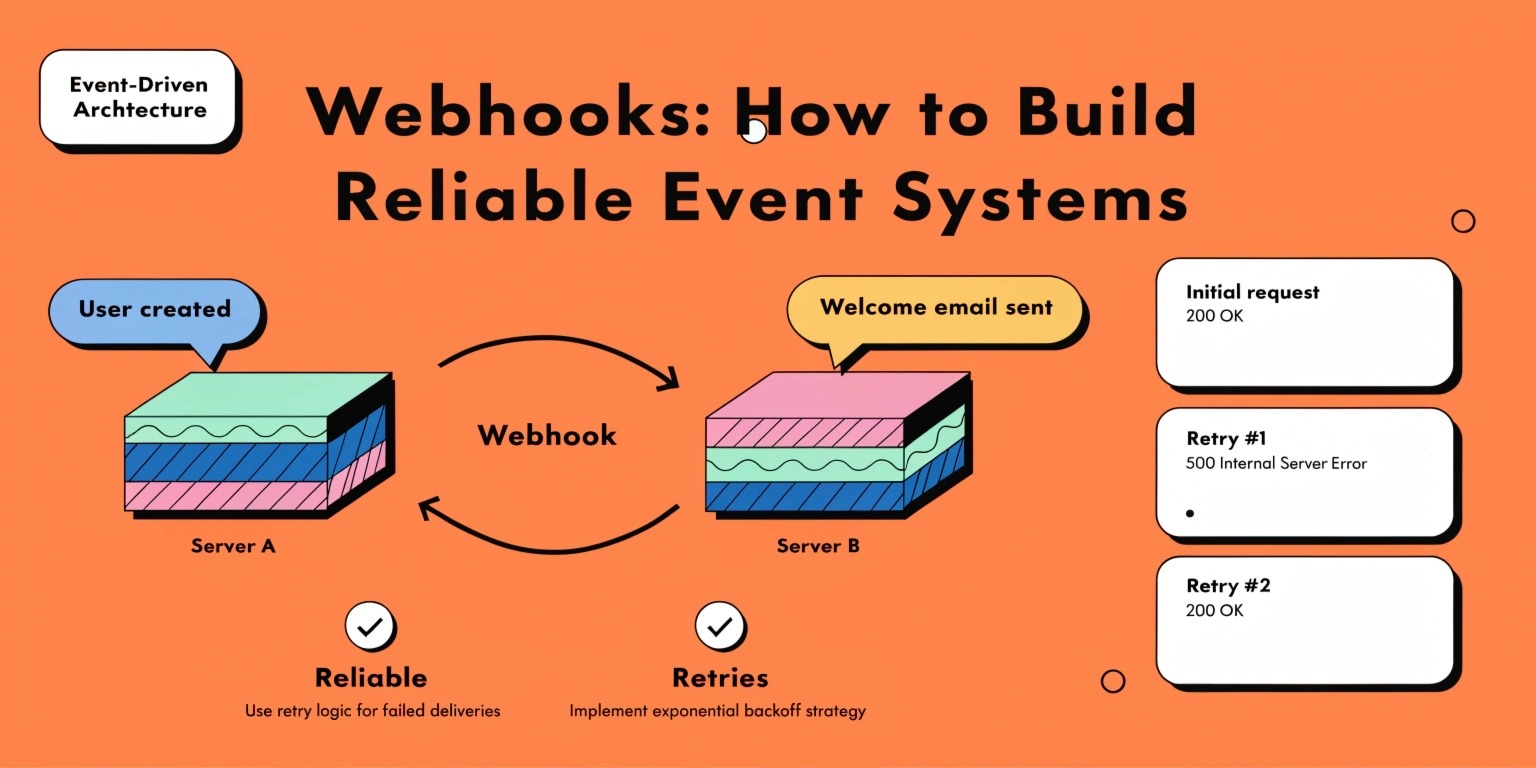
Webhooks enable applications to communicate asynchronously through event notifications. Building reliable webhook systems requires retries, idempotency, secure signatures, queues, timeouts, monitoring, and failure recovery to ensure events are delivered safely and consistently even when services experience errors or downtime.
Modern software applications rarely operate in isolation. Payment platforms communicate with eCommerce systems, SaaS applications exchange data with external services, and microservices continuously notify one another about changes.
One of the simplest ways to enable this communication is through webhooks.
A webhook allows one application to send an HTTP request to another application when a specific event occurs. Instead of repeatedly asking an API whether something has changed, the receiving system gets notified when the event happens.
However, sending an HTTP request is easy. Building a reliable webhook system is considerably more challenging.
Network failures, duplicate events, unavailable servers, timeouts, security threats, and processing errors can all affect webhook delivery. A production-ready system therefore needs mechanisms that make event delivery observable, secure, retryable, and resilient.
What Is a Webhook?
A webhook is an event-driven HTTP callback.
Suppose an online payment is completed. Instead of the merchant repeatedly checking the payment provider's API, the provider can send an event to the merchant's webhook endpoint.
The flow can look like:
Payment Completed → Payment Provider → Webhook Request → Merchant Application
The receiving application processes the event and updates its internal state.
Common webhook events include:
- Payment completed
- Payment failed
- Order created
- Order shipped
- User registered
- Subscription renewed
- File uploaded
- Deployment completed
- Repository updated
Webhooks are particularly useful when applications need near-real-time notifications.
Webhooks vs Polling
Polling requires an application to repeatedly request information.
For example:
Client → "Has the payment completed?"
The server responds:
"No."
The application asks again later.
With webhooks:
Payment Completed → Server automatically sends event → Client processes event
Webhooks can reduce unnecessary API requests and provide faster event notification.
However, webhooks introduce reliability challenges because the sender and receiver are communicating over a network that can fail.
Basic Webhook Architecture
A production webhook architecture typically includes several components:
Event Producer → Event Store/Queue → Delivery Worker → Webhook Endpoint
The producer creates an event.
The event is placed into a queue or durable event store.
A delivery worker sends the HTTP request.
The receiving application acknowledges the request.
If delivery fails, the system retries according to a defined policy.
This architecture is generally more reliable than sending webhooks directly from the main business transaction.
Why Direct Webhook Delivery Can Be Dangerous
Consider an application that processes a payment and immediately sends a webhook before completing the transaction.
If the external endpoint takes 20 seconds to respond, the payment operation may also become slow.
If the external server is unavailable, the main transaction could potentially be affected.
A better approach is to separate business processing from webhook delivery.
The application completes the core transaction and places an event into a durable queue.
A background worker handles webhook delivery independently.
This creates a more resilient architecture.
Use Asynchronous Processing
Queues are one of the most important components of reliable webhook infrastructure.
A typical flow is:
Application → Event Queue → Worker → Webhook Endpoint
The queue provides buffering when the destination is temporarily unavailable or traffic increases suddenly.
For example, if an application generates 100,000 events within a short period, workers can process them at a controlled rate rather than overwhelming receiving systems.
Queues also make retry processing easier.
Implement Retry Mechanisms
Webhook delivery can fail for temporary reasons.
Examples include:
- Network interruption
- DNS failure
- Server overload
- HTTP 500 response
- Timeout
- Temporary service outage
Instead of immediately marking the event as permanently failed, the system can retry delivery.
A common strategy is exponential backoff.
For example:
Attempt 1 → Immediately
Attempt 2 → After 1 minute
Attempt 3 → After 5 minutes
Attempt 4 → After 15 minutes
The exact schedule should depend on application requirements.
Randomized jitter can also help prevent many clients from retrying simultaneously after an outage.
Handle Duplicate Events With Idempotency
Retries create an important problem: the same event may be delivered more than once.
Suppose the receiver successfully processes an event but its response is lost because of a network failure.
The sender assumes delivery failed and retries.
The receiver may therefore process the same event twice.
Webhook consumers should be designed to be idempotent.
Each event should have a unique identifier.
The receiver can store processed event IDs and ignore duplicate deliveries.
For example:
Event ID: evt_82931
If event ID already processed:
Ignore duplicate
Else:
Process event
Record event ID
Idempotency is one of the most important principles in reliable event processing.
Use Event IDs
Every webhook event should contain a unique identifier.
A useful payload may include:
{
"id": "evt_82931",
"type": "payment.completed",
"timestamp": "2026-08-29T10:30:00Z",
"data": {
"payment_id": "pay_12345"
}
}
The event ID allows consumers to identify duplicates and provides a useful reference for troubleshooting.
Secure Webhooks With Signatures
Webhook endpoints are public HTTP endpoints, so security is essential.
One common approach is to sign webhook payloads using a shared secret.
The sender calculates a cryptographic signature from the request body and secret.
The receiver independently calculates the expected signature and compares the values.
Conceptually:
Payload + Secret → Signature
The receiver verifies:
Received Signature = Expected Signature
This helps prevent unauthorized systems from successfully impersonating the webhook provider.
Protect Against Replay Attacks
Even a valid signed webhook could potentially be captured and resent.
To reduce replay risks, webhook systems can include timestamps or unique event identifiers in their verification process.
The receiving application can reject requests that:
- Have an expired timestamp
- Use an already processed event ID
- Fall outside an acceptable time window
This adds another layer of protection.
Set Appropriate Timeouts
Webhook requests should not remain open indefinitely.
The sender should establish a reasonable timeout.
Similarly, the receiver should process webhook requests efficiently.
A webhook endpoint should ideally:
- Authenticate the request.
- Validate the event.
- Store or enqueue it.
- Return a success response.
- Perform heavy processing asynchronously.
This prevents external systems from waiting while complex business logic executes.
Separate Acknowledgment From Processing
One of the most useful webhook patterns is to acknowledge receipt quickly.
For example:
Webhook Request → Validate → Queue Event → HTTP 200
The actual processing happens afterward.
This approach reduces timeout-related failures and allows the application to scale event processing independently.
However, the application should only acknowledge an event once it has safely accepted it for processing, such as by persisting it or placing it into a durable queue.
Validate Payloads
Webhook consumers should never blindly trust incoming data.
Validate:
- Event type
- Required fields
- Data formats
- Event ID
- Timestamp
- Signature
- Content type
Schema validation can prevent malformed events from entering internal systems.
It also helps protect against unexpected changes in third-party integrations.
Dead-Letter Queues
Some events may continue failing even after multiple retries.
A dead-letter queue, or DLQ, provides a place to store these permanently failed events.
A typical workflow is:
Event → Retry → Retry → Retry → DLQ
Operations teams can then investigate the failure and potentially replay the event after resolving the underlying issue.
DLQs are particularly useful for large-scale event systems where silently dropping failed events would be unacceptable.
Ordering Challenges
Webhook systems do not always guarantee event ordering.
For example:
Order Updated
could arrive before:
Order Created
if events travel through different network paths or are processed asynchronously.
Applications that require ordering should design explicitly for it.
Possible strategies include:
- Sequence numbers
- Event versions
- Per-resource queues
- Ordered partitions
- Version checks
Consumers should avoid assuming that network delivery automatically guarantees business-event ordering.
Handling Eventual Consistency
Webhook-based architectures commonly operate with eventual consistency.
The receiving application may process an event shortly after the source system changes.
This means different systems can temporarily contain different states.
Applications should therefore be designed to tolerate short periods of inconsistency where appropriate.
Webhook Observability
Reliable systems need strong monitoring.
Important metrics include:
- Successful deliveries
- Failed deliveries
- Retry counts
- Delivery latency
- Response status codes
- Processing time
- Queue depth
- DLQ size
Logs should contain useful identifiers such as:
- Event ID
- Delivery ID
- Destination
- Attempt number
- Timestamp
- Response code
This makes debugging significantly easier.
Version Your Webhook Events
Webhook payloads may evolve over time.
A provider might add new fields or change event structures.
Versioning helps prevent unexpected compatibility problems.
For example:
payment.completed.v1
payment.completed.v2
Consumers can migrate gradually instead of being forced to upgrade immediately.
Backward compatibility should be considered when changing event schemas.
Rate Limiting and Backpressure
A receiving service may become overloaded if it receives too many webhook requests simultaneously.
Webhook infrastructure should therefore support rate limiting and backpressure.
The sender can control delivery concurrency, while the receiver can communicate temporary overload through appropriate HTTP responses.
Queues help absorb traffic spikes without immediately overwhelming downstream services.
Common Webhook Mistakes
Several mistakes frequently reduce webhook reliability:
- Sending events synchronously inside critical transactions
- Not implementing retries
- Assuming every event is delivered exactly once
- Ignoring duplicate events
- Skipping signature verification
- Performing heavy processing before acknowledging requests
- Not storing failed events
- Having no monitoring
- Assuming event ordering
- Using undocumented payload structures
Avoiding these mistakes can significantly improve system resilience.
Building a Reliable Webhook Strategy
A production-ready webhook system should generally include:
1. Unique Event IDs
Every event should be uniquely identifiable.
2. Durable Queues
Events should not disappear because a destination is temporarily unavailable.
3. Retries
Temporary failures should trigger controlled retries.
4. Idempotency
Consumers should safely handle duplicate deliveries.
5. Authentication
Requests should be verified before processing.
6. Timeouts
Systems should avoid indefinite connections.
7. Dead-Letter Handling
Repeatedly failed events should be preserved for investigation.
8. Monitoring
Delivery failures and latency should be visible to operators.
Conclusion
Webhooks provide a simple and powerful mechanism for connecting modern applications through event-driven communication. However, reliable webhook infrastructure requires considerably more than sending an HTTP POST request.
Production systems should account for network failures, duplicate deliveries, temporary outages, traffic spikes, security threats, ordering issues, and processing failures.
Queues, retries, exponential backoff, idempotency, event IDs, cryptographic signatures, timeouts, dead-letter queues, schema validation, and comprehensive observability form the foundation of a resilient webhook architecture.
The key principle is to design for failure rather than assuming successful delivery. Once applications treat webhook delivery as an asynchronous, distributed event-processing problem, they can build integrations that remain dependable even when individual services, networks, or external dependencies fail.
We build scalable web, mobile, and game products for clients worldwide — combining modern frameworks, cloud infrastructure, and best engineering practices.
.jpg)
.jpg)
.jpg)