Main Content
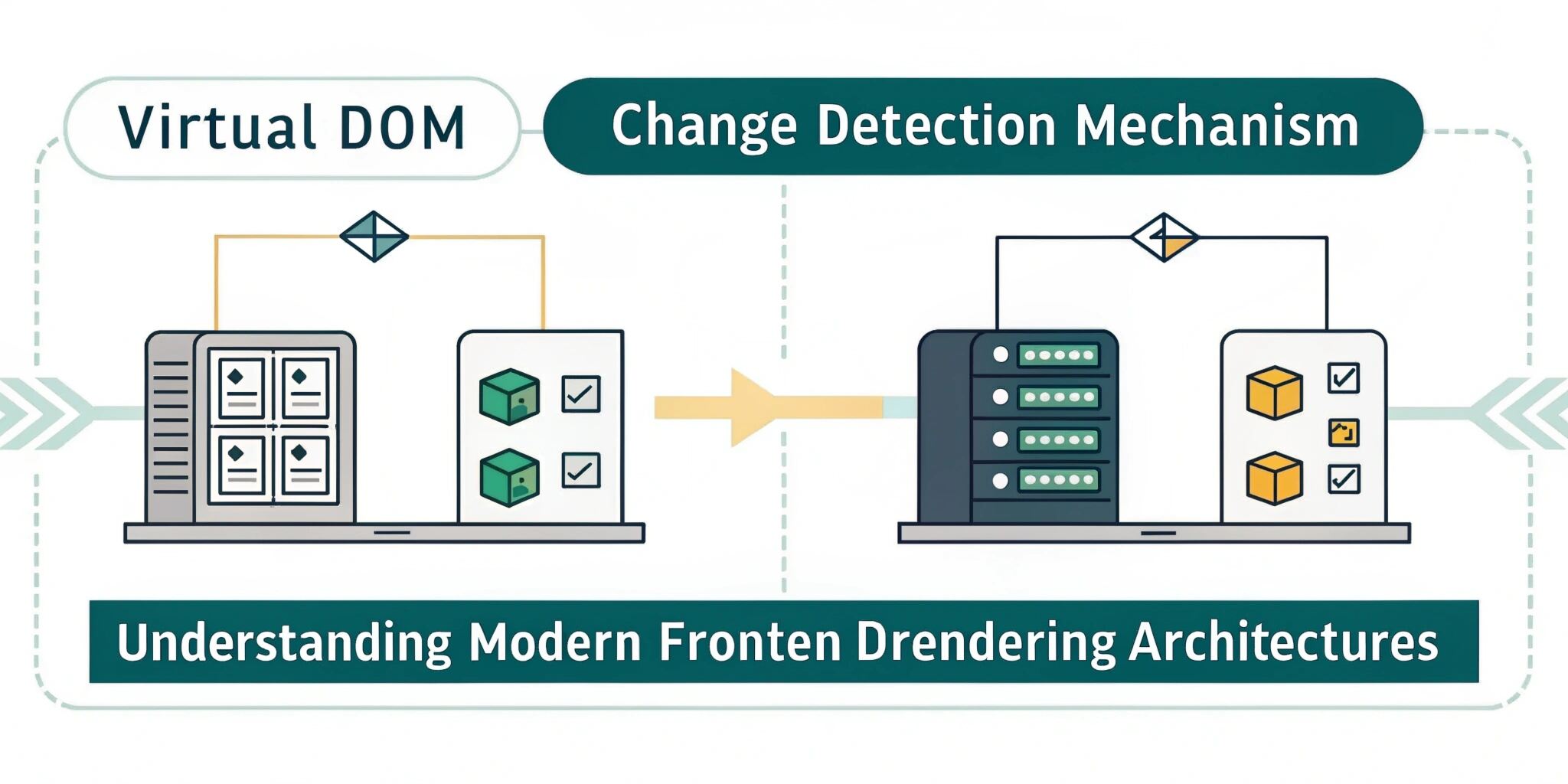
Frontend development has evolved significantly over the last decade. Modern JavaScript frameworks focus heavily on rendering performance, scalability, and user experience. Two major concepts that dominate frontend architecture today are the Virtual DOM and the Change Detection Mechanism. These approaches are widely used by frameworks like React and Angular to efficiently update user interfaces without unnecessarily manipulating the browser’s Real DOM.
Understanding these concepts is essential for frontend developers building scalable and high-performance web applications.
What is the DOM?
The Document Object Model (DOM) represents the structure of an HTML document as a tree of objects. Whenever a webpage changes dynamically, the browser updates the DOM.
However, direct DOM manipulation is expensive because browsers need to:
- Recalculate layouts
- Repaint UI elements
- Re-render visual components
- Handle memory allocation
As applications become larger and more interactive, constantly updating the Real DOM reduces performance significantly.
To solve this issue, modern frameworks introduced optimized rendering techniques.
Understanding the Virtual DOM
The Virtual DOM is a lightweight JavaScript representation of the Real DOM. Instead of updating the browser DOM directly, frameworks like React first create a virtual copy of the UI.
When application state changes:
- A new Virtual DOM tree is created.
- The framework compares it with the previous Virtual DOM tree.
- Differences are identified using a diffing algorithm.
- Only the changed elements are updated in the Real DOM.
This process is called reconciliation.
Advantages of Virtual DOM
1. Faster UI Updates
Only modified elements are updated instead of re-rendering the entire page.
2. Better Performance
Minimizes costly Real DOM operations.
3. Efficient State Management
Works effectively with component-based architectures.
4. Improved Developer Experience
Declarative programming makes UI logic easier to maintain.
React and Virtual DOM
React popularized the Virtual DOM concept. It uses:
- Component-based rendering
- Efficient reconciliation algorithms
- React Fiber architecture
- State-driven UI updates
React applications are highly responsive because unnecessary DOM manipulations are minimized.
Limitations of Virtual DOM
Despite its advantages, the Virtual DOM is not perfect.
- Memory usage increases because an additional virtual tree is maintained.
- Diffing large component trees can become computationally expensive.
- Performance may degrade in extremely complex applications without optimization.
Understanding Change Detection Mechanism
Angular uses a different strategy known as the Change Detection Mechanism.
Instead of comparing virtual trees, Angular tracks application data changes and synchronizes them with the UI automatically.
Whenever an event occurs, Angular checks components to determine whether data has changed.
Common triggers include:
- User interactions
- HTTP responses
- Timers
- Async operations
Angular uses Zone.js to monitor asynchronous events and initiate change detection cycles.
How Angular Change Detection Works
Angular creates a hierarchy of components. During each cycle:
- Angular checks component bindings.
- It compares previous and current values.
- If changes are detected, the UI updates automatically.
This process keeps the application synchronized with the underlying data model.
Advantages of Change Detection
1. Automatic Synchronization
Developers do not need to manually update the UI.
2. Structured Architecture
Works well for enterprise-scale applications.
3. Predictable Data Flow
Angular applications follow organized component communication patterns.
4. TypeScript Integration
Angular’s ecosystem supports strong typing and scalable development.
Limitations of Change Detection
1. Performance Overhead
Large component trees may trigger unnecessary checks.
2. Complex Optimization
Developers may need advanced techniques like:
- OnPush strategy
- Immutable data structures
- RxJS optimization
3. Higher Learning Curve
Angular’s architecture is more complex compared to lightweight frameworks.
Virtual DOM vs Change Detection Mechanism
FeatureVirtual DOMChange DetectionUsed ByReactAngularCore IdeaCompare virtual treesTrack data changesPerformanceEfficient selective updatesEfficient structured checkingComplexitySimpler rendering logicMore architectural complexityMemory UsageHigher due to virtual copiesLower virtual overheadBest ForDynamic UI applicationsEnterprise applicationsLearning CurveModerateHigherOptimizationMemoization, hooksOnPush, RxJS
Which Approach is Better?
There is no universal winner. The choice depends on project requirements.
Choose Virtual DOM If:
- You need highly interactive UI
- Performance optimization is critical
- You prefer flexibility
- You are building SPAs with React
Choose Change Detection If:
- You are building enterprise-level systems
- You need structured architecture
- You prefer TypeScript-heavy development
- You require built-in tooling and scalability
Future of Frontend Rendering
Modern frameworks are continuously evolving beyond traditional rendering methods.
Emerging trends include:
- Fine-grained reactivity
- Signals-based rendering
- Incremental DOM
- Server Components
- Partial Hydration
Frameworks like SolidJS, Svelte, and Vue are introducing new rendering models that reduce overhead even further.
This shows that frontend rendering optimization remains one of the most important areas in modern web engineering.
Conclusion
Virtual DOM and Change Detection Mechanisms represent two powerful approaches to solving frontend rendering challenges. React’s Virtual DOM focuses on efficient UI diffing and rendering flexibility, while Angular’s Change Detection emphasizes structured synchronization and enterprise scalability.
Both architectures have transformed modern frontend development and continue to influence how developers build scalable, responsive, and high-performance applications.
Choosing the right rendering strategy ultimately depends on project complexity, performance requirements, development team expertise, and long-term scalability goals.