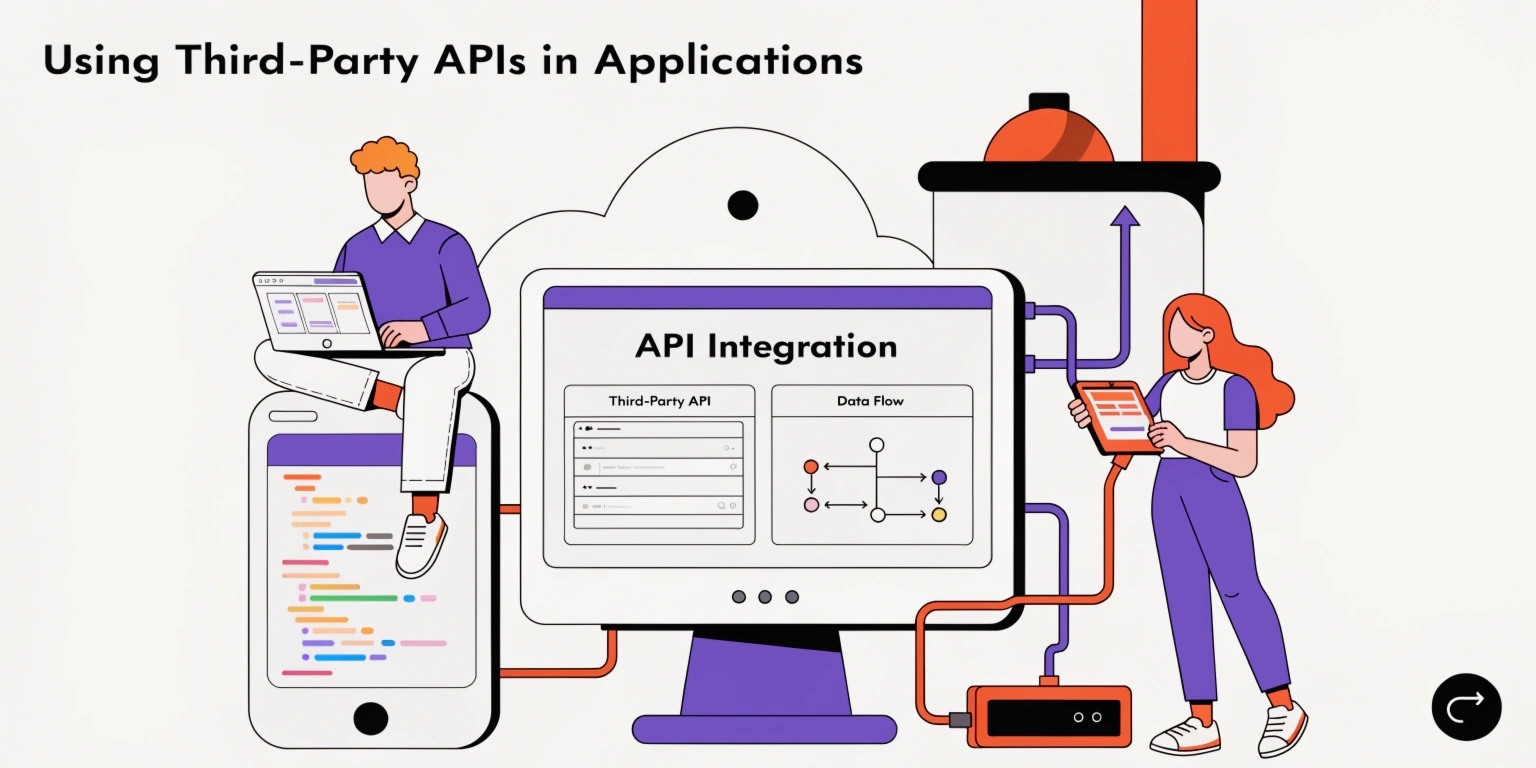
Modern applications are no longer built entirely from scratch. Today’s web, mobile, and cloud-based applications rely heavily on third-party APIs to add advanced functionality quickly and efficiently. APIs, or Application Programming Interfaces, allow different software systems to communicate and exchange data seamlessly.
From payment gateways and authentication systems to AI-powered tools and cloud services, third-party APIs have become essential for modern software development. Instead of building every feature internally, developers can integrate external services to reduce development time, lower costs, and improve application capabilities.
Whether you are developing an eCommerce platform, SaaS product, mobile app, or enterprise software solution, understanding how to use third-party APIs effectively is critical for scalable and secure application development.
What are Third-Party APIs?
A third-party API is an external service provided by another company or platform that developers can integrate into their applications.
These APIs expose predefined endpoints that allow applications to send requests and receive responses.
Basic API Communication Flow
Client Application→API Request→Third-Party Service→API ResponseClient\ Application \rightarrow API\ Request \rightarrow Third\text{-}Party\ Service \rightarrow API\ ResponseClient Application→API Request→Third-Party Service→API Response
For example:
- Payment processing through Stripe
- Authentication using Google Login
- Maps using Google Maps API
- AI features using OpenAI APIs
Third-party APIs simplify development by providing ready-made services.
Why Businesses Use Third-Party APIs
Faster Development
Building features internally requires significant time and resources. APIs allow developers to integrate advanced functionality within hours instead of months.
Cost Efficiency
Using APIs eliminates the need for developing complex infrastructure from scratch.
Scalability
Most API providers offer scalable cloud-based infrastructure capable of handling large traffic volumes.
Improved User Experience
APIs enable advanced features like:
- Real-time notifications
- Social logins
- Chat systems
- AI recommendations
- Payment processing
This enhances application usability and engagement.
Common Types of Third-Party APIs
Payment APIs
Used for online transactions and billing.
Examples:
Authentication APIs
Enable secure user login systems.
Examples:
AI & Machine Learning APIs
Provide AI-powered features without building models internally.
Examples:
Mapping & Location APIs
Used for navigation, tracking, and geolocation services.
Examples:
Communication APIs
Enable messaging, calls, and notifications.
Examples:
How Third-Party APIs Work
Applications communicate with APIs through HTTP requests.
Common request methods include:
- GET → Retrieve data
- POST → Send data
- PUT → Update data
- DELETE → Remove data
Most modern APIs use REST architecture and exchange data in JSON format.
Example API Request Structure
GET /users/id→JSON ResponseGET\ /users/{id} \rightarrow JSON\ ResponseGET /users/id→JSON Response
The server processes the request and returns structured data to the application.
Benefits of Using Third-Party APIs
Reduced Time-to-Market
Businesses can launch products faster using existing services.
Access to Advanced Technologies
Companies can integrate AI, analytics, or cloud infrastructure without deep expertise.
Better Reliability
Established API providers maintain robust infrastructure and uptime.
Continuous Feature Updates
Third-party providers regularly improve services and security.
Easier Cross-Platform Integration
APIs allow communication between:
- Web applications
- Mobile apps
- Cloud systems
- IoT devices
Challenges of Third-Party API Integration
Dependency Risks
Applications become dependent on external providers.
If an API service fails, application functionality may break.
Rate Limits
Many APIs restrict the number of requests allowed within a timeframe.
Security Concerns
Improper API handling can expose:
- User data
- Authentication tokens
- Sensitive business information
Versioning Issues
API providers may release updates that affect compatibility.
Performance Delays
External API response times may impact application speed.
API Security Best Practices
Use Secure Authentication
Implement:
- OAuth 2.0
- API keys
- JWT tokens
Protect API Keys
Never expose sensitive API credentials publicly.
Enable HTTPS
Encrypt all API communication channels.
Implement Rate Limiting
Prevent abuse and excessive requests.
Validate API Responses
Always sanitize and verify incoming data.
Security is essential when integrating external services into business applications.
Best Practices for API Integration
Read Documentation Carefully
Good API documentation reduces implementation errors.
Use Error Handling
Applications should gracefully handle API failures.
Cache Frequently Used Data
Caching reduces unnecessary API requests and improves performance.
Monitor API Usage
Track:
- Response times
- Downtime
- Request failures
- Cost usage
Plan for Scalability
Choose APIs capable of supporting future business growth.
Role of APIs in Modern Technologies
Third-party APIs power many emerging technologies, including:
- AI applications
- Cloud computing
- FinTech platforms
- IoT ecosystems
- SaaS products
- Real-time collaboration tools
APIs are now the foundation of digital transformation and interconnected software systems.
Future of Third-Party APIs
The API ecosystem continues evolving with:
- AI-powered APIs
- GraphQL adoption
- Serverless integrations
- Low-code API platforms
- Real-time event-driven APIs
Businesses increasingly depend on APIs to accelerate innovation and remain competitive.
As software ecosystems become more connected, APIs will continue playing a central role in digital product development.
Conclusion
Third-party APIs have transformed modern application development by enabling businesses to integrate advanced functionality quickly and efficiently. From payment systems and AI services to authentication and communication platforms, APIs reduce development complexity while improving scalability and user experience.
However, successful API integration requires careful planning, proper security implementation, and reliable performance management. Businesses must evaluate API providers based on reliability, scalability, documentation quality, and long-term support.
In today’s technology-driven world, mastering API integration is essential for developers, startups, and enterprises building modern digital applications.