Main Content
Asynchronous programming has always been a challenging area in C++. Traditional approaches like callbacks, threads, futures, and promises often lead to complex control flow, poor composability, and difficult error handling. To address these challenges, modern C++ is moving toward a new asynchronous programming model based on Senders and Receivers, introduced through the C++ standardization efforts such as std::execution.
What Is the Sender/Receiver Model?
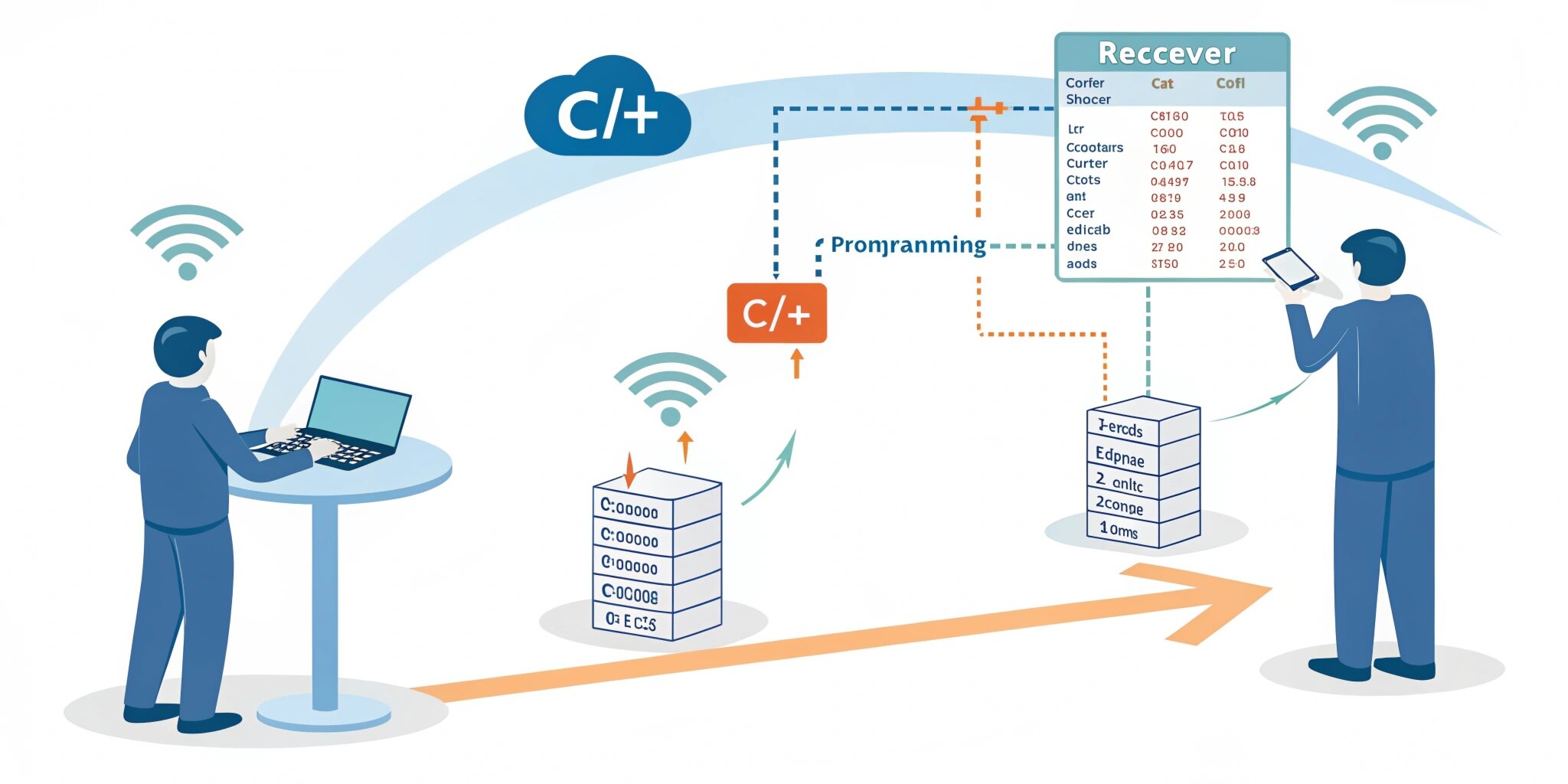
The sender/receiver model defines a clear contract between asynchronous operations and their consumers.
- A Sender represents an asynchronous operation that can produce a value, an error, or a completion signal.
- A Receiver consumes the result of that operation by handling one of three outcomes:
- set_value, set_error, or set_done.
This separation makes asynchronous code more declarative and composable, allowing developers to build complex workflows without deeply nested callbacks or blocking calls.
Why Traditional Async Models Fall Short
Older asynchronous techniques in C++ often come with trade-offs:
- Callbacks lead to “callback hell” and tangled control flow.
- Futures and promises limit composability and flexibility.
- Threads are powerful but expensive and error-prone when mismanaged.
These approaches make it difficult to chain asynchronous tasks, propagate errors cleanly, or switch execution contexts efficiently.
The sender/receiver model solves these problems by treating asynchronous operations as first-class values that can be composed, transformed, and executed predictably.
Core Concepts of Senders and Receivers
At the heart of this model are a few key ideas:
Lazy Execution
Senders do not start work immediately. They describe what should happen, not when. Execution begins only when a sender is connected to a receiver and started.
Composability
Senders can be combined using algorithms like then, let_value, or when_all, allowing developers to build pipelines of asynchronous operations.
Explicit Error Handling
Errors are handled through set_error, making failure paths explicit and consistent across the system.
Execution Contexts
Senders can specify where work runs, such as a thread pool or event loop, without hard-coding execution details.
How Senders Improve Code Readability
One of the biggest benefits of the sender/receiver model is readability. Instead of scattering logic across callbacks or blocking calls, developers describe a flow of operations in a linear, expressive way.
Asynchronous code becomes easier to reason about because:
- Control flow is explicit
- Data dependencies are clear
- Error handling is centralized
This leads to code that is not only more maintainable but also easier to test and extend.
Performance and Scalability Benefits
Senders and receivers are designed with performance in mind. Since they avoid unnecessary thread creation and blocking, applications can scale more efficiently under heavy workloads.
Key performance advantages include:
- Reduced context switching
- Better cache locality
- Fine-grained control over execution
This makes the model especially useful for high-performance systems, networking libraries, game engines, and real-time applications.
Real-World Use Cases
The sender/receiver model is well-suited for:
- Network servers handling thousands of concurrent connections
- Game engines managing parallel tasks
- Data processing pipelines
- AI and simulation workloads requiring structured concurrency
As the C++ ecosystem evolves, more libraries are adopting this model to provide safer and more expressive asynchronous APIs.
The Future of Asynchronous C++
With ongoing standardization efforts, the sender/receiver model is shaping the future of concurrency in C++. It offers a unified approach that combines clarity, performance, and flexibility—something traditional async patterns struggle to deliver.
For developers working with modern C++, learning senders and receivers is becoming increasingly important as the language moves toward more declarative and composable concurrency models.